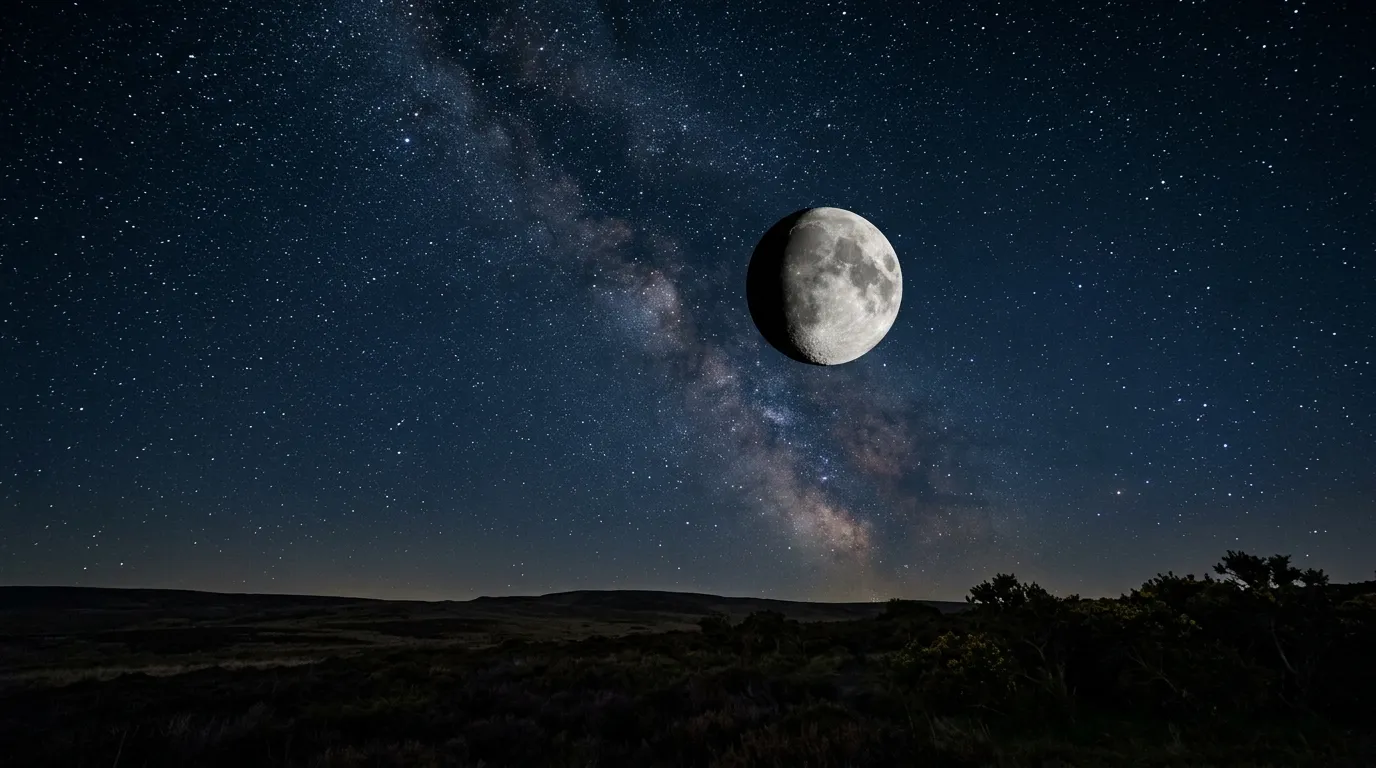
Most people arrive here holding a question, not a shopping list: what phase is that, or is that photograph real. These pages answer those one at a time, in plain English, with the sources named. It's free to read. Some guides also link to relevant prints or tools for readers who want to keep exploring a subject or mark a particular night.

Find your question
| Page | What it answers |
|---|---|
| The eight phases of the Moon | All eight phases in sequence over roughly 29.5 days |
| Every full moon name and date | Each full moon of 2026 and 2027 with its name and London time |
| Meteor showers and the Moon | Eight main showers, their peaks, and how near each falls to a full moon |
| The next solar eclipse in the UK | The partial eclipse of 2 August 2027, and every UK eclipse to 2030 |
| The planets in order | Mercury to Neptune, with NASA sizes and distances |
| Star names and constellations | Who approves a star name, and the bright named stars from the UK |
| What a constellation is | The 88 official constellations and their boundaries |
| Zodiac signs and constellations | Why the Sun crosses thirteen zodiac constellations, and how the dates drifted |
| What a nebula is | Emission, reflection, dark and planetary nebulae |
| The life cycle of a star | How the mass a star starts with shapes its ending |
| What causes the aurora | How the solar wind and the magnetic field light the polar sky |
| Are photos of nebulae real? | Where the colours in telescope pictures come from |
The finder guides move from one shape to the next. Orion's Belt, three bright stars in a short row, leads to the rest of Orion in winter. The Plough, seven stars inside Ursa Major, is above Britain every night of the year, and the Polaris and Summer Triangle guides take it from there.
Below the general reading sit two sets of shorter pages: thirteen full-moon pages, one for each named moon, and twelve month pages giving that month's star sign dates and the constellation the Sun is really in.
More looking up guides, in reading order
- Finding the Summer Triangle
- The Pale Blue Dot
- How to find the North Star
- What a planetary alignment is
- Halley's Comet, and when it returns
- Jupiter's four big moons
- Orion's Belt, and finding Orion
- Ursa Major and the Plough
- How long it takes to reach the Moon
- Why planets have rings
- Ophiuchus, the thirteenth
- How pictures of galaxies are taken
- When galaxy prints were popular
- February: the snow moon
- January: the wolf moon
- December: the cold moon
- August: the sturgeon moon
- November: the beaver moon
- March: the worm moon
- October: the hunter's moon
- July: the buck moon
- April: the pink moon
- June: the strawberry moon
- September: the harvest moon
- May: the flower moon
- May: the blue moon
- What shape stars are
- Zodiac elements
- January star signs
- February star signs
- March star signs
- April star signs
- May star signs
- June star signs
- July star signs
- August star signs
- September star signs
- October star signs
- November star signs
- December star signs
Next: your own sky
The stage that follows this one is your own sky: One particular night, or one particular photograph. What a star map shows, and what happens to a photo you upload.

Written by Craig Fearn, Aphelion Prints. Last updated .