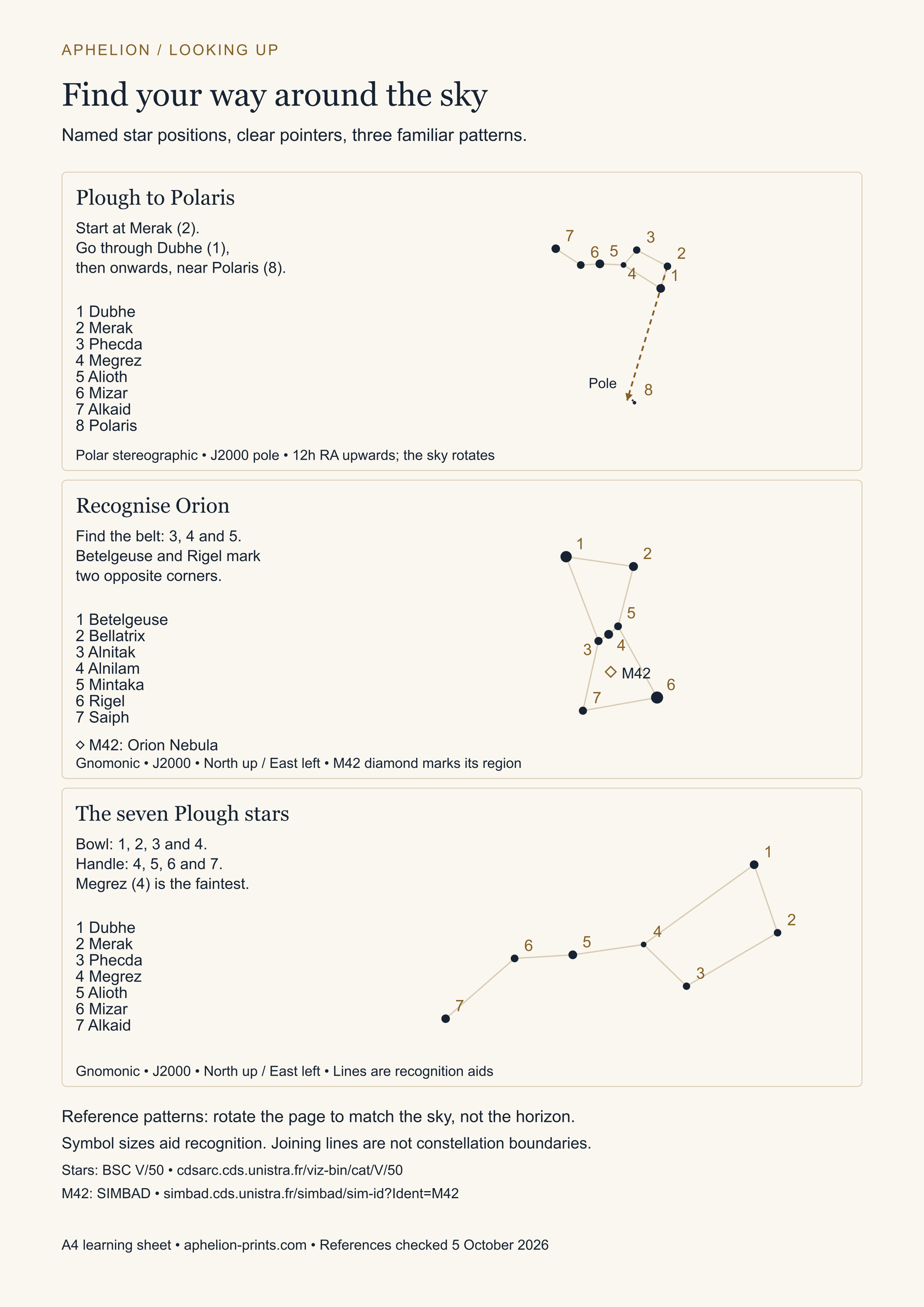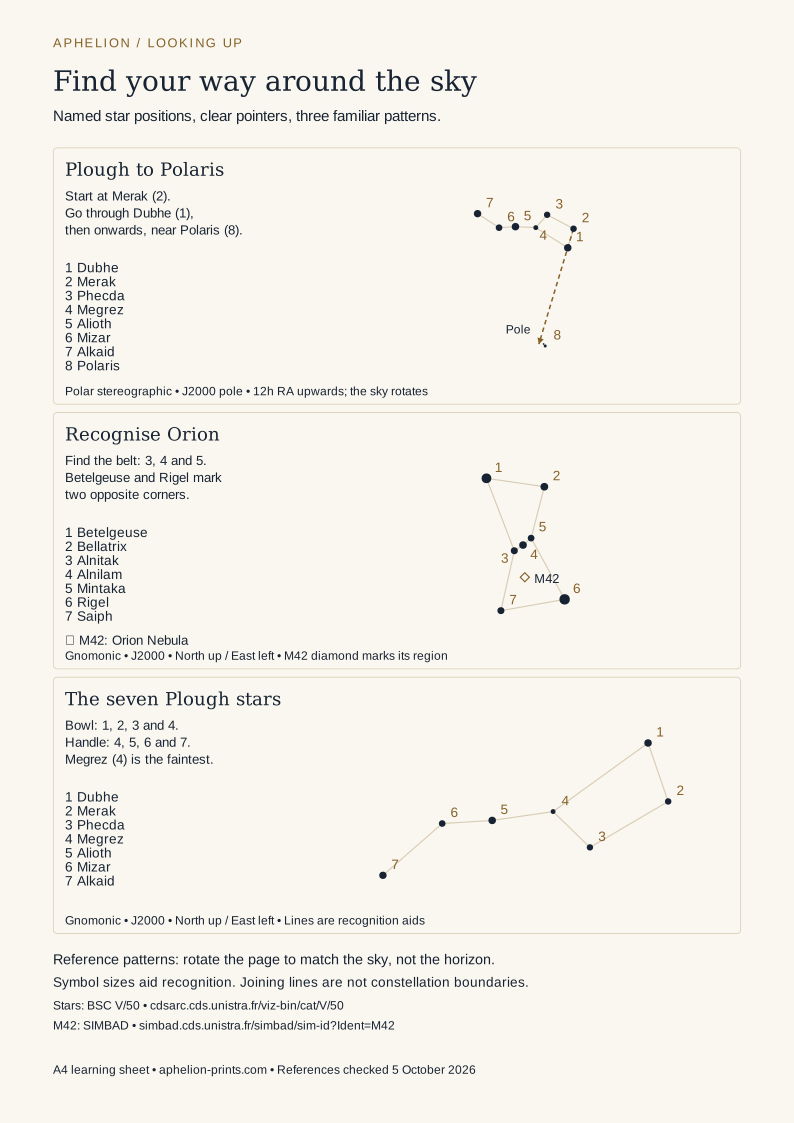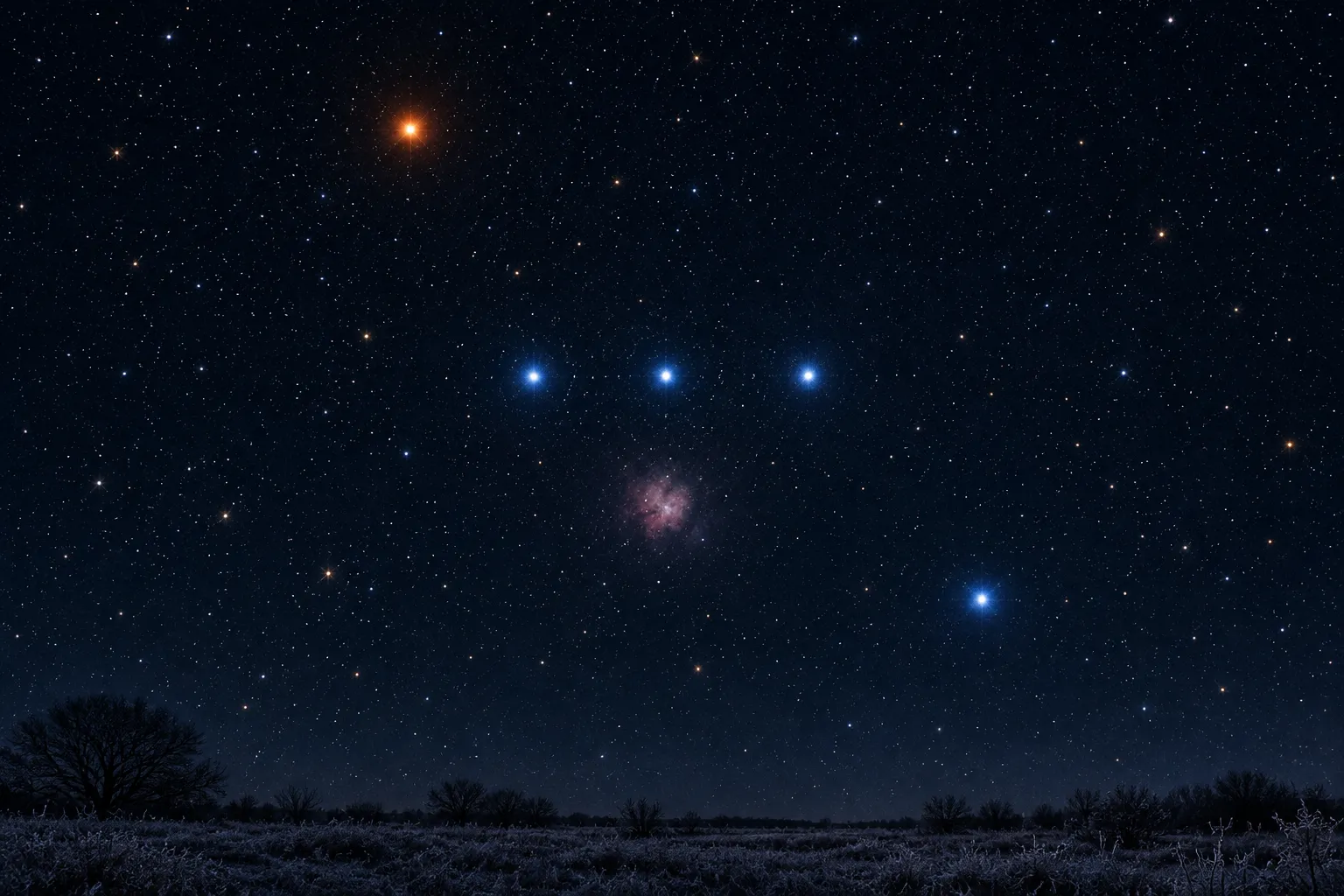
Illustration: the landscape above is decorative. The labelled chart below uses verified catalogue positions.
Orions belt is where almost everyone starts. Three bright stars with approximately even spacing, in a nearly straight line. Little else in the sky looks like it, which is why it has been the beginner’s anchor for as long as people have been pointing at things.
NASA names them in order: Alnitak, Alnilam, and Mintaka are the bright bluish stars from east to west along the diagonal in this cosmic vista.
Three blue stars, not three white ones — worth looking for once you know.
When to see Orion from the UK
Orion is a winter object here. The Royal Observatory Greenwich calls it a famous winter constellation for the Northern Hemisphere
, and from Britain that means the winter months, in the south, highest around the middle of the night in midwinter.
Unlike the Plough, which is circumpolar from Britain and so never sets, Orion is a seasonal sight here: a winter constellation, not a year-round one.
Above and below orions belt: the two supergiants
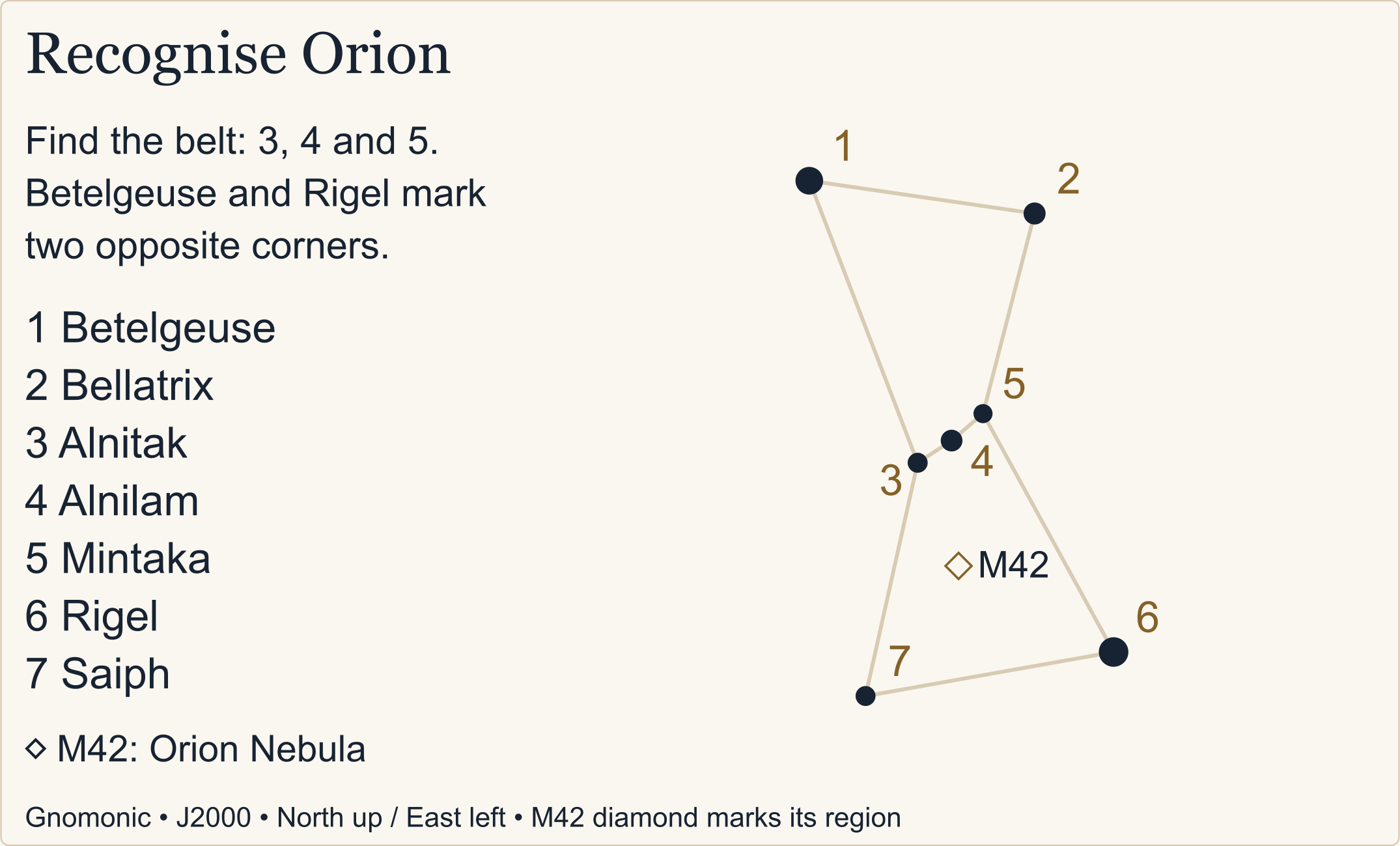
The numbered stars use named records from the Bright Star Catalogue, with fixed J2000 reference positions. Rotate the pattern to match the sky; it is a recognition chart rather than a prediction of tonight's horizon. Joining lines help you see the pattern and do not mark constellation boundaries.
The M42 location is checked separately against SIMBAD. Its diamond is a location marker; the nebula spreads over a region of sky.
Download the free A4 northern-sky finder sheet: print PDF, 300dpi PNG or scalable SVG. Print the PDF at actual size on A4 paper.
Once you have the belt, look for the two brightest stars either side of it. They are the reason Orion is worth more than a glance, because they are visibly different colours and they are different in kind.
Royal Museums Greenwich on the first: Betelgeuse, a red supergiant star which is deep orange-red in colour.
On a clear night you can see that colour with the naked eye, and it is startling the first time — an orange star among white ones.
And the second, from the same page: Rigel, a blue supergiant and the seventh brightest star in the sky.
Seventh brightest in the whole sky, which is a reminder of how much of the good stuff is packed into this one figure.
Two supergiants, one red and one blue, on opposite corners of the same constellation. Nowhere else offers that comparison so plainly.
What hangs below the belt
Drop your eye south of the three belt stars and there is a fainter vertical line of stars — Orion’s sword. The middle of it is not a star.
It is the Orion Nebula, M42, and NASA notes it is within naked-eye reach: because of its brightness and its place below Orion’s belt, M42 can be spotted with the naked eye.
Under British skies the honest expectation is a soft fuzzy patch rather than the pillars and colour of the photographs. Binoculars turn it into something obviously not-a-star. What you are looking at is a region where stars are being made now, close enough that we get a front-row view of the process.
How far away the Orion Nebula is
Worth stating carefully, because the published figures do not agree with each other. ESA/Hubble says in its own description: The Orion Nebula is 1,500 light-years away, the nearest star-forming region to Earth.
The technical specifications further down that same page give 1,400 light-years.
We are not going to pick one. A few hundred light-years of disagreement on an object this close is normal — distances in astronomy are measured, not looked up — and a page that quotes a single confident number is hiding that from you. Call it roughly 1,400 to 1,500 light-years. NASA describes M42 as the closest large star-forming region, which is more precise than saying no nearer region forms stars.
The Horsehead: a demanding visual target
Orion holds a dark nebula that is famous in photographs and effectively invisible to the eye. ESA/Hubble places the Horsehead Nebula at 1300 light years
from us, in Orion.
It is a column of cold dust silhouetted against brighter gas behind it. Photographs reveal the familiar shape far more readily than an eyepiece view. The British Astronomical Association’s observing account describes it as a difficult visual target: dark skies, careful field placement and often an H-beta filter help. Do not expect the detail or colour of the published photographs.
Betelgeuse’s great dimming
In 2019 and 2020 Betelgeuse dimmed enough for the change to be obvious to the naked eye, and the explanation turned out to be dust rather than the end. ESA/Hubble reported the cause: A dust cloud formed when superhot plasma was unleashed from an upwelling of a large convection cell on the star’s surface
.
So the star belched, the ejected material cooled into dust, and the dust got between us and it. Betelgeuse is a red supergiant, and the 2019 dimming was not the warning shot a good deal of the coverage suggested it was.
Using Orion to find everything else
Orion is the best signpost in the winter sky, and two lines do most of the work.
RMG gives the line to follow: You can find them when they’re visible from your location by following the straight line of Orion’s belt (see above), to a bright reddish star called Aldebaran, and on to where these blue gems live.
Aldebaran is the orange eye of Taurus, and the blue gems are the Pleiades.
Sirius comes into it too, by a different route: The Winter Triangle is made up of the stars Betelgeuse (in Orion), Sirius (in Canis Major), and Procyon (in Canis Minor), making a neat and almost perfect equilateral triangle.
That is several constellations from one three-star row, which is the whole trick of learning the sky: use the obvious thing to get to the next thing.
Orion on the wall
The nebula beneath the belt is the subject of our Orion Cradle plate, and the wider nebula prints collection covers the other star-forming regions. If you want the stars rather than the clouds, the names of the bright stars explains where Betelgeuse and Rigel got theirs.