How to use it
Type a UK town or city, or press Use my location, and the tool works out tonight's sky for that spot. Your location stays on your device. To plan ahead, pick another night with the date box. The link in your address bar keeps the place and the date, so you can send it to a friend or post it for your group.
How to read the answer
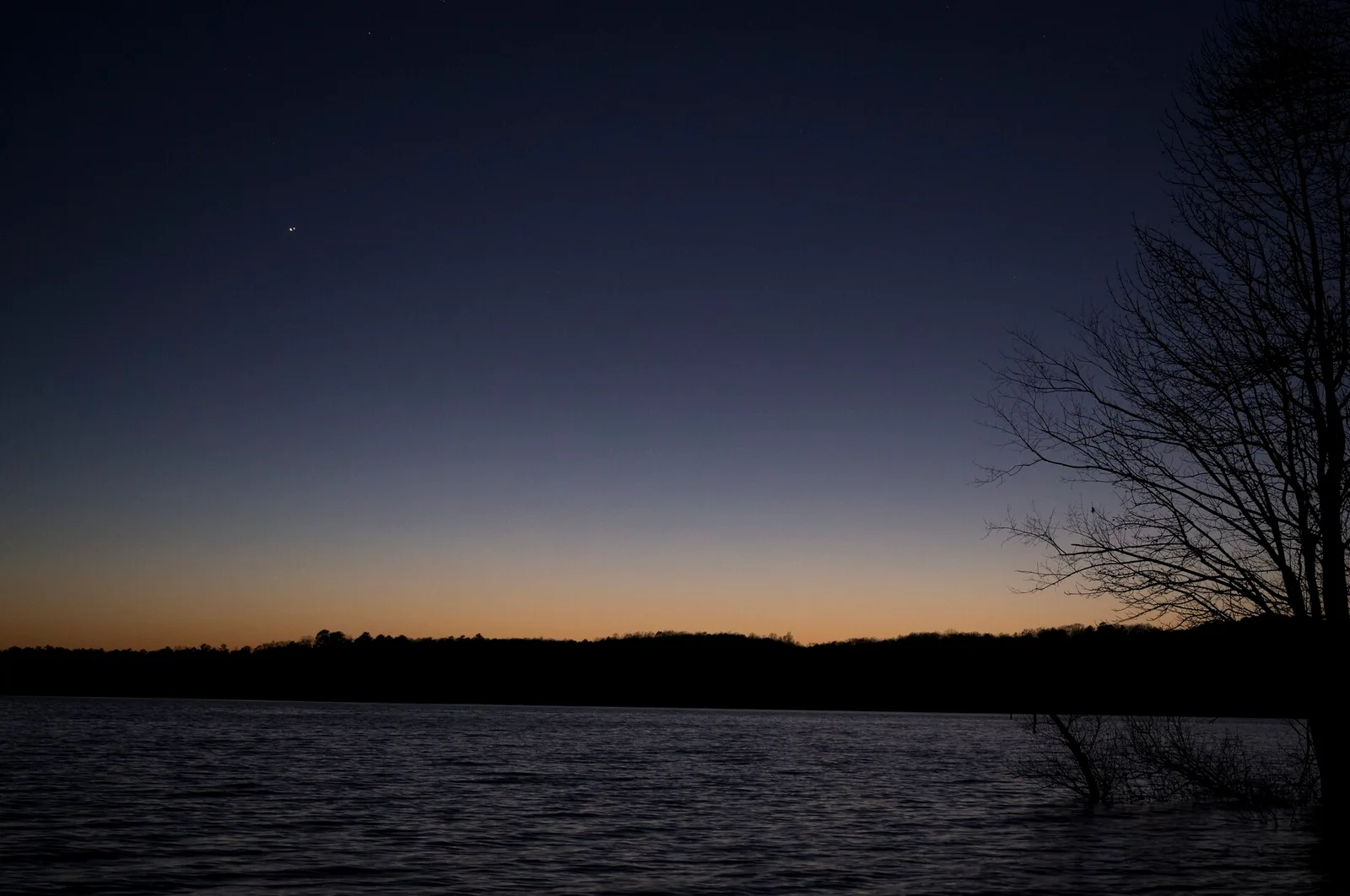
The top line sums the night up. Below it, last light is when the Sun is 6° below the horizon, the end of what astronomers call civil twilight. Bright planets and the brightest stars show from about then. Fully dark starts when the Sun is 18° down, the end of astronomical twilight. Only then does the last glow leave the sky, and the Milky Way and faint stars come out.
In the north of the UK, and even in London for a few weeks around midsummer, the Sun never sinks 18° down. The tool says so plainly and gives the darkest moment instead. At the far north of Shetland around midsummer it does not even reach 6° down, so the whole night is twilight.
The planet table covers the five you can see without a telescope: Mercury, Venus, Mars, Jupiter and Saturn. A planet counts as visible when it is at least 10° up while the Sun is at least 6° down. That is our own rule, and it is a fair one: 10° is about the width of your fist held at arm's length, and anything lower tends to hide behind trees, houses and haze. Brightness is the magnitude, where a lower number means brighter. Venus and Jupiter are often brighter than any star.
How it is worked out
Every time and position comes from Astronomy Engine, an open astronomy library. It works out where the Sun, Moon and planets are for your exact latitude and longitude, allows for the way the air bends light near the horizon, and gives each planet's magnitude. We checked it against the US Naval Observatory's published sunset, twilight and moonrise times, which it matches to within two minutes, and against NASA JPL's planet positions, which it matches to within a fifth of a degree. Town positions come from GeoNames (CC BY 4.0). All times are UK clock time, GMT in winter and BST in summer, with the zone shown next to each one.
The Moon's phase on the card is the same sum as our Moon phase today tool. For sunrise and sunset on any day of the year, see sunrise and sunset times.
Make a night to remember
Some nights are worth keeping. Our personalised star map prints the stars over any place on any date, and the UK meteor shower dates show which peaks get a dark, Moon-free sky.
Written by Craig Fearn, Aphelion Prints. Last updated .