Moonlight brightens the sky, and the International Meteor Organization takes it into account when it describes each shower in its yearly calendar. So the useful question is when a shower peaks and where the Moon is that night. The tables below put the two side by side.
For the rest of 2026: the Geminids on 14 December sit furthest from a full moon, ten days before it. The Orionids and Leonids peak five and six days before full moon, and the Ursids two days before, with the Cold Moon on 24 December.
What is a shooting star?
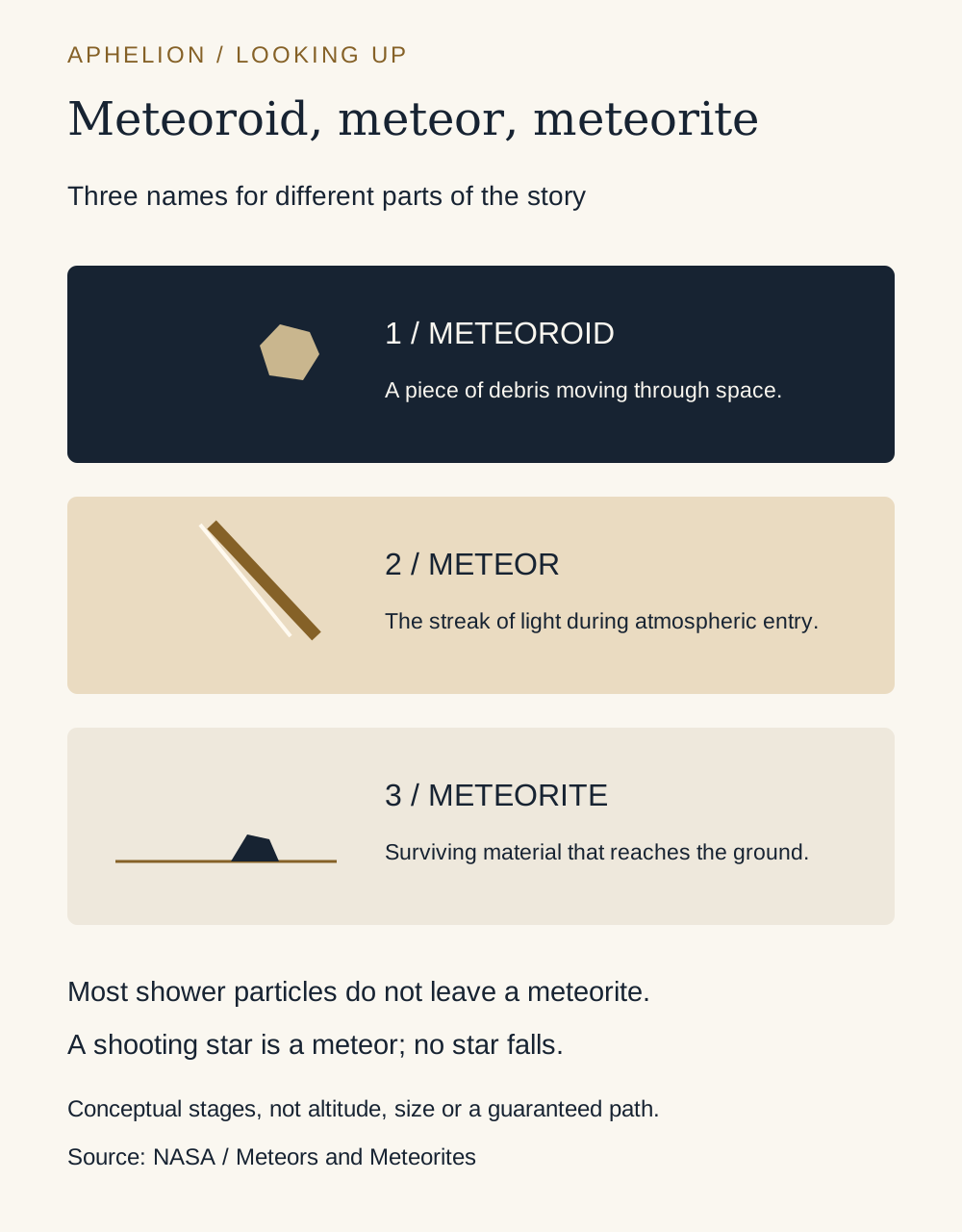
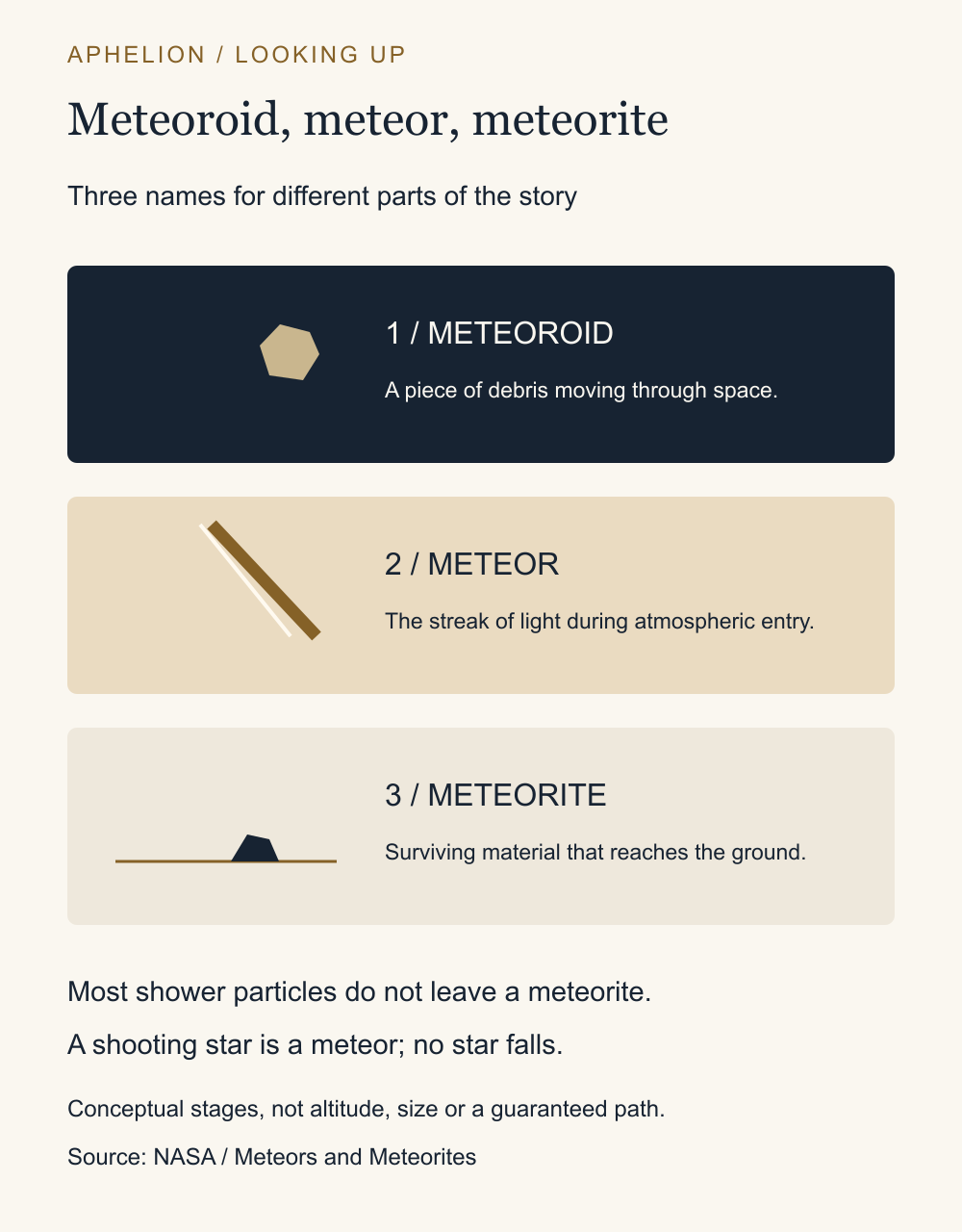
A shooting star is a meteor: the visible streak when a small piece of space debris enters the atmosphere. No star falls. NASA distinguishes three names: a meteoroid is debris in space, a meteor is the light during atmospheric entry, and a meteorite is material that survives to reach the ground.
Shower particles often come from debris left by a comet. Earth passes through that stream on its orbit, which is why a named shower returns at a similar time each year. The Eta Aquariids and Orionids are linked to Halley’s Comet. Most shower particles disintegrate in the atmosphere; seeing a meteor does not mean a rock landed nearby.
How to read the moon column
Each figure counts whole calendar days from the peak to the nearest full moon, using the London dates in our full moon calendar. Full moons in that calendar fall 29 or 30 days apart, so a peak about 15 days from one is close to new moon, and a peak a day or two from one is close to full.
It's a count of days, not a measure of how bright the Moon is. If you want to picture what the Moon looks like a given number of days from full, the eight phases of the Moon walks through the cycle.
Meteor shower peaks in 2026
| Shower | Peak | Possible hourly rate | Moon at the peak |
|---|---|---|---|
| Quadrantids | Early hours of 4 January | 120 | 1 day after full moon |
| Lyrids | 22 April | 18 | 9 days before full moon |
| Eta Aquariids | 6 May | 40 | 5 days after full moon |
| Perseids | 12-13 August | 150 | 15 days either side of full moon |
| Orionids | 21 October | 15 | 5 days before full moon |
| Leonids | 18 November | 15 | 6 days before full moon |
| Geminids | 14 December | 120 | 10 days before full moon |
| Ursids | 22 December | 10 | 2 days before full moon |
Peak dates and rates: Royal Museums Greenwich meteor shower guide, read 28 September 2026. Where RMG gives a night, the moon count uses the second date.
The 2026 Perseids fell as well as they can: 15 days after the Buck Moon and 15 days before the Sturgeon Moon. The Quadrantids had the worst of it, a day after the Wolf Moon.
For a printable year reference, use the 2027 Moon and meteor planner. Its selected shower dates are planning context, not a forecast.
Meteor shower peaks in 2027
| Shower | Peak | ZHR | Moon at the peak |
|---|---|---|---|
| Quadrantids | 4 January, 03:25 UT | 80 | 11 days after full moon |
| Lyrids | 23 April, 01:40 UT | 18 | 3 days after full moon |
| Eta Aquariids | 6 May, 09h UT | 50 | 14 days before full moon |
| Perseids | 13 August, 08h to 10h UT | 110+ | 4 days before full moon |
| Orionids | 22 October | 20 | 7 days after full moon |
| Leonids | 18 November, 06h UT | 15+ | 4 days after full moon |
| Geminids | 14 December, around 20h UT | 150 | 1 day after full moon |
| Ursids | 23 December, 04h UT | 10 | 10 days after full moon |
Peak dates, times and ZHR: International Meteor Organization, 2027 Meteor Shower Calendar (linked from imo.net/resources/calendar), read 28 September 2026. UT is Universal Time; add an hour for British Summer Time. The 2027 full moons come from NASA alone, as the full moon calendar explains.
In 2027 the Eta Aquariids peak 14 days before full moon, and the IMO expects their peak to be free of moonlight. The Quadrantids fall 11 days after a full moon. The Geminids arrive a day after the December full moon, and the IMO expects that Moon to badly disturb anyone watching for them.
Two different rates
RMG publishes a possible hourly rate: a guide to how many meteors you might see in good conditions. The IMO publishes a ZHR, or Zenithal Hourly Rate, which it defines as a calculated count for an ideal observer under a clear, dark sky with the radiant straight overhead. Neither is a promise. The two bodies also disagree on some showers, which is why 2026 and 2027 are shown with their own source rather than mixed.
Seeing them from the UK
RMG lists all eight of these showers as visible from the UK. Two come with caveats from the sources. RMG describes the Eta Aquariids as low in the sky, and the IMO says they show only in the hours before dawn, with the best results from south of about 40° north. For the Perseids, the IMO says the radiant is at a reasonable height from 10 or 11pm local time at mid-northern latitudes, and that the shower cannot be properly seen from north of about 60° north.
RMG links two of these showers to one comet: the Eta Aquariids and the Orionids are both associated with Halley's Comet. Our guide to Halley's Comet covers when it comes back. More night-sky guides are in Looking up.
Written by Craig Fearn, Aphelion Prints. Last updated .