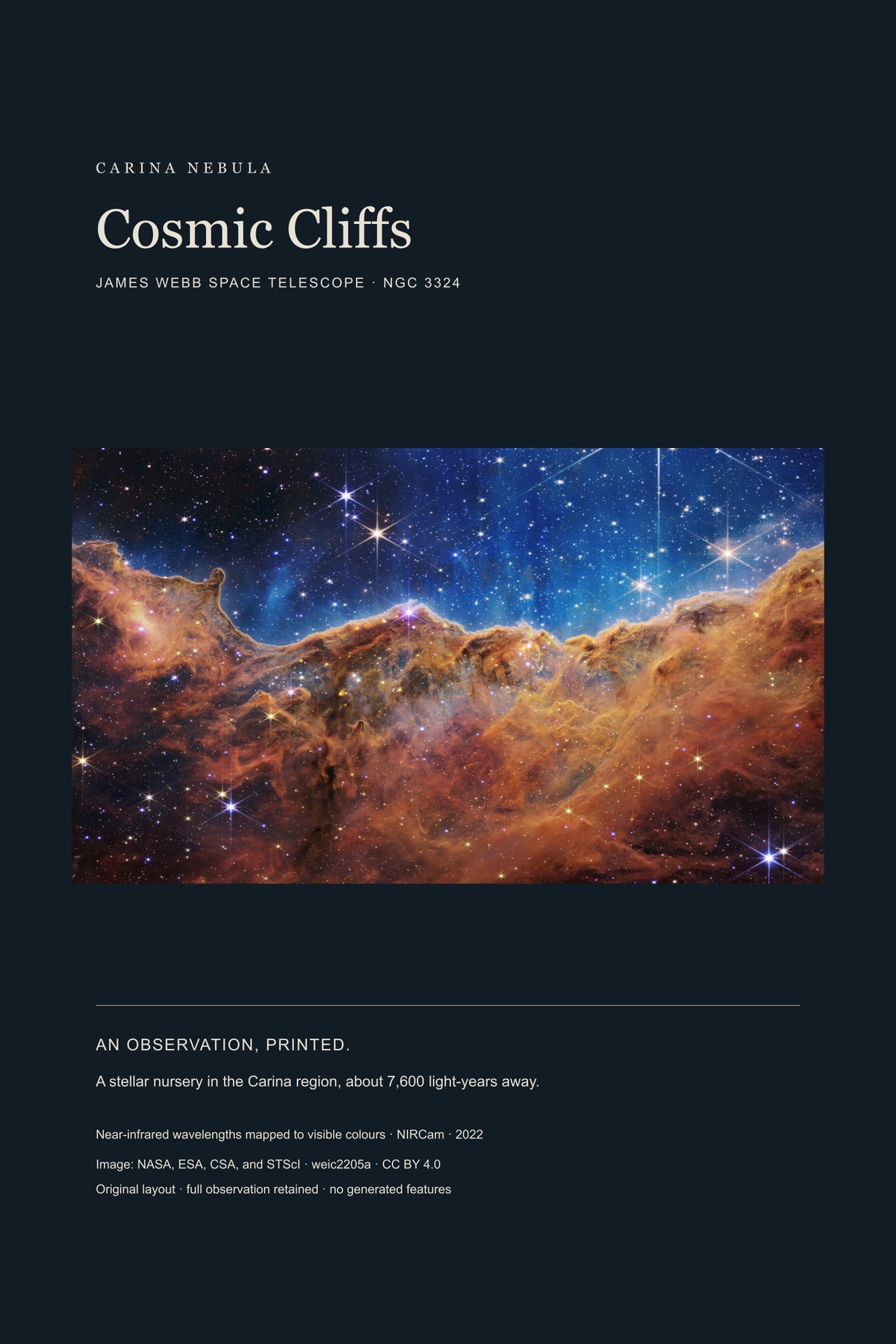
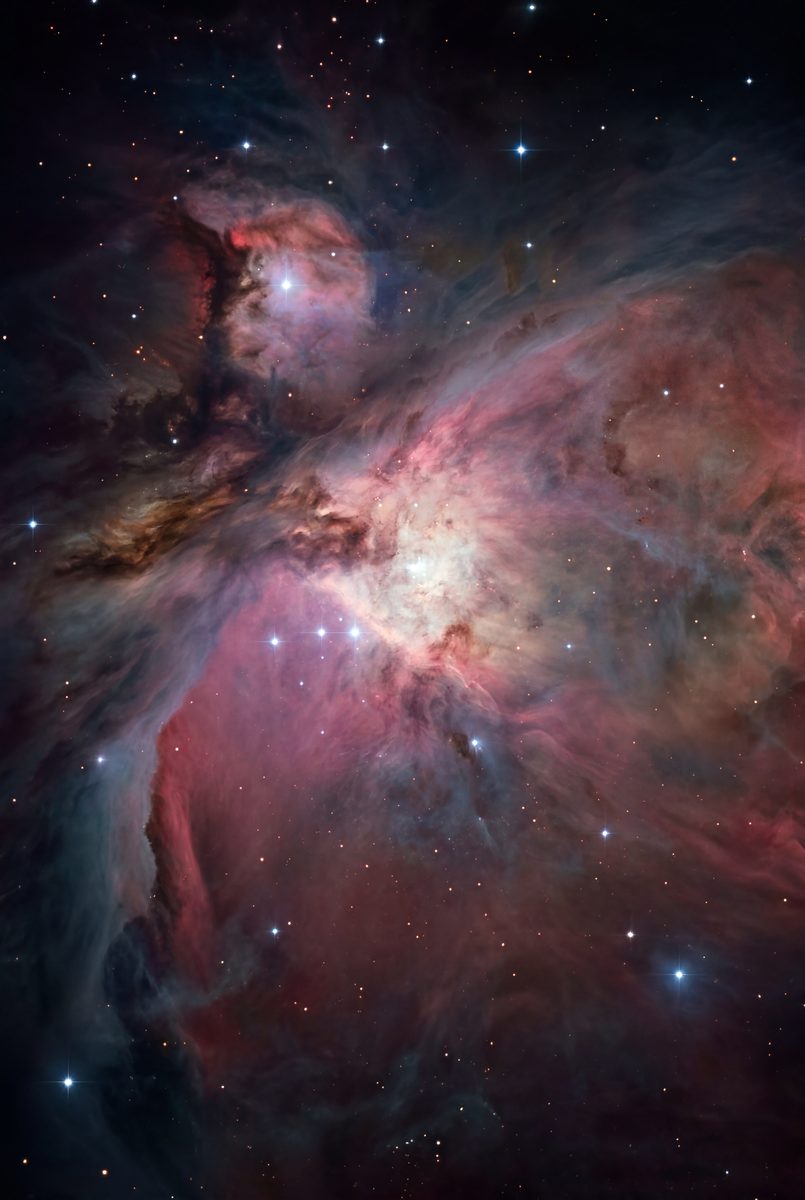
Pillars of Carina uses Webb telescope imagery; Orion Cradle is an AI illustration. Their product pages carry the process notes and source credits.
Nebula artwork: two nebulae, two different pictures
Pillars of Carina shows the Cosmic Cliffs in NGC 3324, in the Carina region: a cloud ridge beneath a field of stars, recorded by Webb’s NIRCam instrument. The near-infrared observations are shown in mapped colour, within an original typographic layout. Orion Cradle is the soft one: rose, slate and a pale bright core, with no hard edge anywhere in the frame, so it reads as a cloud rather than a landscape.
Orion Cradle takes its subject from the Orion Nebula, “a huge, star-forming nebula in the constellation Orion”. Those two plates are the whole nebula list for now.
Why a nebula glows
Emission nebulae, as this explainer notes, “emit their own light”: ultraviolet from the stars inside strips electrons from the hydrogen, and the gas glows as the electrons settle back. Orion is that kind. Orion Cradle uses an AI illustration’s palette. The Carina image instead maps measured near-infrared wavelengths into visible colour; its product page gives the observation credits. The answer on whether nebula pictures are real shows where that choice comes in.
Beyond the two plates
- Want the object explained first? What a nebula is covers the four main types.
- Prefer a galaxy to a cloud? Galaxy prints holds Galactic Core and Andromeda.
- Want your own photo in nebula colours? The nebula watercolour style in Cosmic Canvas restyles a photo you upload, with a free preview first.
- Browsing the whole shelf? Every subject is on astronomy prints.