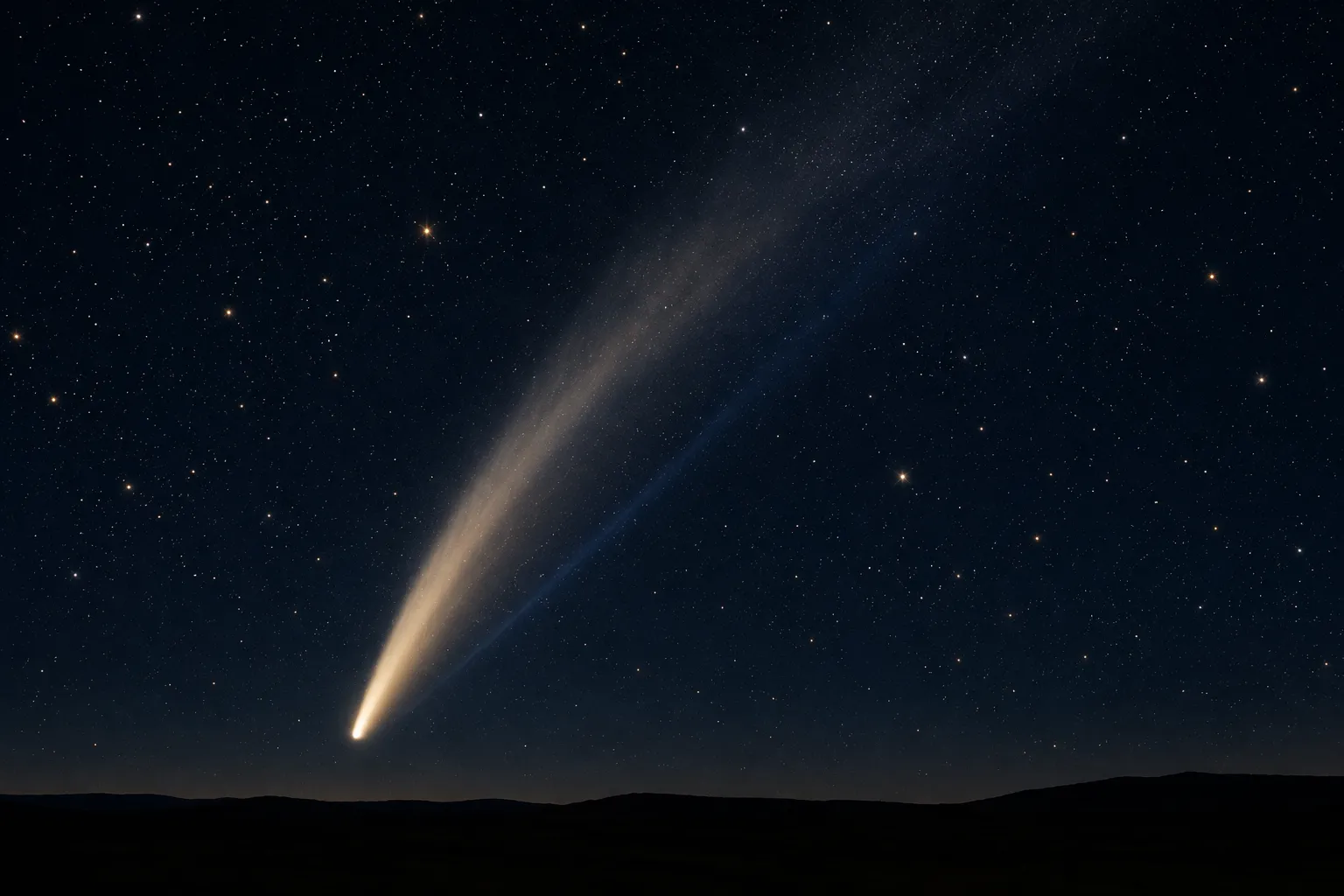
Halley's Comet travels around the Sun on a long orbit. NASA states it plainly: Halley’s orbit period is, on average, 76 Earth years.
Its next return is decades away, which makes the annual showers from its debris much easier to plan for.
When Halley's Comet last visited, and when it returns
The last visit is well within living memory. NASA records the moment of closest approach to the Sun: At perihelion on Feb. 9, 1986, Halley was only 0.5871 AU (87.8 million km: 54.6 million miles) from the Sun.
That date marks perihelion, rather than the whole period when observers could see it.
The next is a date to write down. It will return in 2061 on its regular 76-year journey around the Sun.
Whether you saw the 1986 visit or know it through photographs, 2061 is the next return to plan around.
Why it carries Edmond Halley’s name
Halley did not discover the comet. People had been recording it for centuries without realising the sightings were the same object. What he did was harder and more interesting: he worked out that they were.
NASA describes the method: In 1705, Halley used Isaac Newton’s theories of gravitation and planetary motions to compute the orbits of several comets.
Having computed them, he noticed that several historical comets shared an orbit, concluded they were one comet on a long loop, and predicted its return. It came back as predicted, and he did not see it. Royal Museums Greenwich: While Edmund Halley did not live long enough to see this, the comet returned to orbit near Earth in 1758, proving his theory correct.
It is one of the cleanest early demonstrations that the sky obeys rules you can calculate rather than merely observe.
Watching Halley’s debris each year
The comet's next return to the inner Solar System is in 2061. Its debris produces meteor showers each year.
A comet sheds material along its orbit, and Earth ploughs through that debris annually. NASA makes the connection explicit: Orionid meteors appear every year when Earth travels through an area of space littered with debris from Halley’s Comet.
The October Orionids give observers an annual connection to Halley through its debris. The meteors appear to radiate from the direction of Orion, which is why they are named for it, though the constellation has nothing to do with their origin. Use the meteor shower guide to compare peak dates with the Moon, then choose a dark site with a clear view of the sky. A peak rate is not a guaranteed count.
How big it is
We have a size for it. NASA puts it at Halley’s dimensions are about 9.3 by 5 miles (15 kilometers by 8 kilometers).
Fifteen kilometres by eight: a dark, irregular lump roughly the size of a city, which throws a tail across a large fraction of the sky when the Sun gets to work on it. The visible coma and tail extend around and away from the much smaller solid nucleus.
For the difference between the piece of debris and the light it makes, see what a shooting star is. The same guide compares sourced shower peaks with the Moon.
Two showers, not one
Halley’s debris crosses Earth’s path twice a year, not once. NASA: This debris stream results in two weak meteor showers each year: the Eta Aquarids in May and the Orionids in October.
So there are two chances annually to watch pieces of this comet burn up: May, when the radiant sits low in the pre-dawn sky — an awkward one from Britain — and October, which is the better bet from here.
A comet in the Bayeux Tapestry
Halley has been watched for a very long time, and one appearance ended up stitched into a wall-hanging. NASA notes the comet appears in the Bayeux Tapestry, which chronicles the Battle of Hastings in 1066.
The 76-year figure is also an average rather than a metronome. NASA records the interval running as short as 74.42 years (1835-1910)
, and gives the reason: The period varies from appearance to appearance because of the gravitational effects of the planets.
The giant planets pull at the orbit on every circuit, so the arrival date moves.
What we learned in 1986
The 1986 pass was the first time anyone got close. ESA records its own mission’s achievement: ESA’s Giotto probe swept within 600 km of Comet Halley, obtaining the first close-up images of a comet.
Those images let scientists study the nucleus close up, beyond the coma and tail seen from Earth.
Seeing it, and marking it
If you're planning for 2061, the useful habit starts now: learn the autumn sky well enough that you would notice something new in it. The Orionids give you a reason to be out in October, and the winter constellations that follow are the easiest in the year to learn.
Comets and long returns are the subject of our The Long Return plate, and the wider astronomy posters collection covers the rest of the sky. If you would rather read on, the planets in order is the next thing overhead.