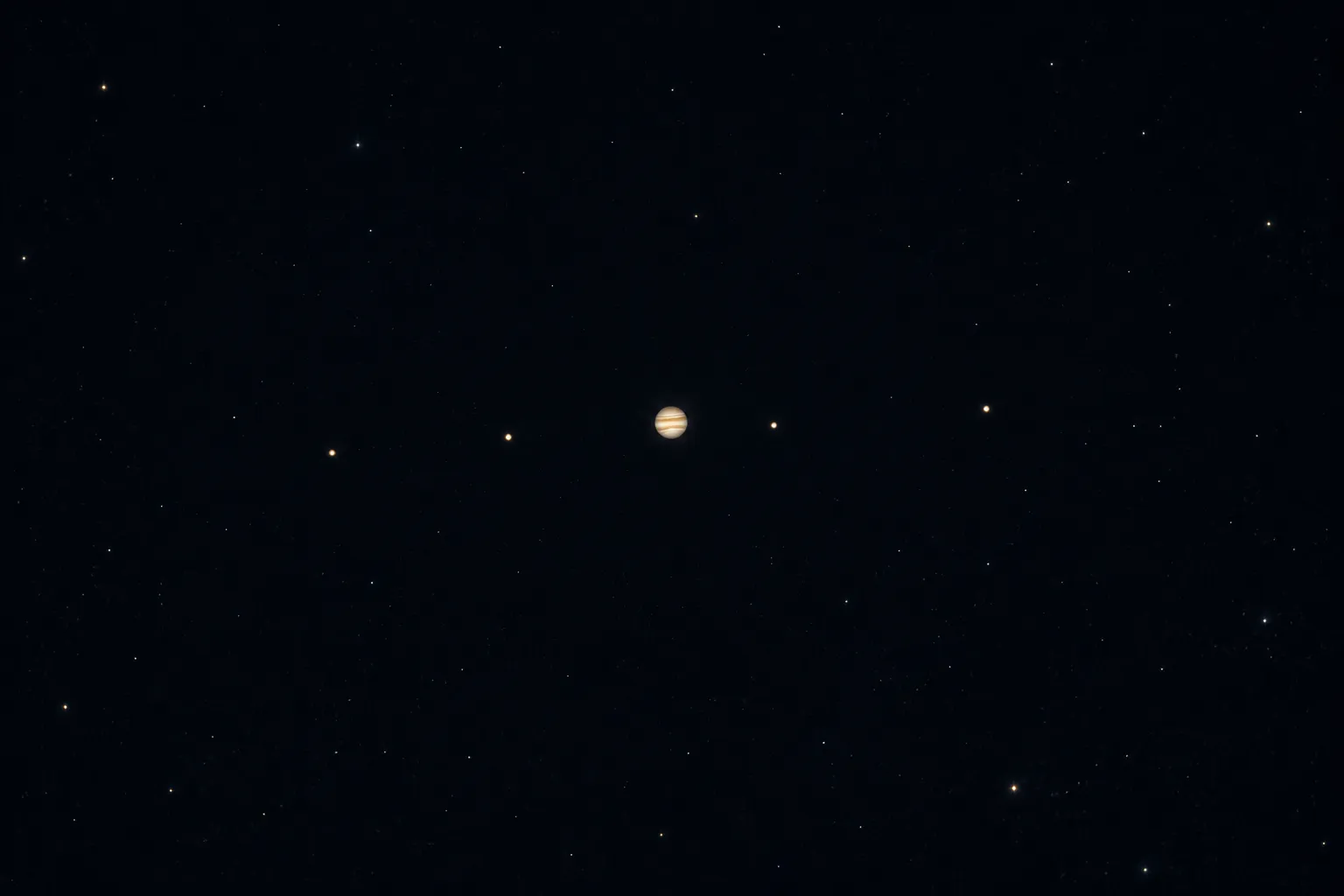
Jupiter’s four largest moons are a rewarding target for a beginner. When Jupiter is above a clear horizon, suitable binoculars held steadily can show some of them as small points beside the planet. You may not see all four: glare, weather and the moons’ positions can hide them.
NASA gives the running total: Jupiter has 115 moons that have been officially recognized by the International Astronomical Union, as of August 2026.
The number moves as surveys find more, which is why it is worth quoting with its date attached.
The four of jupiters moons that matter
Four of the 115 are in a different class, and they have been known for four centuries. NASA records the discovery: Galileo Galilei spotted the first Jupiter moons in 1610 with a new invention called a telescope.
They are Io, Europa, Ganymede and Callisto, and the naming has its own small controversy: German astronomer Simon Marius found Jupiter’s moons about the same time as Galileo, but Galileo was first to report the moons and is credited with their discovery.
NASA credits the names to him: But the names Marius proposed for the moons in 1614 (mythological characters associated with Jupiter, suggested to him by fellow astronomer Johannes Kepler) are the ones we use today — Ganymede, Callisto, Io, and Europa.
Marius supplied the names we still use; Galileo got the credit.
Io, the volcanic one
NASA: Jupiter’s moon Io is the most volcanically active world in the solar system, with hundreds of volcanoes, some erupting lava fountains dozens of miles (or kilometers) high.
Not the most volcanically active moon — the most volcanically active world, full stop, more so than Earth.
Europa, the ocean one
Europa is the one that keeps people awake. NASA: Scientists believe a saltwater ocean lies beneath its icy shell, holding twice as much water as Earth’s global ocean.
Twice all the water on Earth, under ice, on a moon smaller than ours: NASA puts Europa at about 90% the size of Earth’s Moon.
Ganymede, the enormous one
NASA: Jupiter’s icy moon Ganymede is the largest moon in our solar system, even bigger than the planet Mercury, and the dwarf planet Pluto.
A moon that outsizes a planet is a good reminder that the categories are ours, not nature’s.
Callisto, the battered one
NASA: Callisto is the most heavily cratered object in our solar system.
An old, quiet, thoroughly hit surface — the opposite of Io in every way that matters.
How to see them from the UK
Jupiter is among the brightest things in the night sky when it is up. Brace suitable binoculars against a support or use a tripod. NASA’s binocular observing guide treats spotting the moons as a skill to practise, rather than a guaranteed view. Check current skywatching guidance for when Jupiter is visible, and choose a clear view with the planet comfortably above the horizon. What you see is a line of points, because you are looking at their orbits edge-on — NASA: Viewed from Earth, the orbits of the Galilean moons presently lie nearly edge-on, offering many chances to observe similar dances of Jupiter’s moons.
(NASA wrote that in 2003; the geometry it describes is a phase, not a permanent arrangement.)
Come back the next clear night and they will have moved. That's the part worth doing twice: the arrangement changes within hours, and watching it change is watching the same thing Galileo watched when he worked out they were going round.
What is going there now
Europa has two missions pointed at it. NASA states the aim of its own: Europa Clipper will try to determine if Jupiter’s icy moon Europa currently has habitable conditions.
It is already flying: JPL gives the Launch Date: Oct. 14, 2024
, with arrival at Jupiter in April 2030 — a five-and-a-half year cruise to reach a moon you can try to observe when Jupiter is visible and conditions are suitable.
Europe is going too. ESA: ESA’s Jupiter Icy Moons Explorer, Juice, will make detailed observations of the giant gas planet and its three large ocean-bearing moons – Ganymede, Callisto and Europa
. Three ocean-bearing moons, around one planet, all of which are potential binocular targets under suitable conditions.
The lock that keeps Io molten
Io is not volcanic by accident. The three inner Galilean moons are tied to one another in a rhythm: NASA describes it as every time Ganymede orbits Jupiter once, Europa orbits twice, and Io orbits four times
.
A one-two-four lock means they meet in the same places repeatedly and tug each other’s orbits out of round. Being pulled about in an out-of-round orbit around something as massive as Jupiter kneads a moon from the inside, and that friction is the heat. It's the same mechanism keeping Europa’s ocean liquid under its ice: NASA describes the tidal heating running down the line, Distance from Jupiter also determines how much tidal heating the Galilean satellites experience – Io, closest to Jupiter, is heated so much that it is the most volcanically-active body in the solar system.
Ganymede has a magnetic field
One more thing that should belong to a planet: NASA states Ganymede is the only moon known to have its own magnetic field – something typically found on planets like Earth.
The only moon known to have one, anywhere.
How we found out about Io
The volcanoes are a recent discovery in the scheme of things. NASA: It was Voyager 1 that spotted the first signs of the little moon’s powerful volcanism in 1979.
Galileo saw Io as a point of light in 1610; it took another 369 years to learn it was erupting.
Jupiter on the wall
The planet itself, banded and storm-ridden, is our Jupiter plate, and Europa’s frozen ocean is the subject of Europa. For the whole neighbourhood in one chart, the solar system posters collection covers it. If you would rather keep reading, the planets in order sets the scale.