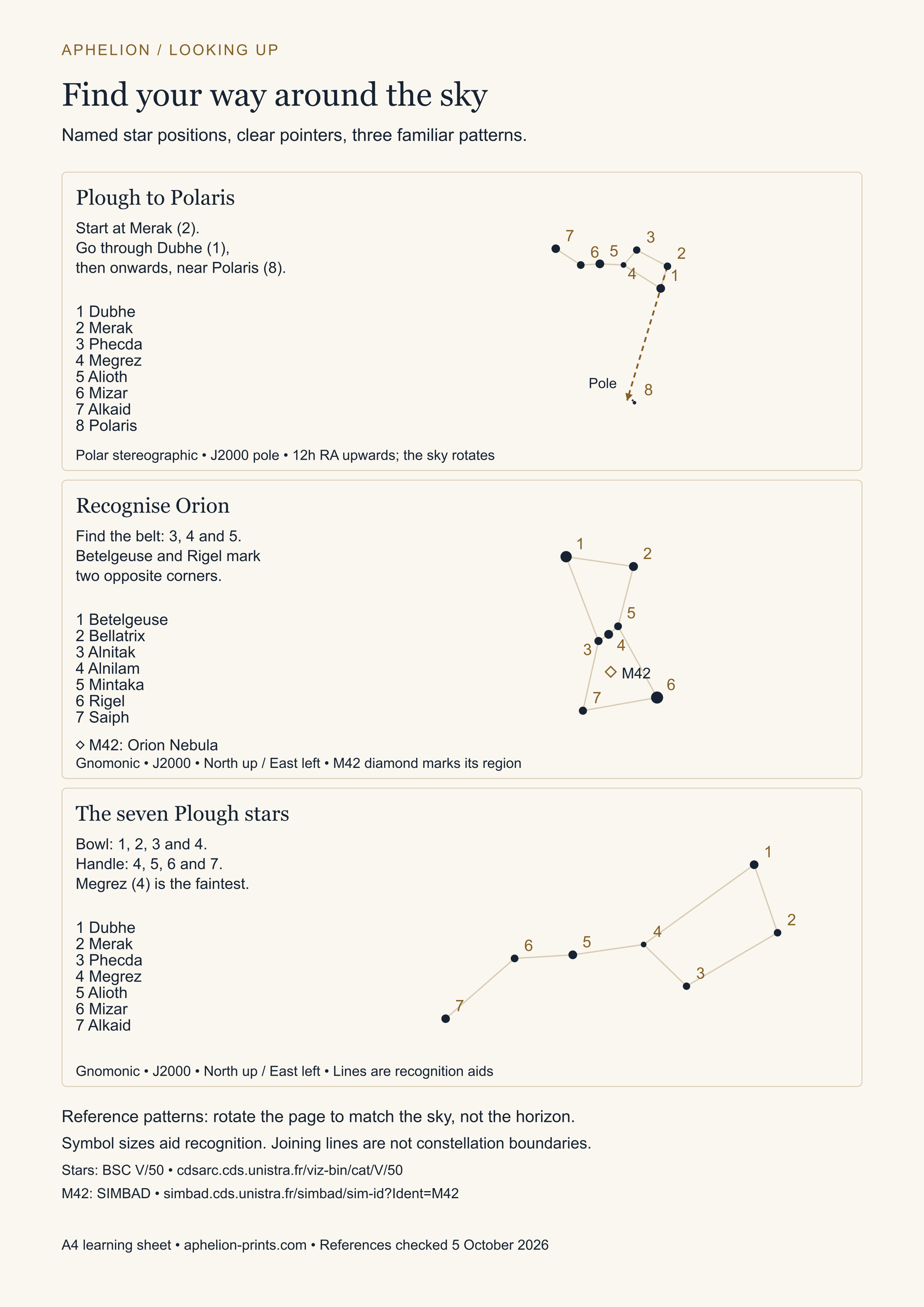
Illustration: the landscape above is decorative. The labelled chart below uses verified catalogue positions.
The north star is a star that stays almost in place in the British sky. NASA describes it this way: Polaris, known as the North Star, sits more or less directly above Earth’s north pole along our planet’s rotational axis.
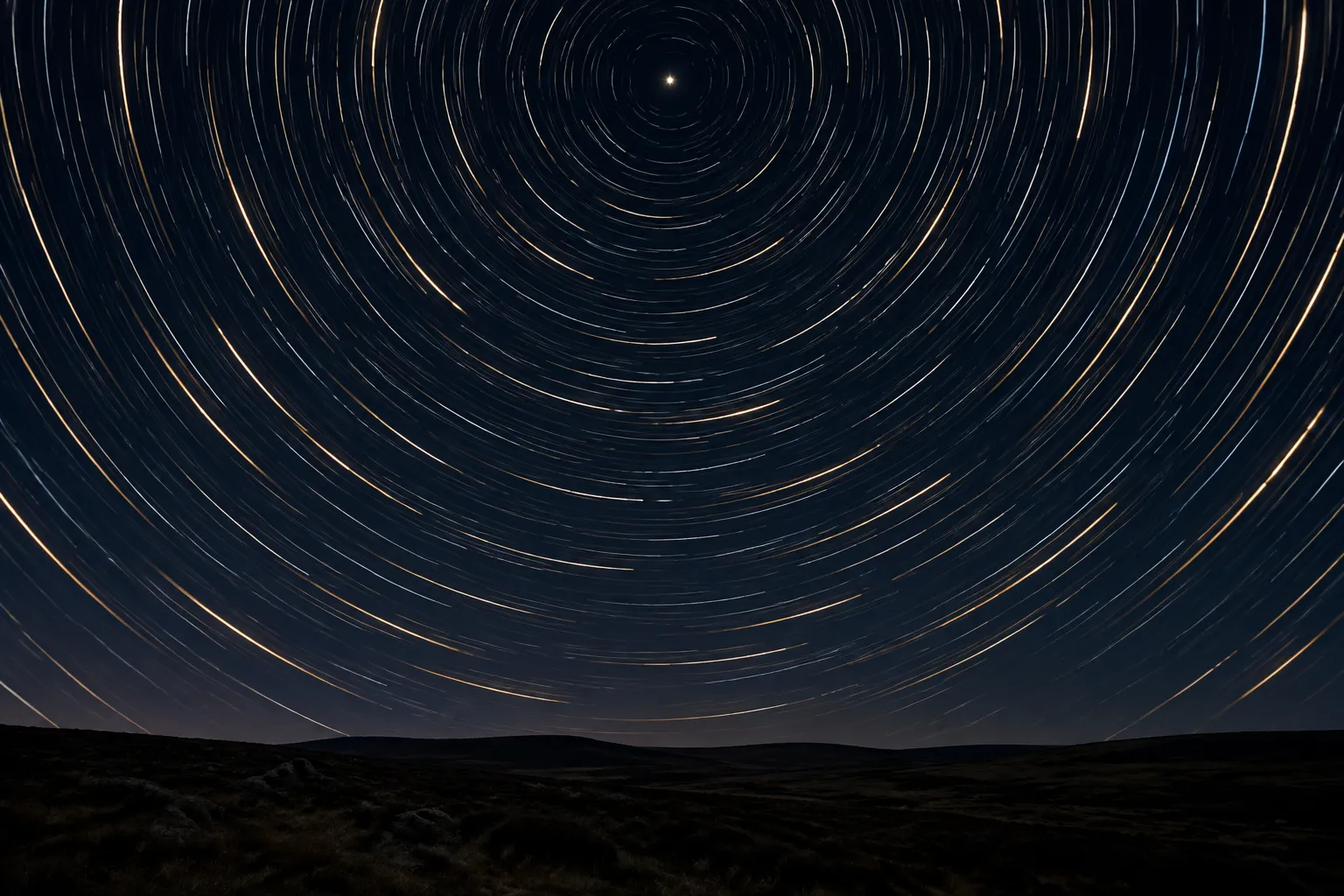
The sky turns around the celestial pole. Polaris traces a small circle nearby, which is why it seems almost stationary.
That makes it a useful star to know, and a much over-promised one. Almost everything people believe about it is half right.
The north star is not the brightest star in the sky
This is the misconception worth killing first. NASA again: The North Star isn’t the brightest star in the sky, but it’s usually not hard to spot, even from the city.
That honour belongs to Sirius: Royal Museums Greenwich has it that Sirius resides in the constellation of Canis Major (the Great Dog), and is the brightest star in the night sky.
It is a winter star, low in the south from Britain. Polaris is useful because of where it is, not how it looks.
It is, however, the brightest star in its own constellation. The Royal Observatory Greenwich confirms it is the brightest in Ursa Minor — a small and otherwise faint pattern, which is part of why people expect more of it than they get.
How to find Polaris from the UK
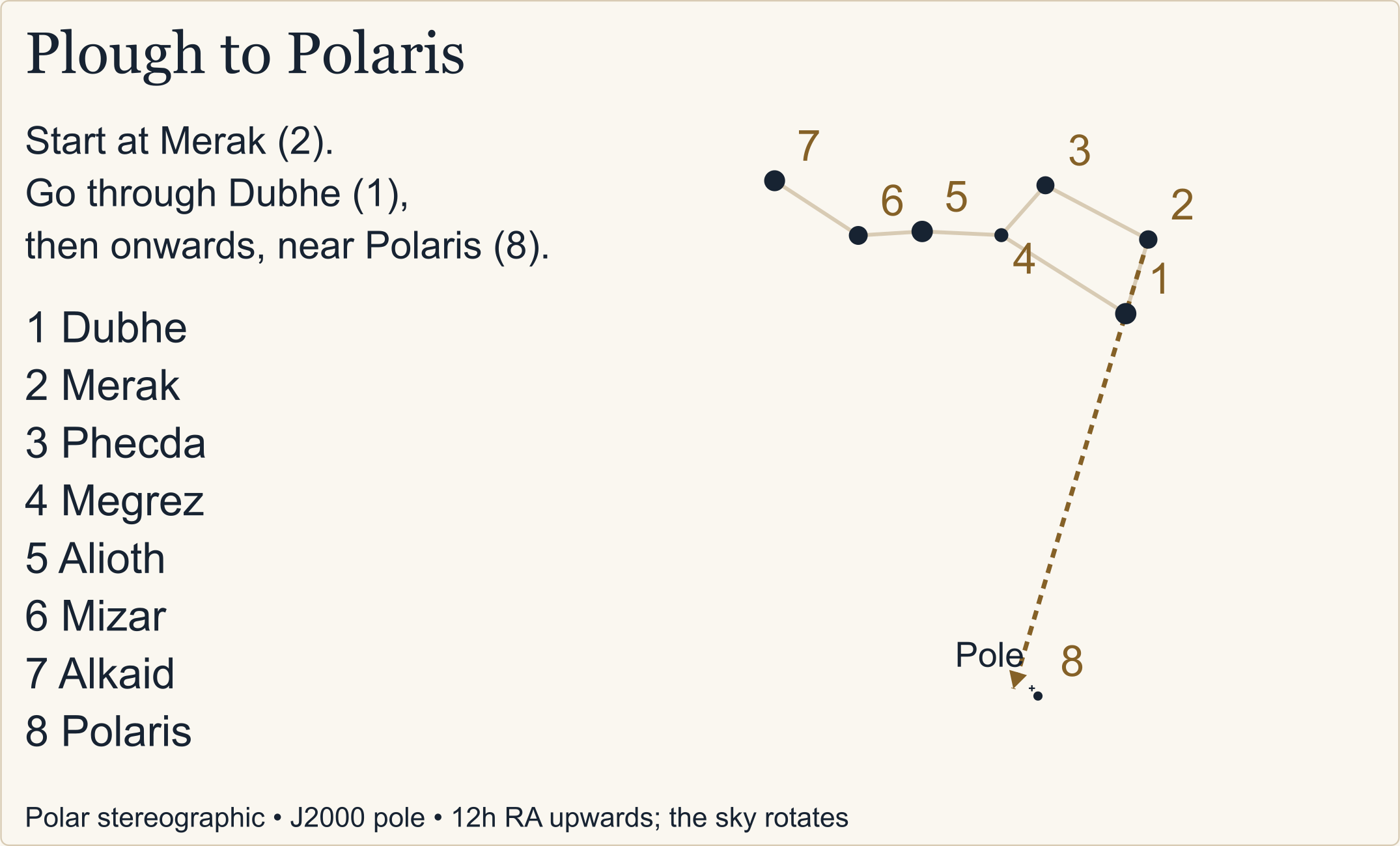
The numbered stars use named records from the Bright Star Catalogue, with fixed J2000 reference positions. Rotate the pattern to match the sky; it is a recognition chart rather than a prediction of tonight's horizon. Joining lines help you see the pattern and do not mark constellation boundaries.
Download the free A4 northern-sky finder sheet: print PDF, 300dpi PNG or scalable SVG. Print the PDF at actual size on A4 paper.
You do not look for Polaris. You look for the Plough, which from anywhere in Britain is circumpolar, never setting, and let it point.
Royal Museums Greenwich gives the method in one sentence: You can find the North Star, Polaris, by following a line drawn through Dubhe and Merak, the two end stars in the bowl part of Ursa Major (Great Bear).
Those two are the far edge of the Plough’s pan, away from the handle. Start at Merak, draw the line through Dubhe, then continue beyond Dubhe. It brings you near Polaris, a moderately bright star; the line is a guide rather than a perfect alignment.
NASA words the same trick for the American name: find the Big Dipper, then The two stars on the end of the Dipper’s ‘cup’ point the way to Polaris.
Same seven stars, same two pointers, different national nickname.
Once you have it, you have a useful bearing. Polaris marks approximate north. Royal Museums Greenwich: the angle of the star above the horizon gives you your latitude (north-south position on the Earth’s surface).
From London that puts it about halfway up, and from the north of Scotland noticeably higher.
Where Polaris sits
NASA places it precisely: Polaris, which is the tip of the handle of the Little Dipper, or the tail of the little bear in the constellation Ursa Minor.
Ursa Minor is the faint echo of the Plough, curling away from it, and under a British suburban sky you will often see Polaris and nothing else of the little bear.
That is worth knowing before you go looking for a shape. On most nights from most of England, the constellation is not there to be seen. The star is.
The north star is not one star
The thing you are pointing at is not a star. NASA is direct about it: the North Star is a triple star system. Three stars, bound together, appearing as one point to the naked eye and to most telescopes.
It is also further away than most people assume. NASA gives the figure while describing the system’s geometry: At the system’s distance of 430 light-years, that translates into a separation of about 2 billion miles.
Four hundred and thirty light-years means the light arriving tonight left Polaris more than four centuries ago.
And it does something useful for astronomy beyond pointing north: Astronomers want to determine the mass of Polaris accurately, because it is the nearest Cepheid variable star.
Cepheids brighten and dim on a regular cycle, and that cycle is tied to their true brightness — which makes them the yardstick for measuring distances across the universe. The nearest one is the star everybody already knows how to find.
So the north star is a triple system, 430 light-years off, and the closest example of the class of star we use to measure the cosmos. That is a remarkable record for a star most people dismiss because it is not the brightest.
Why the north star will not always be the north star
Polaris holds the job on a lease, not a freehold. Earth’s axis is not fixed: Earth’s axis of rotation wobbles over the course of about 26,000 years, the way a spinning top also wobbles as it spins
, says NASA. The Royal Observatory puts the consequence plainly: The earth’s axis moves slowly backwards and forwards over thousands of years, so the star nearest the pole changes over time.
So the pole star is a role that different stars hold across the millennia. The pyramid builders had a different one: RMG names it, and names our replacement. About 5,000 years ago, a star called Thuban was the Pole Star and in about 5,000 years’ time, a star called Alderamin in the constellation Cepheus will be nearest the pole.
In several thousand years our descendants will have another. Polaris is the star standing there now, which is a stranger and better fact than “the north star” being a fixed name for a fixed thing.
What to do with it
Three things, in order of how often you will use them. Find north without a phone. Judge your latitude by eye. And use it as the anchor for learning everything else: once Polaris and the Plough are automatic, the rest of the northern sky hangs off them, which is how the named stars stop being a list and start being places.
The northern figures that circle it — Ursa Major, Cassiopeia and the rest — are set out as a single chart in our Northern Constellations plate, and the wider constellation prints collection covers the same sky in other styles.