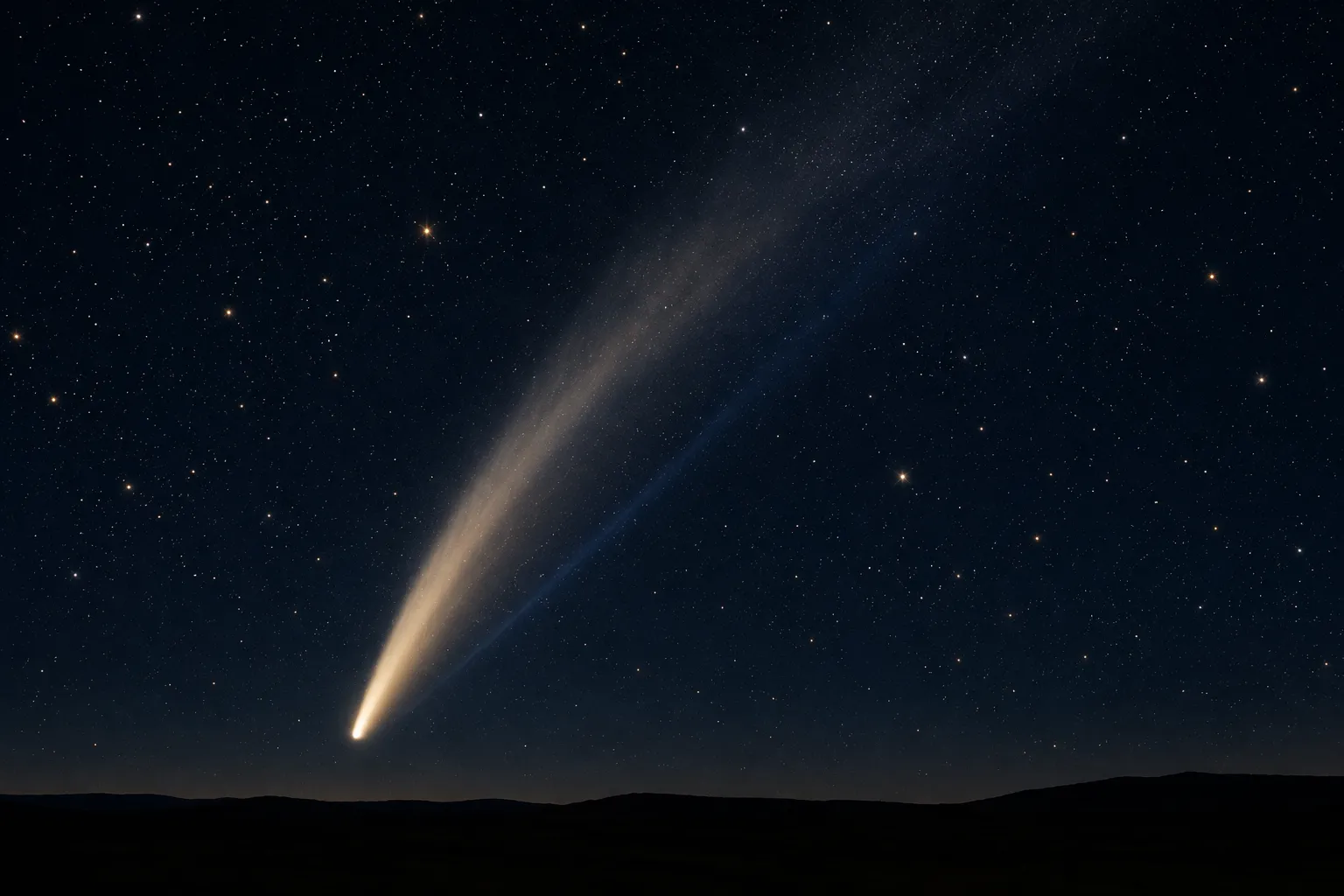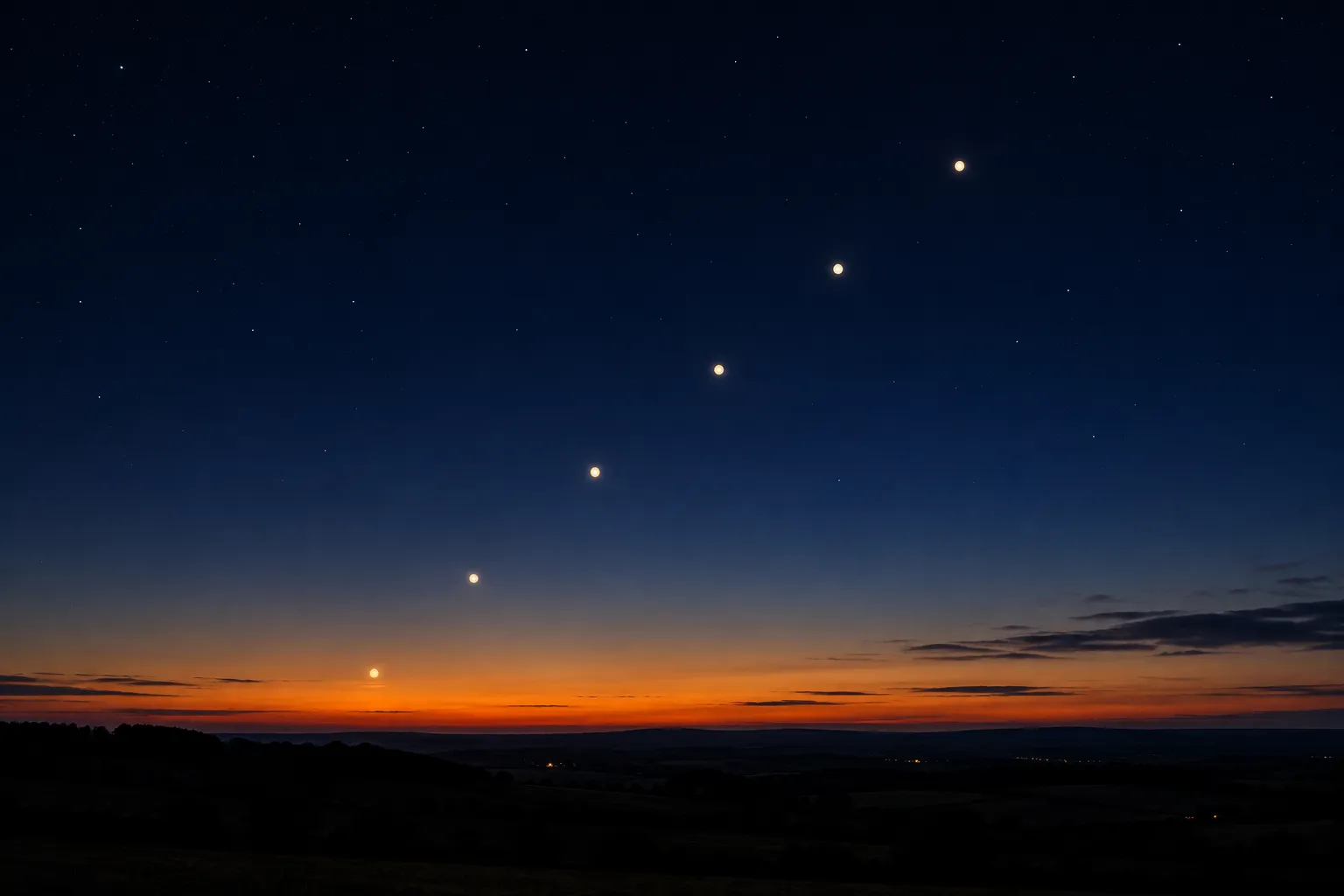
An alignment of planets is one of the few astronomy headlines that is almost always overstated, and the overstatement is easy to unpick. NASA says so directly: ‘Planet parade’ isn’t a technical term in astronomy, and ‘planetary alignment’ can refer to several different phenomena.
What is happening is more ordinary and, once you see why, more satisfying.
Why the planets always appear along one line
The planets appear in a line because of where we are standing, not where they are. NASA: The planets orbit our Sun in a relatively flat, disc-shaped plane. From Earth, we’re looking into that solar system plane from within.
We sit inside a flat disc and look along it. A disc viewed edge-on is a line. NASA names it: When viewed edge-on, this disc appears as a line, which we call the ecliptic or ecliptic plane.
So every planet you ever see is on roughly the same line across the sky, every night, whether or not anyone calls it an alignment. That line is the ecliptic, and the Sun and Moon travel it too. Once you can trace it, you can predict roughly where a planet will be before you find it.
So what makes a planet parade newsworthy?
Not geometry, but coincidence of timing. The planets move at different speeds, so most of the time they are scattered along the ecliptic, with some on the far side of the Sun and invisible. Occasionally several are on our side at once and above the horizon at the same hour.
That is worth going outside for. It is not the planets lining up in space; it is several of them being simultaneously visible from one spot on one evening. The distinction matters because the first version implies something rare and physically significant, and the second is what you will see.
Seeing one from the UK
The limiting factor in Britain is almost never the planets. It is the horizon and the weather.
NASA sets the practical bar: For most observers to see a planet with the naked eye, it needs to be at least a few degrees above the horizon, and 10 degrees or higher is best.
— in other words, anything scraping the horizon is likely lost to haze, buildings and trees before it is lost to darkness.
Practically, for a British viewing: find a spot with a clear low view towards the west after sunset or the east before dawn, since that is where the ecliptic meets the horizon at the hours most alignments are advertised for. Give your eyes time to adjust: NASA puts it at approximately 30 minutes to get dark sky adapted, and a bright light can ruin our night vision temporarily.
Expect the faintest advertised planet to be the one you do not get.
An alignment of planets is a conjunction
There is a precise term for this, and it is not “alignment”. A conjunction is a stated geometry between named bodies — and it does not always mean a view. NASA uses the word for the case where the Sun is the body in the middle: Earth is in a segment of its orbit in which our planet, the sun and Saturn line up, with the sun in the middle — an event called a conjunction.
That is a real conjunction and an unwatchable one: the planet is behind the Sun. The conjunctions worth going outside for are the ones where two planets appear close together in our sky, with Earth doing the looking rather than the lining up. Both are conjunctions, which is why astronomers name the bodies and headline writers say parade.
Telling a planet from a star, properly
The twinkling rule has a real mechanism behind it. NASA explains it: Planets tend to shine steadily, whereas stars twinkle.
Stars are so far away that each is a point of light, and ripples in our atmosphere easily distort them, which causes the flicker.
A planet shows a small disc rather than a point, so atmospheric ripples average out across it and the light stays steady. That is why the rule works, and why it fails for a planet very low down, where you are looking through far more air.
Mercury is the one you will miss
Most disappointing alignment-watching comes down to a single planet. NASA’s own guidance says why: Mercury will sit lower toward the horizon, so you will need a clear view to the west to catch it in the glow of twilight.
Mercury is the one that is always caught in twilight and always low. From Britain, with our habit of hedges, houses and low cloud, it is the planet most often advertised and least often seen. If a parade includes Mercury, find your western horizon first and everything else will look after itself.
The whole neighbourhood, on one wall
Laid out as a set, the planets in their real order are our solar system posters collection, and the Solar System Minimal plate lays them out as a single clean chart. For the distances behind the picture, the planets in order has NASA’s own figures in kilometres and AU.