How to use it
Type a distance, pick its unit, and every other unit appears underneath, with how long light takes to cover it. Tap any row in the table of places to drop its distance into the converter. The address in your browser changes as you go, so you can share the exact answer.
What the units mean
A light-year is how far light goes in a year: about 9.46 trillion kilometres. An astronomical unit, or au, is the average distance from Earth to the Sun, set at exactly 149,597,870.7 km. A parsec is about 3.26 light-years. It comes from the way astronomers measure star distances: a star one parsec away seems to shift by one second of arc as Earth goes round the Sun. A light-minute is how far light goes in a minute, about 18 million kilometres.
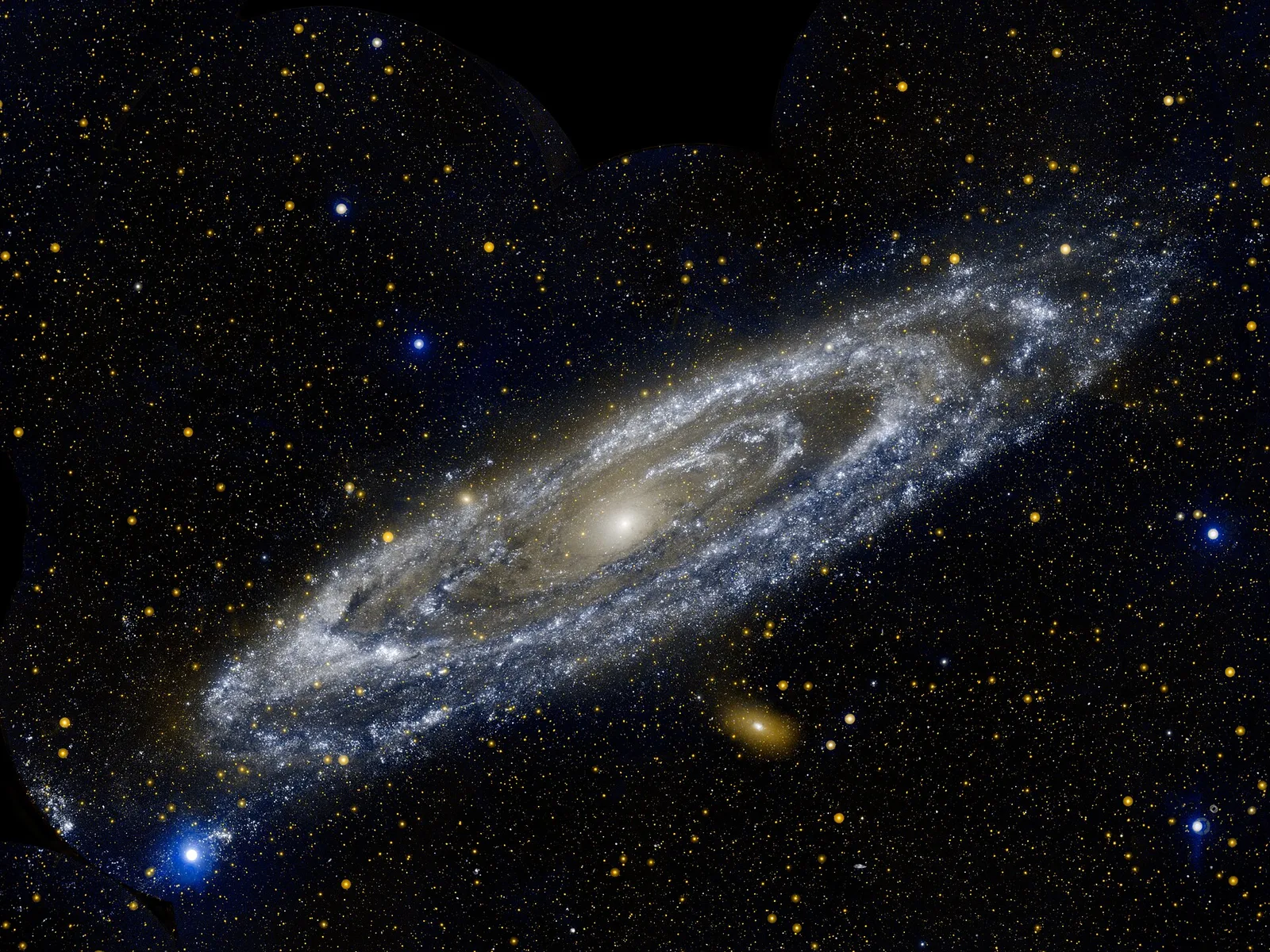
Because light takes time to travel, looking out is looking back. You see the Sun as it was about 8 minutes and 19 seconds ago, and the Andromeda Galaxy as it was 2.5 million years ago.
How it is worked out
Everything is multiplication by fixed numbers. Light travels at exactly 299,792.458 km every second, which is how the metre is defined. The International Astronomical Union fixes the light-year at that speed times 365.25 days, the astronomical unit at 149,597,870.7 km, and the parsec at 648,000 divided by pi astronomical units. A mile is exactly 1.609344 km.
The distances in the table come from NASA's fact sheets for the Moon, Mars and Jupiter, NASA's Hubble catalogue for Andromeda, and the European Space Agency's Gaia mission for Proxima Centauri. Mars and Jupiter are given at their closest and farthest, because the gap changes as they and Earth go round the Sun.
Further out
For a slower trip, our guide to how long it takes to get to the Moon compares real missions, from Apollo's few days to the 13 months ESA's SMART-1 probe took. The galaxy prints include Andromeda, a galaxy we see as it was 2.5 million years ago.
Written by Craig Fearn, Aphelion Prints. Last updated .