Travel time to the Moon depends on the mission and trajectory. Its distance from Earth changes through its orbit; the average distance is about 384,400 km.
NASA gives the distance: The Moon is an average of 238,855 miles (384,400 kilometers) away.
Average, because the orbit isn't a circle — the gap changes through the month. But roughly 384,400 km is the number to hold.
How long does it take to get to the moon by Apollo: three days, or four
This is where it gets interesting, because the two agencies that have done it do not quite agree.
NASA says: The approximately 250,000-mile journey from Earth to the moon took Apollo astronauts about three days.
ESA, describing the same flights, says: Previous missions, such as NASA’s Apollo flights, took about four days to get to the Moon.
Both are primary sources. Both are rounding a figure that varied between missions and depends on whether you count to lunar orbit, to landing, or to the moment the engines stopped pushing. We have not picked one, because there is no honest basis for doing so: the real answer is three to four days, and anyone quoting a single confident number is rounding somebody else’s rounding.
SMART-1: around 13 months to lunar orbit
ESA’s robotic SMART-1 mission tested solar-electric propulsion on a deliberately slow route to the Moon. Its ion engine applied a small thrust over a long period, gradually expanding the spacecraft’s orbit around Earth.
The recorded mission overview gives launch on 27 September 2003 and arrival in lunar orbit on 15 November 2004, describing the cruise as around 13 months. That endpoint is lunar orbit, not a landing.
Early mission pages described prospective schedules of 16 months or an arrival in March 2005. Those were forecasts, not the observed journey. The recorded arrival is the useful comparison with Apollo: different propulsion, route and mission requirements produce very different travel times.
Apollo 11, to the second
The whole mission, not only the outbound leg, is on record. NASA gives it as Duration: 8 days, 3 hours, 18 min, 35 seconds
— launch to splashdown, there and back, with a moonwalk in the middle.
Eight days for the round trip puts the three-to-four-day crossing in proportion: most of the mission was travel.
Why "average" distance is an average
The Moon’s orbit is an ellipse, so the gap changes through the month. NASA gives both ends: at its closest the Moon is about 226,000 miles (363,300 km) from Earth
, and at its furthest about 251,000 miles (405,500 km) from Earth
.
That is a swing of roughly 42,000 km. NASA gives Earth an equatorial diameter of 7,926 miles (12,756 kilometers)
, so the near and far points differ by more than three Earth widths. A mission planner does not get to use the average; they get whatever the Moon is doing on launch day.
What Artemis took
The crewed return has now flown. NASA records the Artemis II crew lifting off at 6:35 p.m. EDT on April 1 from launch pad 39B
, on what it describes as an approximately 10-day journey around the moon
, reaching a maximum of 252,760 miles from Earth. The page does not break out the outbound transit on its own, so we are not going to infer one from the total.
Apollo’s three days wasn't a technical maximum. It was the speed a crew and their consumables made necessary.
The distance you can see for yourself
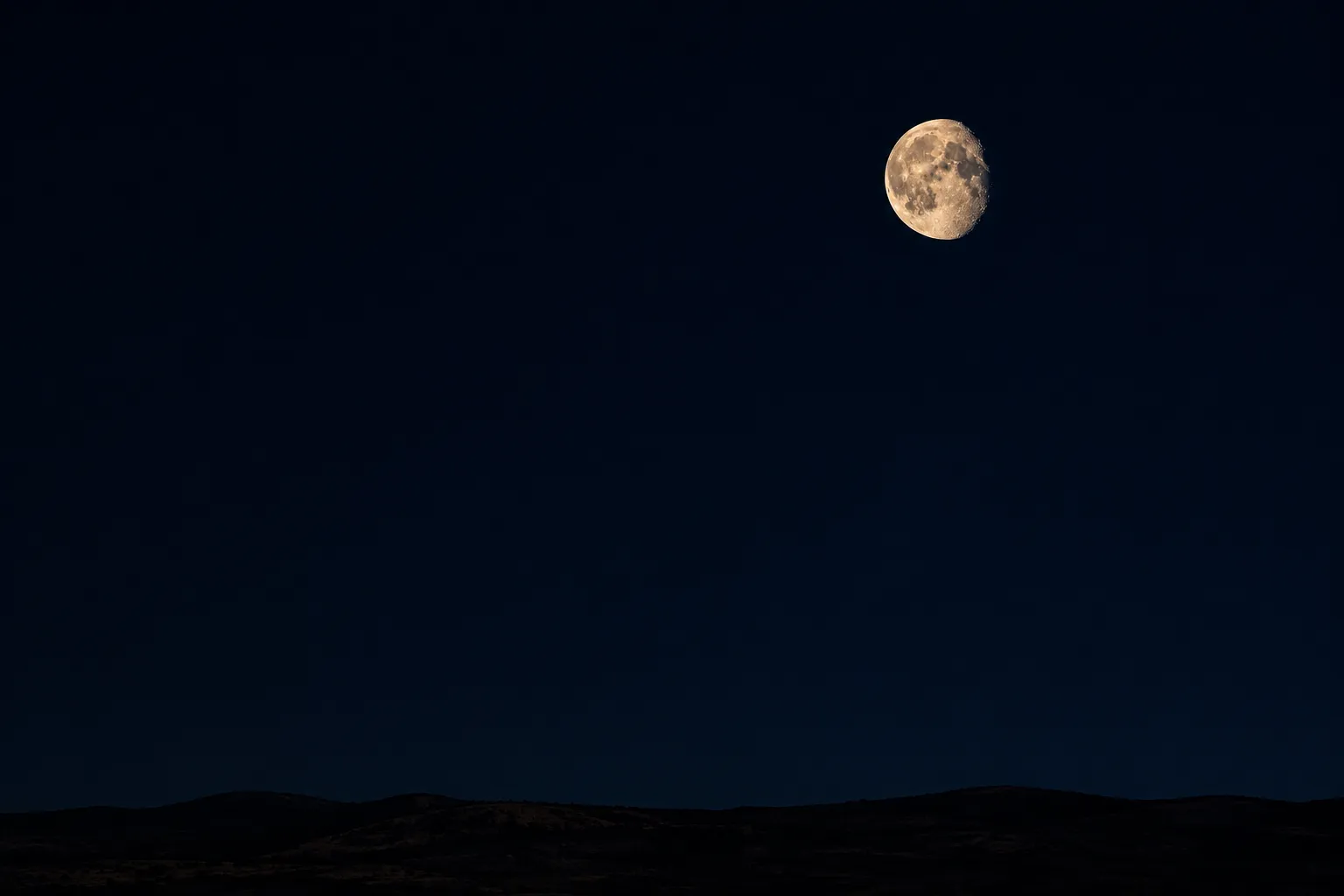
384,400 km is difficult to feel. Everything Apollo did happened between here and that small bright disc, and it took three to four days each way, depending on whose figure you take.
The Sea of Tranquility — NASA: the Eagle landed in the Sea of Tranquility in Site 2
— is one of the dark patches you can pick out with the naked eye on any clear full moon.
The Moon, on the wall
That landing site is the subject of our Visit the Moon travel plate, and the craft that got there appears in blueprint line in Apollo LM Blueprint. The wider moon art collection covers the rest. For what the Moon is doing tonight rather than how long it takes to reach, the phases explained is the place, and Looking up gathers the rest of the reading on the sky.