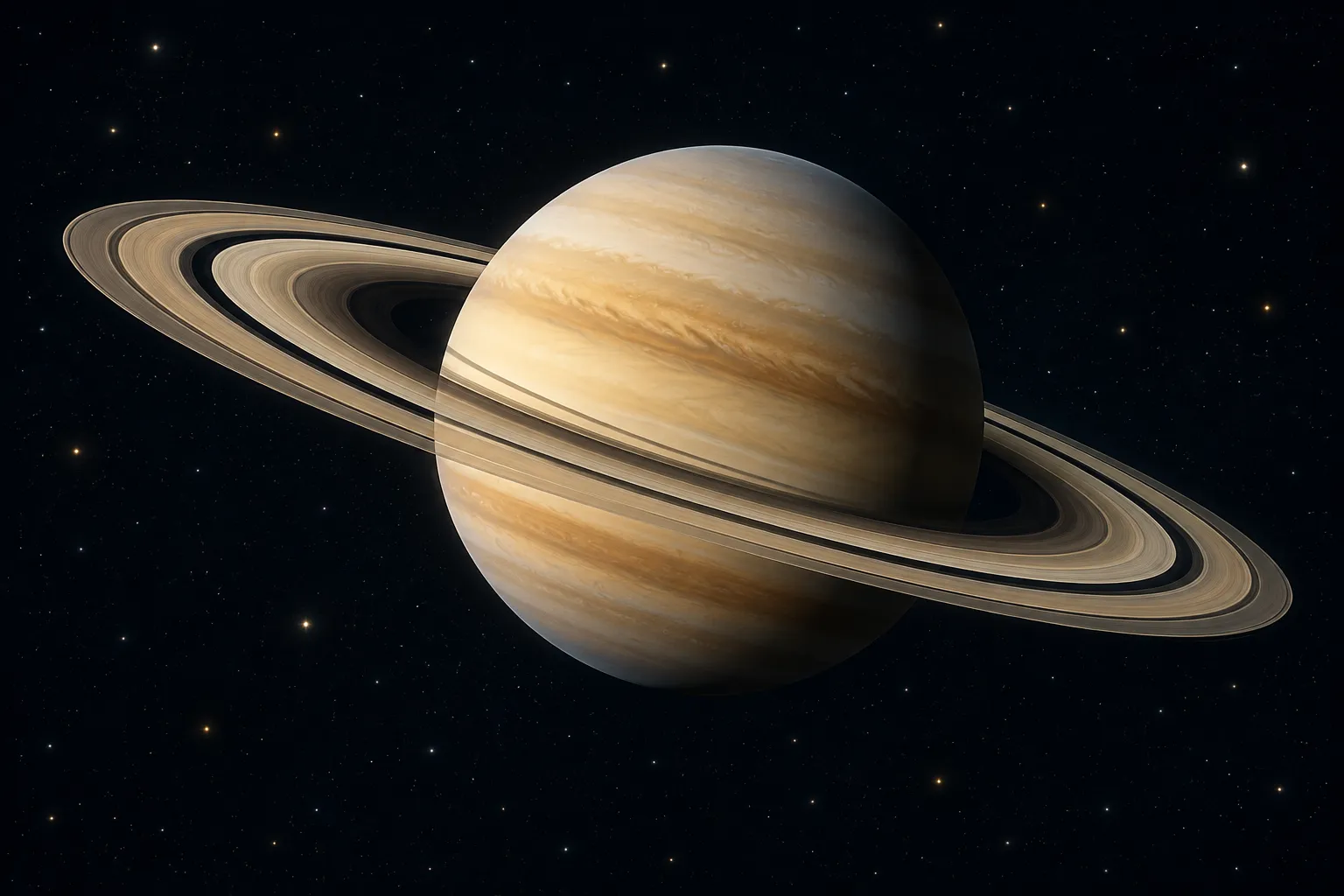
Ask which planet has rings and everyone says Saturn. The better answer is all four of the big ones: Jupiter, Saturn, Uranus and Neptune.
NASA: Although all four giant planets have ring systems, Saturn’s is by far the most massive and impressive.
Jupiter, Uranus and Neptune all have rings.
Does Uranus have rings?
Yes. Uranus has 13 known rings, as NASA Space Place explains. They are much less conspicuous than Saturn's: NASA's Uranus facts describes narrow, dark grey inner rings and faint outer rings.
What the rings are made of
NASA on Saturn’s: The particles in Saturn’s rings are composed primarily of water ice and range in size from microns to tens of meters.
So the rings aren't a solid sheet and not dust. They are countless separate lumps of ice, from specks to objects the size of a house, each on its own orbit, packed closely enough to look continuous from here.
How thin they are
This is the fact that does not fit in the head. NASA again: The main rings (A, B and C) are less than 100 meters (300 feet) thick in most places, compared to their radial extent of 62,120 kilometers (38,600 miles).
Sixty-two thousand kilometres across and under a hundred metres thick. Scaled to a sheet of A4 paper, the rings would be very substantially thinner than the paper. That is why they vanish entirely when Saturn presents them edge-on to us.
Where planet rings come from
There are two leading explanations and NASA gives both in one sentence: They may have formed from the breakup of one of Saturn’s moons or from a comet or meteor that was torn apart by Saturn’s gravity.
Both are versions of the same story. Get close enough to a giant planet and its gravity pulls harder on your near side than your far side. Past a certain distance that difference exceeds whatever holds the object together, and it comes apart. The debris cannot re-form into a moon that close in, so it spreads into a ring.
That is why rings sit close to their planet and moons sit further out. The boundary is not arbitrary; it's where being a moon stops being possible.
The Roche limit, which is where the line is
The boundary between being a moon and being a ring has a name and a definition. NASA describes it as the farthest orbit where a planet’s gravitational force is powerful enough to disintegrate larger bodies of rock or ice that get any closer
.
Inside that distance, a large body cannot hold itself together against the difference in pull across its own width. Outside it, it can. That single threshold is why rings hug their planets and moons keep their distance, and why the debris in a ring never clumps back into a moon: it is sitting in the one place where clumping is not allowed.
What Cassini was doing at the end
Most of what we know about the rings' mass came from a spacecraft deliberately flying where nothing had flown. NASA set out the purpose of those final orbits: The final dives will vastly improve our knowledge of how much material is in the rings, bringing us closer to understanding their origins.
Mass matters because it is the clock. JPL explains which way it reads: Lower mass points to a younger age, because the rings, which are bright and mostly made of ice, would have been contaminated and darkened by interplanetary debris over a longer period.
Cassini flew between the rings and the planet to weigh them, and then was destroyed in Saturn’s atmosphere on purpose. NASA gives the reason as an intentional plunge into the planet to ensure Saturn’s moons – particularly Enceladus, with its subsurface ocean and signs of hydrothermal activity – remain pristine for future exploration
.
Saturn is losing its rings
The rings are not permanent, and the timescale is shorter than you would guess. NASA: From this alone, the entire ring system will be gone in 300 million years, but… the rings have less than 100 million years to live.
Ice is drifting out of the rings and down into Saturn’s atmosphere as “ring rain”. On a solar-system clock, under 100 million years is brief — the rings may be younger than the dinosaurs — JPL dates their formation to between 10 million and 100 million years ago
— and will be gone long before the Sun finishes. We are looking at something temporary, which makes the timing of our looking rather lucky.
Seeing them from the UK
Saturn’s rings are within reach of a small telescope, and that first view is the one that converts people. Binoculars will not resolve them; they show Saturn as an oval rather than a disc, which is itself a clue — it's what Galileo saw before anyone understood what they were looking at. JPL quotes him on it in 1612: I do not know what to say in a case so surprising, so unlooked for and so novel.
Saturn on the wall
The planet and its rings are our Saturn plate, and the rest of the neighbourhood is in the solar system posters collection. For how far out Saturn sits, the planets in order has NASA’s distances in kilometres and AU.