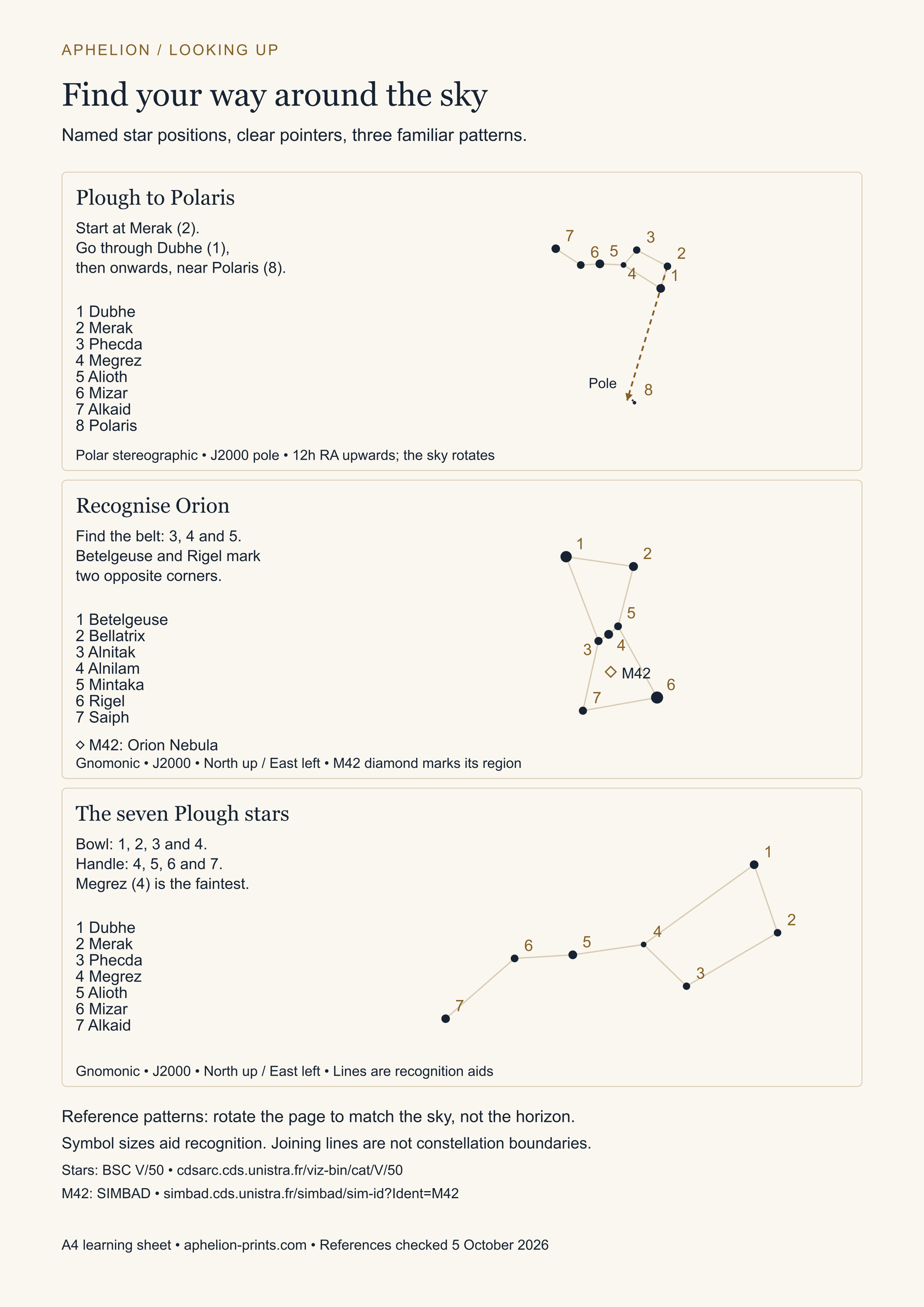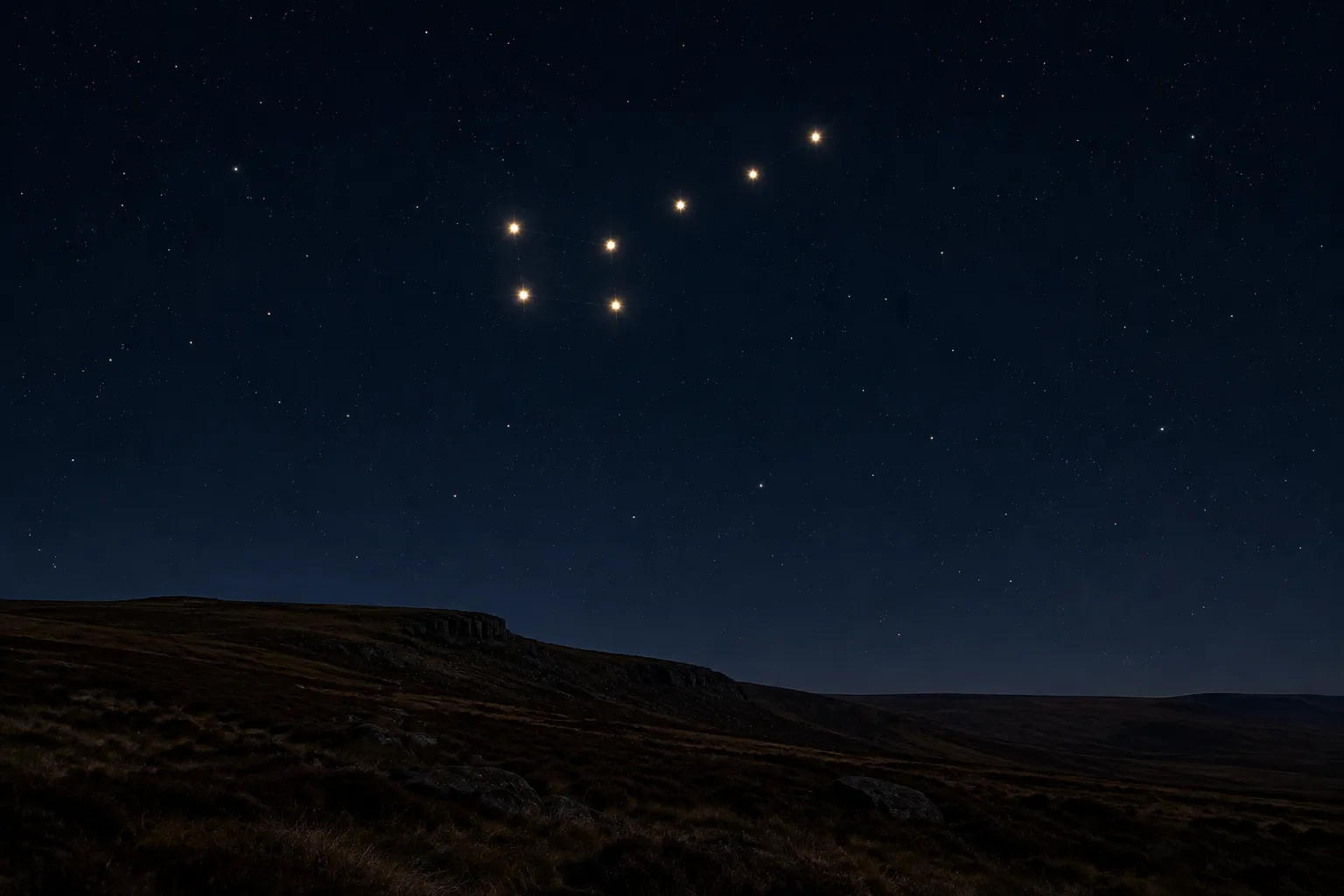
Illustration: the landscape above is decorative. The labelled chart below uses verified catalogue positions.
Ask anyone in Britain to name a constellation and a good number will say the Plough. It is the wrong answer, and the reason why is worth knowing.
The Plough is a pattern of seven familiar stars within Ursa Major. The pattern is an asterism; the constellation is the whole region around it. The Royal Observatory Greenwich explains that distinction.
Why the plough constellation is not a constellation
The distinction is not pedantry, because the modern definition of a constellation is not a pattern. The International Astronomical Union settled this a century ago: a constellation is a surveyed region of sky rather than a picture — the zodiac constellations guide quotes the IAU on that in full.
So a constellation is a patch of sky with surveyed edges, like a county. The Plough is a shape people notice inside one. Ursa Major is much larger than its seven famous stars and contains a great deal that nobody has ever joined up with lines.
Finding it from the UK, any night of the year
This is the Plough’s real advantage over Orion. Royal Museums Greenwich: it is circumpolar (meaning ‘around the pole’), so you’ll be able to see it all year
.
Circumpolar means it never sets from British latitudes — it wheels around the pole instead. Look north on any clear night and it is up there somewhere, standing on its handle or lying on its back depending on the hour. The shape is constant; only the angle changes, which is what throws people who have only ever seen it drawn one way up.
The pointer stars
The Plough’s main job is finding Polaris, and it does it with two stars. Royal Museums Greenwich: the two end stars of the pan, Dubhe and Merak, are the pointers — the north star guide quotes RMG on the method in full.
Those two are the outer edge of the pan, furthest from the handle. Start at Merak, go through Dubhe and extend that direction beyond Dubhe to the area near Polaris. It works from anywhere in Britain, at any time of year, and once learned it is impossible to unlearn.
From there, everything else in the northern sky is reachable: the north star is an almost stationary landmark close to the celestial pole.
Arc to Arcturus, spike to Spica
Royal Museums Greenwich describes the sweep and what is at the end of it: trace an arc eastwards to find the bright, orange star Arcturus in Boötes.
The pointer stars find north. The handle finds spring. The British Astronomical Association gives the old mnemonic in its own words: Following the arc of The Plough’s handle leads first to Arcturus and then on to Spica
.
Do not draw a straight line — follow the curve of the handle onwards and it lands on Arcturus, a distinctly orange star and one of the brightest in the northern sky. Keep the same curve going and you reach Spica in Virgo. Two constellations from one handle, and a reliable way to identify two bright stars that otherwise look like any other.
Never setting, from here
The BAA states the property that makes all this dependable: it describes the well-known constellation of Ursa Major, the Great Bear and its brightest part, better known as the Plough or Big Dipper, never sets
.
Never sets, from British latitudes. Every clear night of the year, whatever the season, it is somewhere in the northern sky. That is why it is the right place to start and the right thing to come back to when you are lost.
What the seven stars are called
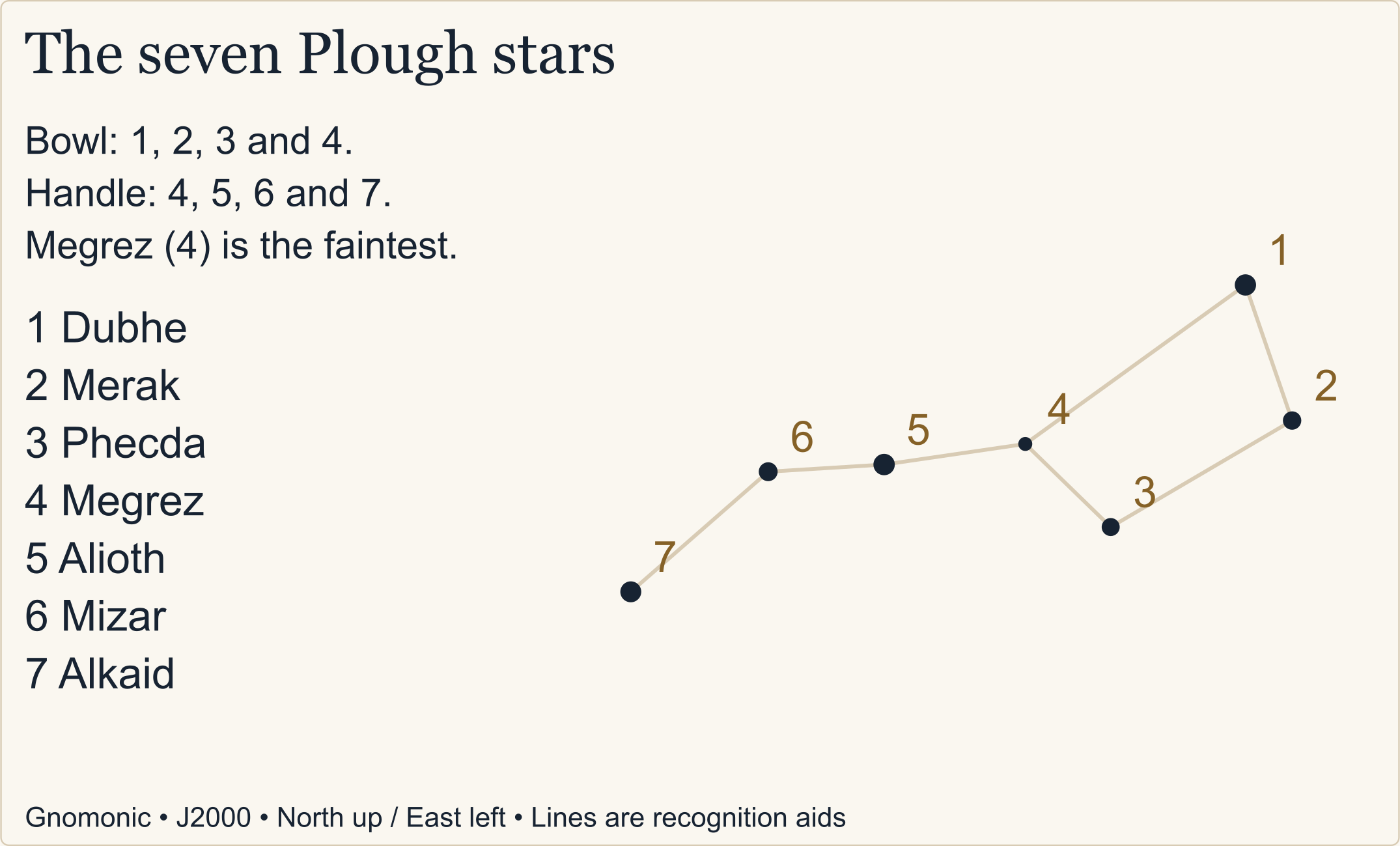
The numbered stars use named records from the Bright Star Catalogue, with fixed J2000 reference positions. Rotate the pattern to match the sky; it is a recognition chart rather than a prediction of tonight's horizon. Joining lines help you see the pattern and do not mark constellation boundaries.
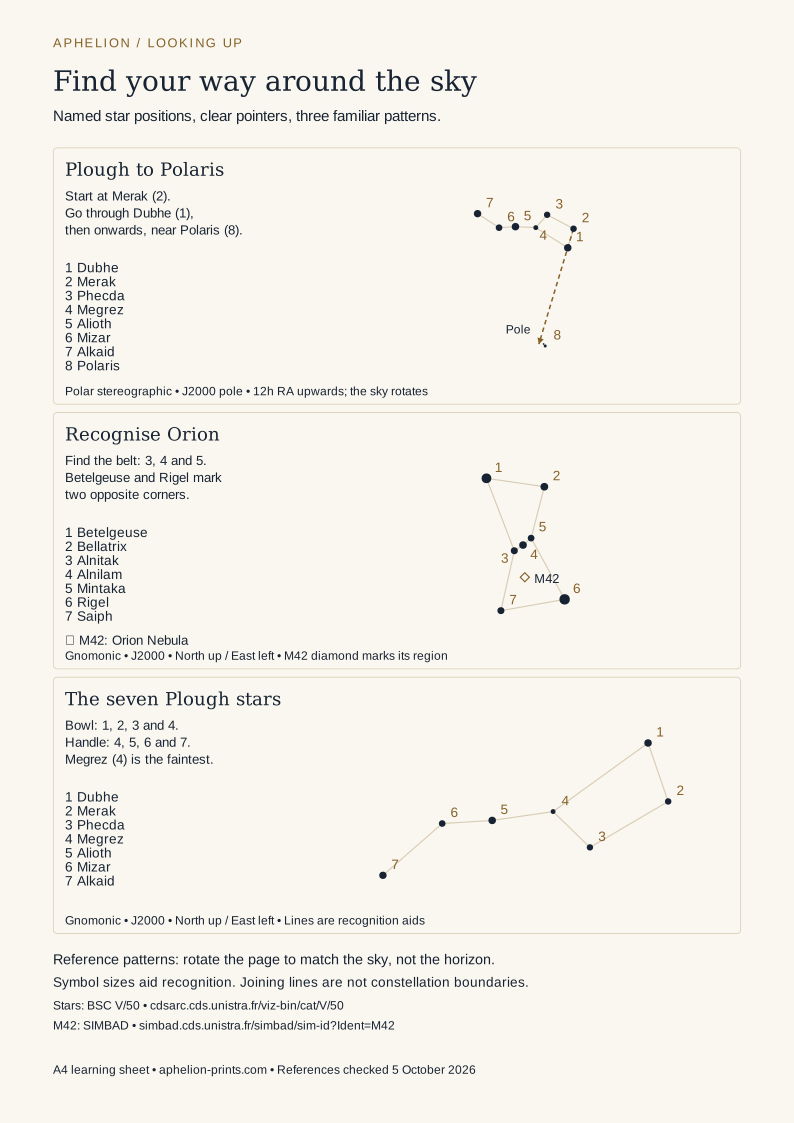
Download the free A4 northern-sky finder sheet: print PDF, 300dpi PNG or scalable SVG. Print the PDF at actual size on A4 paper.
All seven carry names, and they can be checked one designation at a time against SIMBAD, which lists the identifier each star is known by: Dubhe (Alpha Ursae Majoris), Merak (Beta), Phecda (Gamma), Megrez (Delta), Alioth (Epsilon), Mizar (Zeta) and Alkaid (Eta). Dubhe and Merak are the two that matter for the pointer trick.
Names, north, and the rest of the bear
The Plough is also called the Big Dipper in North America. Same seven stars, different local crockery. None of those names is a constellation either.
What they share is the useful property: seven bright stars in a distinctive shape that never sets from Britain, pointing permanently at north. There is no better place to start learning the sky, and no shape that repays five minutes more reliably.
The northern sky, drawn
Ursa Major and the other northern figures are charted together in our Northern Constellations plate. For a sky fixed to one particular night rather than the permanent patterns, the personalised star map plots the real positions for a date and place. And what a constellation is covers the IAU boundaries in full.