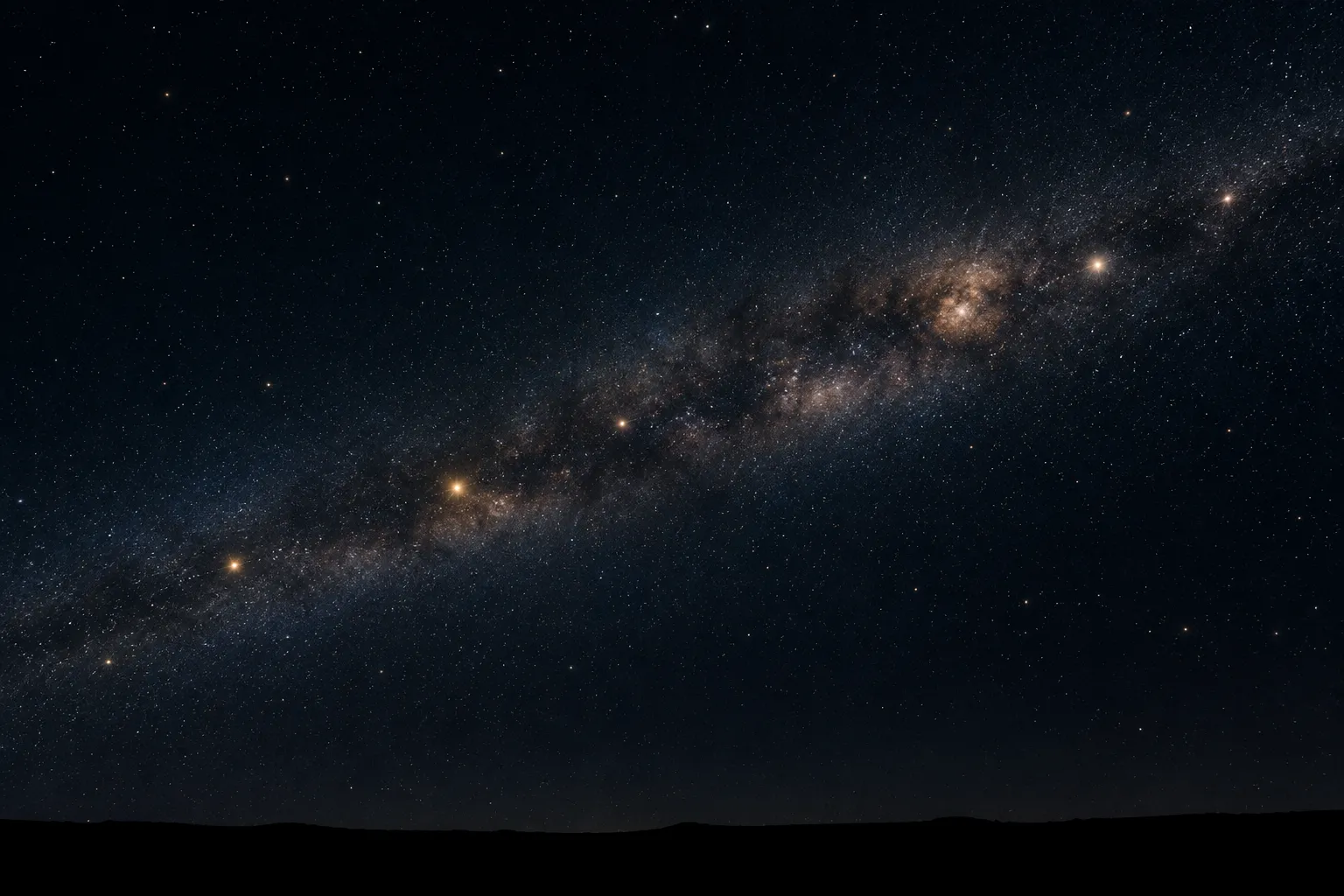
The zodiac constellations are the patterns lying along the ecliptic — the line the Sun traces through the sky over a year. They are ordinary constellations. What makes them the zodiac is only that the Sun, Moon and planets pass in front of them.
Two things about them are almost universally got wrong, and both are interesting.
A zodiac sign and a constellation are different things
An astrological sign is a named convention used by an astrological tradition. An astronomical constellation is a region with boundaries on the sky. Sharing a name does not make the two divisions identical: the Sun spends different lengths of time in the different sky regions, as NASA/JPL’s sky-map resource explains.
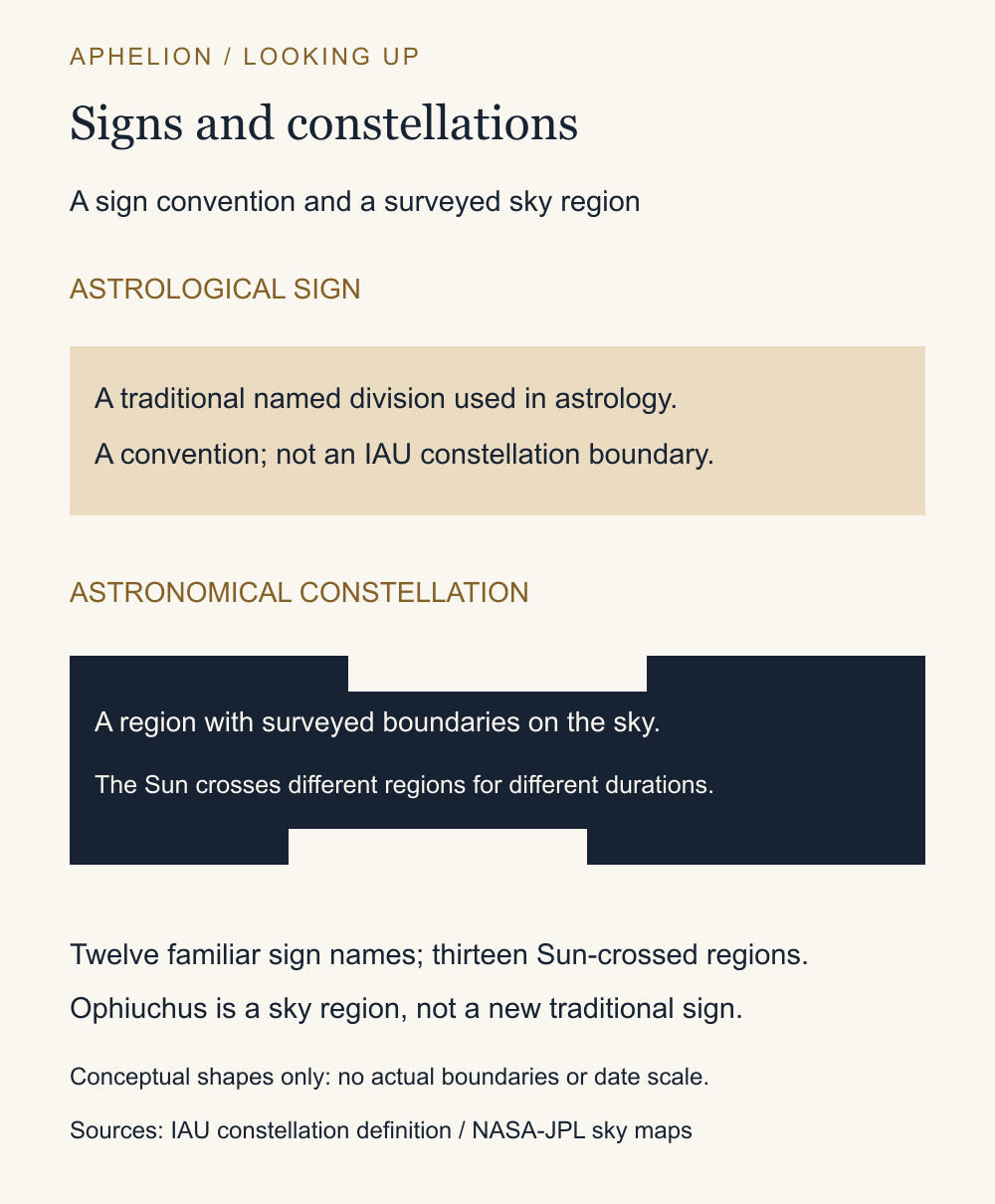
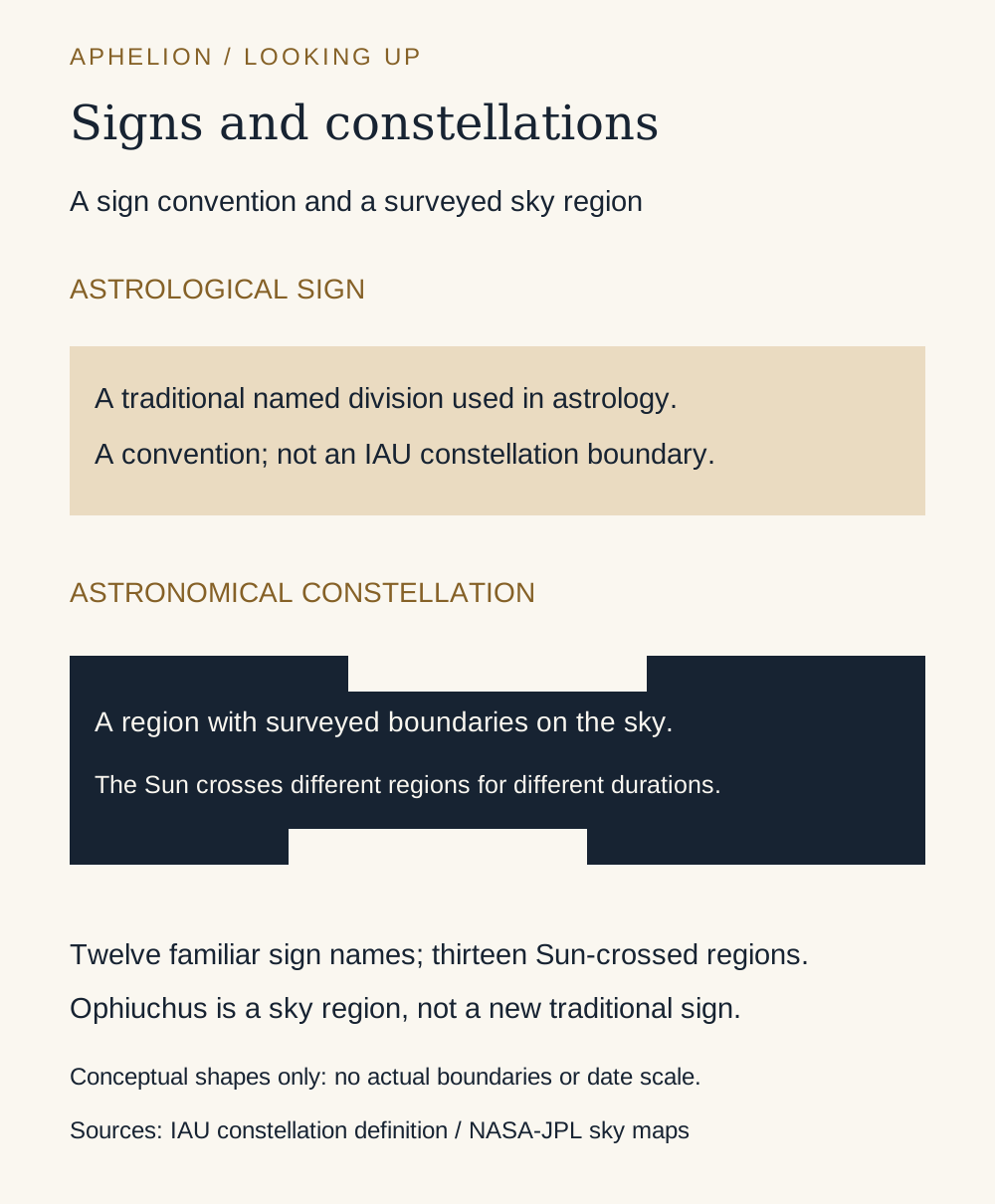
Ophiuchus is another region crossed by the Sun, not an announcement of a new traditional sign. Astronomy describes the sky; it does not change the conventions of an astrological tradition. The associations called fire, earth, air and water belong to those traditions, not to the physical composition of the constellation’s stars.
There are thirteen zodiac constellations, not twelve
The twelve-sign zodiac is a calendar decision rather than an astronomical one: the count was fixed at twelve to fit a twelve-month calendar, and NASA is blunt about the sky not agreeing.
Which constellation was dropped, why a twelve-month calendar made the decision for them, and what NASA says about the one they left out, is the subject of its own guide: Ophiuchus, the thirteenth.
The dates have drifted
The second problem is that the sky has moved since the dates were set. NASA: When the Babylonians first invented the 12 signs of zodiac, a birthday between about July 23 and August 22 meant being born under the constellation Leo.
That was then. Now, 3,000 years later, the sky has shifted because Earth’s axis (North Pole) doesn’t point in quite the same direction.
The mechanism is precession: a wobble in Earth’s axis that takes about 26,000 years to come round, and which also changes which star sits at the celestial pole. The north star guide quotes NASA on it in full.
So the sign dates and the constellations behind them no longer line up. In Western astrology the traditional dates are kept as a convention regardless — that is a matter for the tradition, and this page takes no view on it either way. What we can say is what the sky is doing, and the sky has moved.
What a constellation is now
Since 1922 a constellation has not been a join-the-dots picture. The International Astronomical Union’s first General Assembly agreed on a list of 88 constellations covering the entire sky, with three-letter abbreviations of their Latin names
, and later gave each one surveyed edges.
The consequence is precise: when astronomers say something is “in” a given constellation, they mean it sits within those defined boundaries, not that it is part of any star pattern. A constellation is a region of sky, like a county. That is why the Sun’s path can be stated exactly, and why it crosses thirteen of them rather than a debatable number.
The twelve, and when to see them
Each of the familiar twelve is a real pattern, visible from the UK at some point in the year. Because they sit along the ecliptic they are a southern-sky proposition from Britain, climbing highest in the south.
Brightest stars below are magnitudes from SIMBAD, the astronomical object database, rather than the usual assumption that a constellation’s alpha star is its brightest. For three of the twelve that assumption is wrong.
Taurus, the bull
Its brightest star is Aldebaran, the orange eye of the bull, at SIMBAD magnitude 0.86 — brighter than any other zodiac constellation’s leading star. The Royal Observatory puts the Pleiades cluster here in February: Located in the constellation Taurus, they are visible shortly after sunset
. Winter is its season.
Gemini, the twins
NASA notes that Pollux is the brighter of Gemini’s two ‘head’ stars
, with Castor beside it. February is the month: the Royal Observatory describes objects positioned between the two figures in the constellation of Gemini rising in the east
.
Cancer, the crab
The one where the alpha-star assumption fails: the brightest is Altarf, Beta Cancri, at SIMBAD magnitude 3.52 — Alpha Cancri is fainter at 4.25. Find it in March, when the Royal Observatory says The tip of the Spring Triangle will point you towards the constellation of Cancer
.
Leo, the lion
Regulus is the brightest, and the IAU confirms the brightest star in Leo (the Lion) is Alpha Leonis, also named Regulus
. The Royal Observatory gives the spring view: start by locating Regulus, the brilliant blue-white star that marks the heart of Leo, in the south-western sky
. April and May are its months.
Virgo, the maiden
Spica is its bright blue-white marker. The Royal Observatory uses it as a signpost: You can connect the stars Spica (within Virgo)... to find the small spring triangle.
Spring, in the south.
Scorpius, the scorpion
Antares is its marker: NASA calls it the orange-red star Antares, one of the brightest stars in the night sky
. From Britain it barely clears the horizon: the British Astronomical Association places it in June and July as Below them is Scorpius on the southern horizon.
A southern view and a low one.
Sagittarius, the archer
Another alpha-star trap: the brightest is Kaus Australis, Epsilon Sagittarii, SIMBAD magnitude 1.81, while Alpha Sagittarii (Rukbat) is only 3.94. Its recognisable shape is the Teapot, and the BAA locates it in summer: lying within the Teapot asterism of Sagittarius
.
Capricornus, the sea-goat
Deneb Algedi, Delta Capricorni, is magnitude 2.83 on SIMBAD. We are not calling it the brightest: only that star was checked, not every star in the constellation, and the difference matters. Late summer is the season — the Royal Observatory tracks an object that Through early August it crosses from Capricornus into Piscis Austrinus
.
Aquarius, the water-bearer
Sadalmelik, Alpha Aquarii, is SIMBAD magnitude 2.94. Aquarius is best known for what passes through it rather than its own stars: the Royal Observatory notes the Eta Aquariids are made of debris shed by Comet Halley ... the radiant point in Aquarius remains low in the pre-dawn sky
, peaking on 5–6 May. A pre-dawn, low-southern proposition from the UK.
Pisces, the fishes
Large, faint and hard. Alpherg, Eta Piscium, is SIMBAD magnitude 3.62; Alpha Piscium has no V-band value published there at all, so which is brighter cannot be stated. September is the month, when the Royal Observatory sends observers after Neptune with: Have a look in the constellation of Pisces to find it.
Aries and Libra: brightest star only
Two of the twelve get a row rather than a section, because their brightest star is documented and no astronomical authority we accept publishes a UK viewing month for them. The monthly sky notes from the BAA, the RAS, the Royal Observatory and NASA name both only in passing, when a planet happens to be crossing. Rather than invent a season, here is what is known.
| Constellation | Brightest star | SIMBAD V magnitude |
|---|---|---|
| Aries, the ram | Hamal (Alpha Arietis) | 2.01 |
| Libra, the scales | Zubeneschamali (Beta Librae) | 2.62 |
Libra is the third place the alpha-star guess fails: Alpha Librae is magnitude 2.75, fainter than the Beta star above it.
Astrology and astronomy, kept apart
In Western astrology the twelve signs carry traditional associations, and that tradition is thousands of years old and culturally serious. It is not a branch of astronomy, and nothing here treats it as one. What we offer is the other half: where those constellations are, which stars make them up, and when to look.
The twelve figures are engraved together, ringed around the ecliptic, in our Zodiac Constellations plate, and the wider constellation prints collection covers the rest of the sky. For the boundaries story in full, what a constellation is goes further.