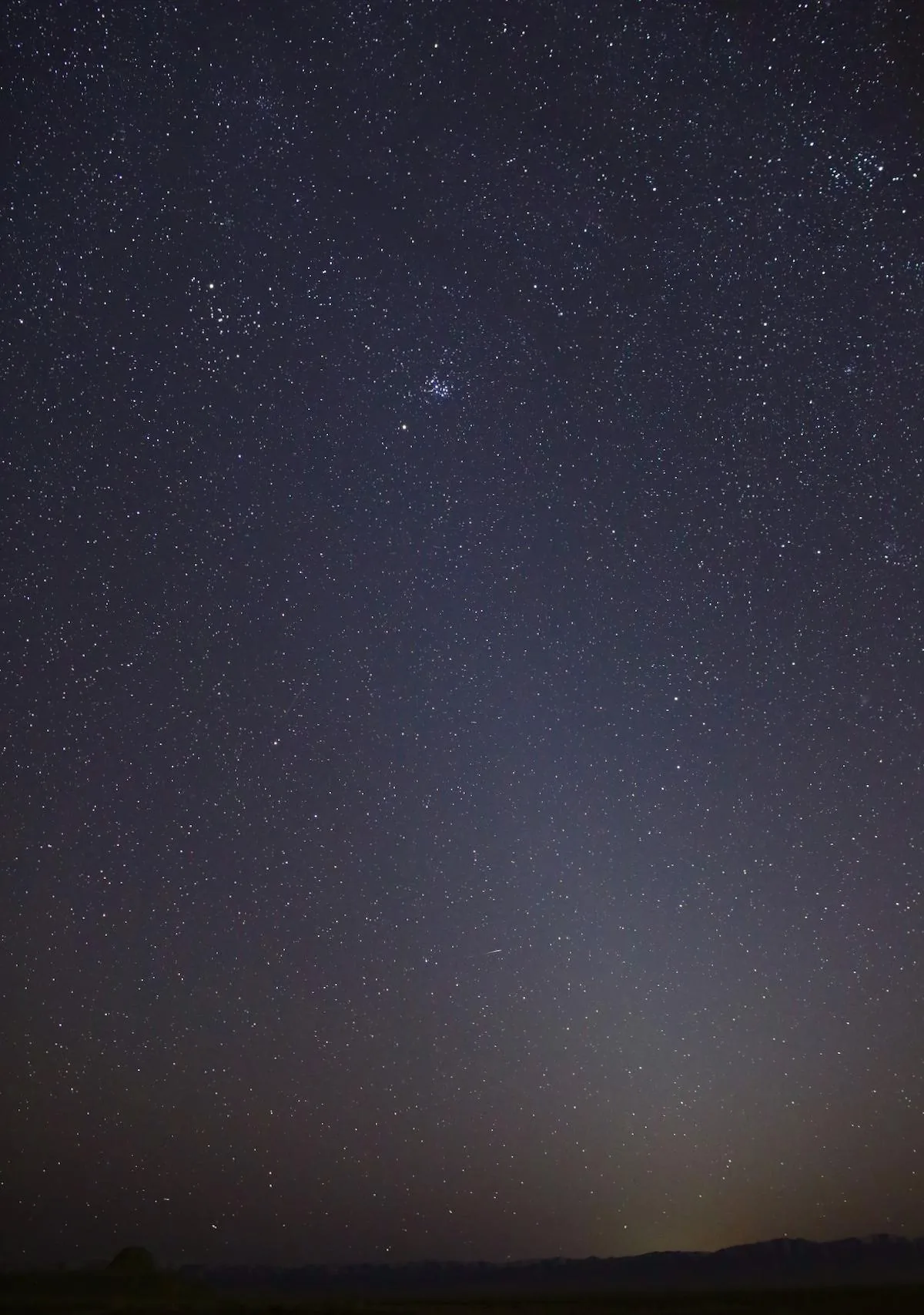
Every star is a ball of gas so massive that gravity pulls it into the most compact shape there is, a sphere. Even the largest telescopes see nearly all of them as points, because they are so far away.
Why stars look like points with spikes
Your eye isn't a perfect lens. Light from a point source spreads slightly as it passes through, and small flaws in the eye give bright stars short rays. Most people see four to six of them, and no two people see quite the same pattern.
Why stars twinkle
Starlight crosses a hundred kilometres or so of moving air before it reaches you, and pockets of warmer and cooler air bend it slightly differently. The star seems to shimmer and change colour, most of all near the horizon. Planets twinkle much less, because they show a tiny disc instead of a single point.
Why photographs show crosses and six-pointed stars
The spikes in telescope pictures are diffraction: light bending around the struts that hold the telescope's second mirror. Hubble's four struts give its stars four spikes. The James Webb Space Telescope gives six large spikes and two smaller ones, from its hexagonal mirror segments and its three struts.
What shape are stars that spin fast?
Fast-spinning stars bulge at the equator. Vega and Altair, two of the stars of the Summer Triangle, rotate so quickly that they are noticeably wider than they are tall. Old giant stars like Betelgeuse have lumpy, shifting surfaces as huge bubbles of gas rise and fall.
Where the five-pointed star comes from
The five-pointed star is a drawing convention thousands of years old, found on Egyptian tomb ceilings and many modern flags. No star looks like that. It is simply an easy shape to draw with straight lines, and it stuck.
For what happens inside them, the life cycle of a star follows a star from cloud to white dwarf, and star names covers the ones you can find from the UK. A personalised star map plots the real ones for a night you choose.