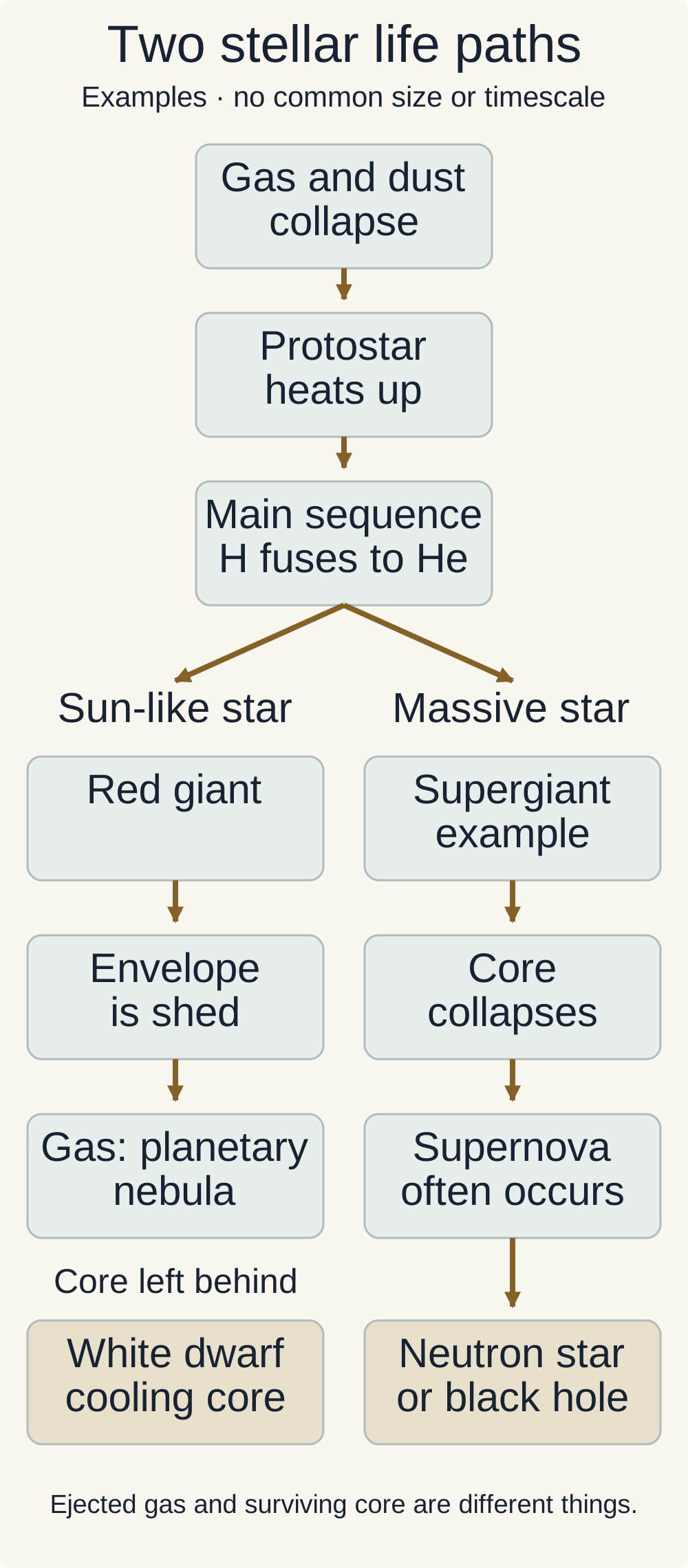
AI illustration of a stellar nursery. It is not a telescope photograph or a sequence of measured star sizes. The original diagram below explains two example paths.
The useful question is not simply “What comes next?” but “How much mass did this star start with?” A larger fuel supply does not automatically mean a longer life. More massive stars need to generate energy much faster to support themselves, so they can run through their fuel sooner. NASA’s overview of stars describes mass as the driver of this difference.
Is the Sun a star, and what are stars made of?
Yes. The Sun is our nearby example of a star, made mostly of hydrogen and helium. Its hot material is largely plasma: gas whose atoms have lost electrons. Hydrogen fusion in its core releases the energy that eventually reaches us as sunlight. It is not a solid ball or a fire burning with oxygen. NASA’s Sun facts explain its composition and place among other stars.
The Sun is about 4.6 billion years old and still in its long main-sequence phase. Looking at it gives us a nearby star to study; looking farther out lets astronomers compare stars of other masses and ages. A lifecycle diagram gathers those observations and models into a sequence. It is not a photograph of one star at every stage.
The shared beginning: cloud, protostar, main sequence
- Part of a gas cloud collapses. Gravity pulls together a dense region of a molecular cloud. The material contains dust as well as gas, and a cloud can form many stars rather than one isolated object.
- A protostar heats up. As material gathers and contracts, it becomes hotter and denser. At this stage much of its energy comes from gravitational contraction; it has not yet settled into the long period of stable core hydrogen fusion.
- Core hydrogen fusion sustains the main sequence. When the conditions are sufficient, hydrogen nuclei combine into helium and release energy. Pressure within the hot star supports it against gravity. The star spends a large part of its life in this phase, gradually changing rather than remaining perfectly fixed.
NASA’s Webb lifecycle explanation connects contracting protostars with the later balance between gravity and internal pressure. A cloud is a beginning, but a star’s initial mass is set by how much material it gathers; it is not determined by the apparent size of a painted nebula.
Two example paths, not one universal chain
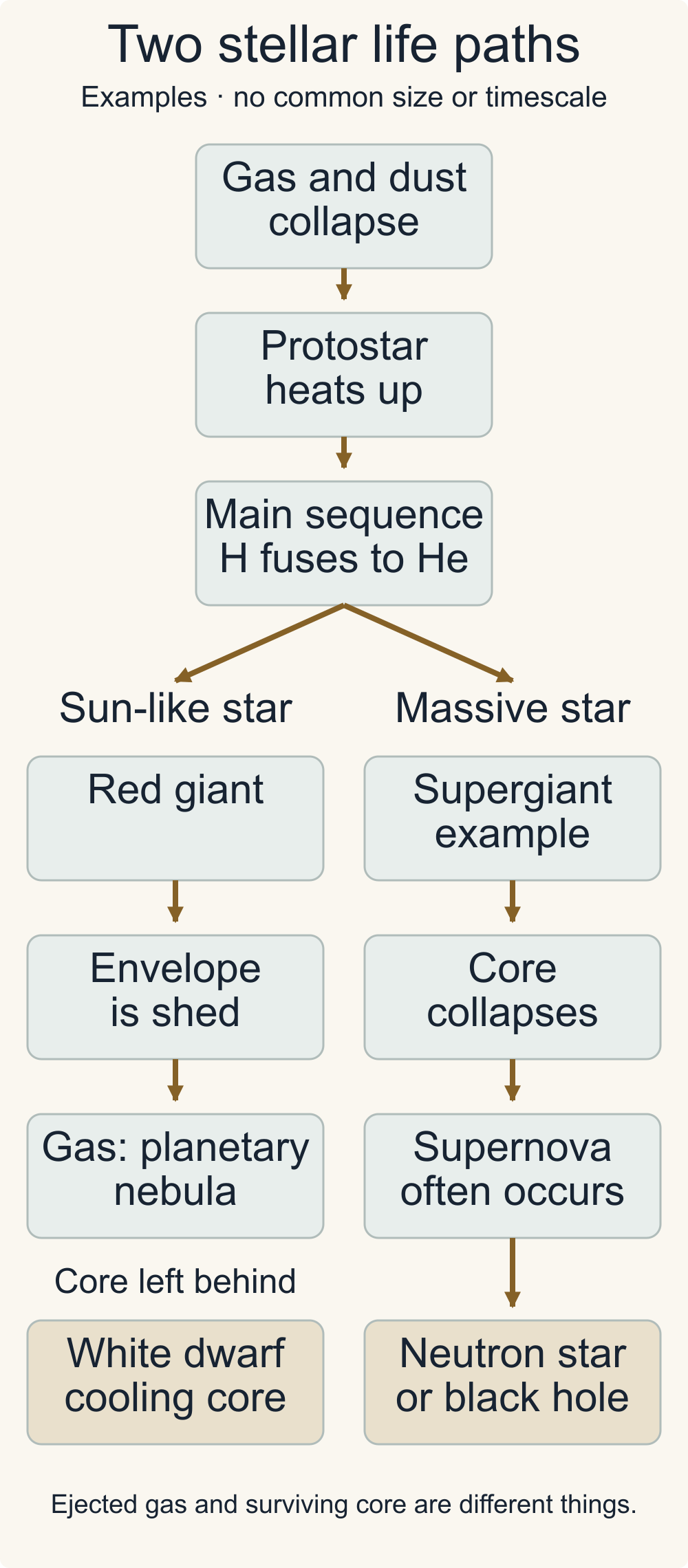
Open or download the scalable stellar lifecycle diagram. Read the shared beginning, then follow the column that matches the example. The final Sun-like boxes separate the shed gas from the remaining core; they are not two successive objects made from the same material.
A Sun-like example: red giant, shed envelope, white dwarf
When a Sun-like star uses up the hydrogen in its core, the main-sequence balance changes. The core contracts while the outer layers expand. Fusion can continue in a shell around the core, and later helium fusion contributes energy. The large, cooler outer surface is the red-giant stage; an exhausted core does not mean that all fusion everywhere has stopped at once.
Later the star loses its outer layers. The exposed hot core can illuminate that ejected gas as a planetary nebula. The name is historical: planets are not what the nebula is made from. The core itself remains as a white dwarf, supported in a very compact state and gradually cooling. It does not sustain ordinary core fusion like a main-sequence star.
This is the kind of ending expected for the Sun, rather than a core-collapse supernova. NASA describes the white-dwarf and red-giant stages alongside other types of star. The bright nebula is temporary; the compact cooling remnant lasts far longer. Read the nebula guide for the difference between a stellar nursery and gas around a dying star.
A massive-star example: heavier fuels and core collapse
A much more massive star can reach conditions that allow later fusion stages beyond the Sun-like path. Its interior becomes more complex as different fuels are used. In one familiar example the star becomes a supergiant and builds an iron-rich core. Fusing iron does not provide the supporting energy that earlier fusion reactions did.
When the core can no longer support itself, it collapses. A successful core-collapse supernova ejects material into the surroundings, while the central remnant may be a neutron star or a black hole. The expanding debris is a supernova remnant; it is different from the central compact object. ESO’s observations of a supernova aftermath connect stellar explosions with these remnants.
A neutron star is an extremely dense stellar remnant. Some rotating neutron stars are observed as pulsars when their radiation beams sweep past us. A stellar-mass black hole is a different outcome of collapse, with a region from which even light cannot escape. The two names are not stages that every remnant passes through in that order.
Why the diagram needs qualifications
Starting mass matters greatly, but it does not by itself supply a precise universal boundary between every ending. Mass lost in winds, interaction with a companion and the star’s composition can alter its later evolution. A simple diagram cannot encode all those histories.
Nor does every black-hole-forming collapse have to produce a bright, ordinary supernova. ESO’s study of VFTS 243 discusses evidence for a black hole whose progenitor may have collapsed without a previous powerful explosion. That is why the diagram says a supernova often occurs, rather than making one compulsory on the way to a black hole.
The smallest main-sequence stars are another limit of the two-column picture. Their future evolution differs from a Sun-like example, and some are expected to keep fusing hydrogen for trillions of years. The universe has not existed long enough for us to watch that full story. NASA’s red-dwarf explanation describes these long lifetimes. The diagram deliberately does not label the Sun-like column “all low-mass stars”.
How long does a star live?
There is no single stellar lifespan. A massive star may pass through its luminous life in millions of years; the Sun’s main-sequence phase lasts billions; some very small stars are expected to last much longer. The arrows in the figure show relationships, not equal blocks of elapsed time. The brief dramatic ending is not representative of how long a star spends in its stable phase.
Material returned to space can become part of later gas clouds, stars and planets. That connects this lifecycle to the star-birth and star-death sections of the nebula guide. If you want to recognise stars before thinking about their evolution, the star-name guide supplies familiar landmarks. Both kinds of reading sit in Looking up.