
The wolf moon is January’s full moon. The next one is full on Friday 22 January 2027 at 12:17pm GMT.
What is the January full moon called?
The Wolf Moon. In the words of Royal Museums Greenwich: Named after the howling of hungry wolves lamenting the scarcity of food in midwinter.
The name came to Britain through American almanacs. The older English name for the first full moon after Christmas was the Moon after Yule.
Watching the wolf moon from the UK
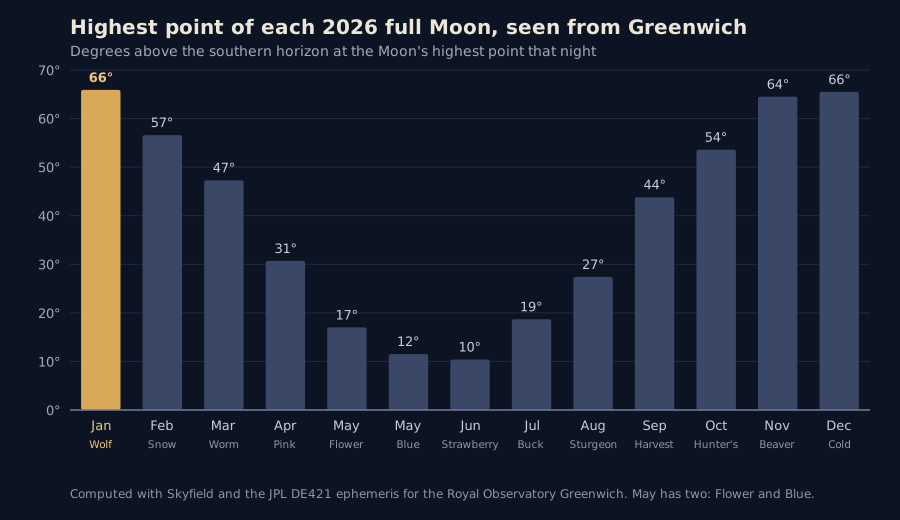
January full moons ride high across a UK sky, because a full moon sits opposite the Sun and the Sun is at its lowest. High up means less atmosphere to look through, so it reads hard and bright, not soft and orange.
Early January is the darkest stretch of the British year, which helps: sunset before four in the afternoon means a full moon is up and obvious by teatime. It also means cloud, and January is not a generous month for it. If the sky does clear, a high full moon washes out most of the fainter stars around it, so this is a night for looking at the Moon itself.

How high the wolf moon climbs
From Greenwich on the night of 22 to 23 January 2027, 2 of 2027’s full moons climb higher than the wolf moon and 9 stay lower.
| Wolf Moon rises | 4:35pm, north-east |
|---|---|
| Wolf Moon at its highest | 12:42am, 57° up, due south |
| Wolf Moon sets | 8:26am, north-west |
| Time above the horizon | 16 hours for the Wolf Moon |
| Sun at 12:42am | 58° below the horizon |
Also in the January sky
The Quadrantid meteor shower peaks in the first days of January, usually on the 3rd or 4th, and a bright moon near the peak drowns most of it. Orion is well up in the south-east by mid-evening, the easiest winter constellation to start from.
For January’s meteor dates and how much the Moon gets in the way, see UK meteor showers and the Moon.
What people get wrong about the wolf moon
That it is the year's first full moon in any meaningful sense. It is first on our calendar, which is a human artefact; the lunar cycle pays it no attention. In some years January catches two full moons and in 2018 it caught two with a blue moon among them, which shifted every name after it.
Wolf Moon dates, London time
- 2026: Saturday 3 January 2026 at 10:03am (GMT)
- 2027: Friday 22 January 2027 at 12:17pm (GMT)
The 2026 wolf moon time is from NASA and the Royal Observatory; 2027 is NASA only until the Observatory publishes.
In 2027 the wolf moon falls on Friday 22 January 2027. Why named full moons drift.

The wolf moon in the sequence
In 2026 the wolf moon is the first of 13 full moons. The Snow Moon follows it on Sunday 1 February 2026. On the nights either side of the wolf moon the Moon isn’t quite full: it’s a waxing, then a waning, gibbous, and the eight phases of the Moon explains both.
Any moon print can be checked the same way, wolf moon or not: how to tell an accurate moon phase print.
Written by Craig Fearn, Aphelion Prints. Last updated .
