AI illustration: a stargazer preparing at dusk. The labelled finder below uses catalogue star positions.
The Summer Triangle is an asterism, a recognisable star pattern, rather than a constellation of its own. Its corners are Vega in Lyra, Deneb in Cygnus and Altair in Aquila. They are far apart across the sky, so look for a large shape rather than three neighbouring pinpoints. NASA’s Summer Triangle guide uses the same three landmarks.
Start with the three bright corners
You can recognise the triangle without a telescope. Choose a clear view away from nearby lamps and give your eyes time to adjust. The bright corners are easier than the faint constellation lines or the Milky Way, so a washed-out sky can still let you begin.
- Find Vega first. It is the brightest of these three stars. On late-summer evenings it is high in the British sky, but its exact direction changes with the hour. Use the dated chart below as a worked example, or set your own location and time in a sky viewer.
- Find Deneb across a broad stretch of sky. It lies at one end of Cygnus’s cross-like pattern. It is less conspicuous than Vega, but much brighter than many of the surrounding points.
- Look lower for Altair. In the example shown here it is nearly due south, below the other two. Two fainter stars closely flank it; that small arrangement helps distinguish it from an unrelated bright object.
Join those three corners in your mind. The triangle has unequal sides; it is not an equilateral symbol. Do not require it to stand upright. The pattern turns as the sky moves and as you turn to face a different direction.
A UK finder for one stated evening
This example is calculated for Greenwich, London, on 1 September 2026 at 22:00 BST, which is 21:00 UTC. Face south and look well above the horizon. Vega is high to the right, Deneb higher to the left, and Altair below them. Those left/right positions describe this particular view, not every evening in Britain.
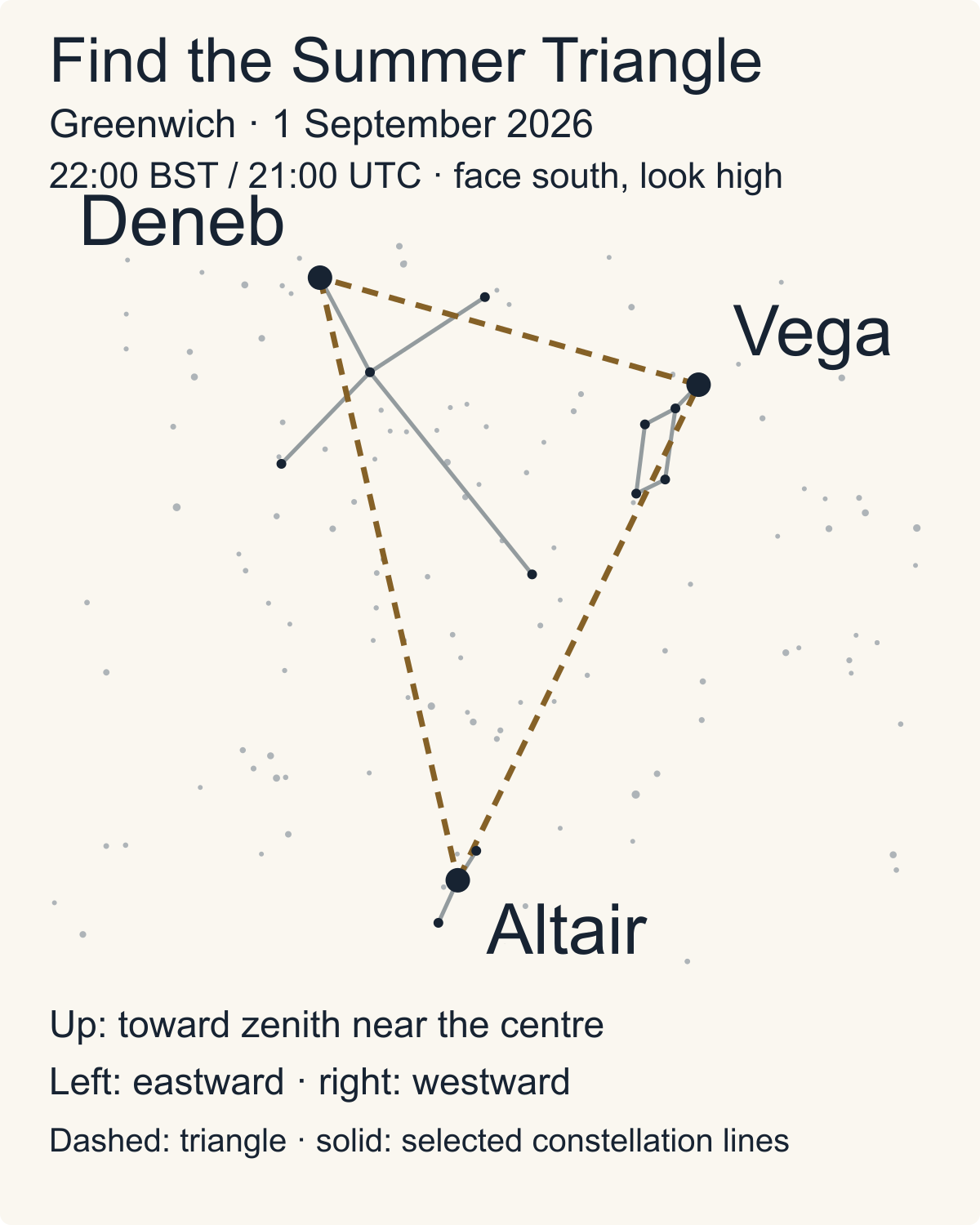
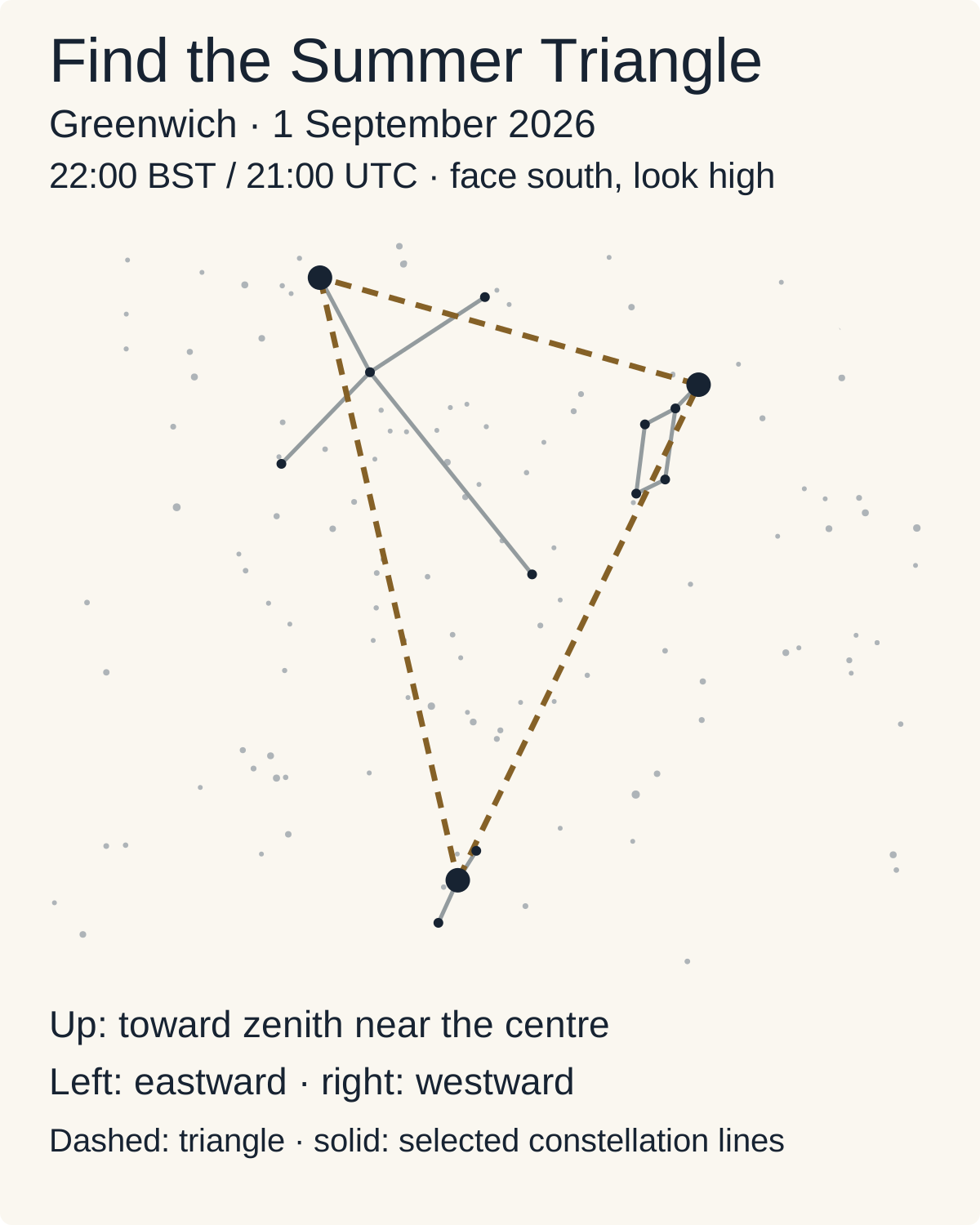
Open or download the scalable finder chart for a larger view. The three named corners are the starting points; the faint stars and small Lyra pattern may need a darker sky. Marker sizes suggest which stars to notice, rather than predicting their brightness under your observing conditions.
The positions come from named records in the Bright Star Catalogue, rotated to the stated place and time with Earth’s precession and nutation accounted for. Proper motion, atmospheric refraction and obstructions are omitted. It is an approximate visual finder, not a precision pointing chart. For another evening, set the actual date, local time and location in Stellarium Web.
From the triangle to three constellations
Lyra: the small pattern beside Vega
Lyra is the Lyre. Vega is its conspicuous anchor; the rest is much smaller and fainter. Find the little parallelogram beside it. Our solid lines link Zeta-1, Beta, Gamma and Delta-2 Lyrae, with a short connection toward Vega. You may see Vega easily while the small shape disappears into light pollution. That is a visibility limit, not a reason to move the stars farther apart on the chart.
Cygnus: follow the long cross from Deneb
Cygnus is the Swan. Its familiar Northern Cross gives you a second way to check Deneb: trace the long line inward through the middle star, Gamma Cygni, then onward toward Beta Cygni. The shorter arms cross that line. In a swan interpretation Deneb marks the tail and Beta Cygni the head; the drawn cross is just one way of recognising the same stars.
Aquila: Altair and its two neighbours
Aquila is the Eagle. Begin with the short line of Gamma Aquilae, Altair and Beta Aquilae rather than trying to see a complete bird immediately. NASA’s Altair guide explains its place in Aquila. The finder shows selected connecting lines, not every star or the full extent of that constellation.
When to look from Britain
Late summer and early autumn offer a useful combination: the triangle is high on an evening sky and darkness arrives earlier than it does around midsummer. In June and July, especially farther north, bright twilight can hide the fainter patterns long after sunset. Seeing the three main stars and seeing the Milky Way are different tests of the same night.
At the same clock time on successive autumn dates, the pattern is generally farther round toward the west; within one night it also moves as Earth rotates. It remains useful after the season in its name has ended. By winter the early-evening view is lower toward the west, and a building or hill may hide Altair first. A planet or a bright moving satellite can be an extra distraction, so check the arrangement of all three corners rather than one bright point.
For the worked Greenwich example, Vega is about 73° above the horizon, Deneb about 79° and Altair about 47°. The numbers explain why looking only along the horizon misses this pattern. They are rounded geometric altitudes for the stated moment; another location or hour gives another view.
What to read after you find it
If the star pattern and the official sky region still sound like the same thing, read what a constellation is. Star names and their meanings explains the names you have just learned. For a different first landmark, the Plough-to-Polaris finder helps with approximate north.
If you want to keep a chart of a particular night, the personalised star map calculates a separate view for your chosen date and place. The free observing guides remain together in Looking up.