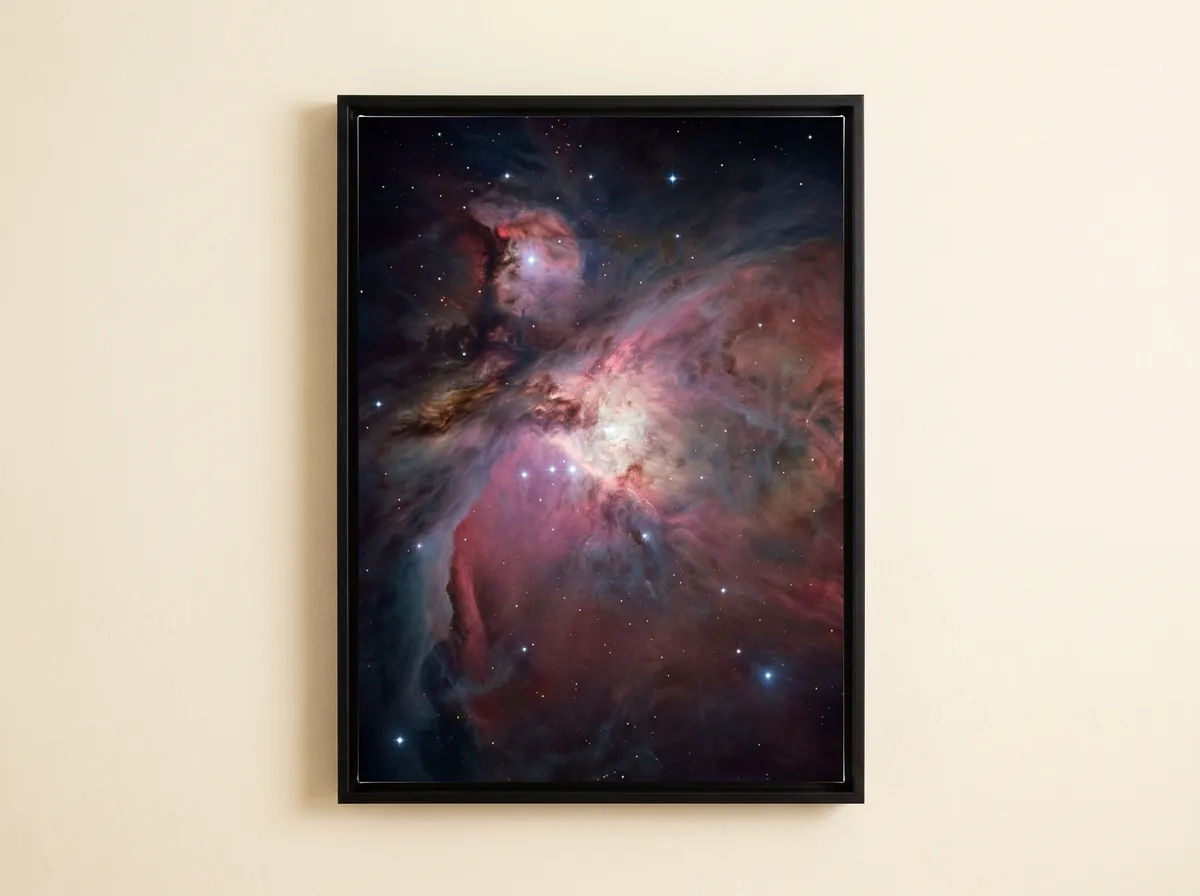
An unframed canvas is stretched over a wooden bar; the sides carry a soft, blurred band taken from the picture's colours, and it hangs as an object with no border between picture and wall. That casual, gallery-studio look suits contemporary rooms and imagery that benefits from having no hard stop, particularly deep-space fields, whose dark colours carry into the blurred sides. It also hangs straight from the box: there's nothing to fit.
A frame does the opposite job: it draws a line around the image and separates it from the wall, which reads as more considered and holds its own in a room with mouldings, panelling or other framed work. It costs more and adds weight. The room decides, not the picture. If you're weighing up the finishes in general, our framed prints and canvas prints sit side by side, and the fuller comparison including paper is in canvas vs framed print vs poster.
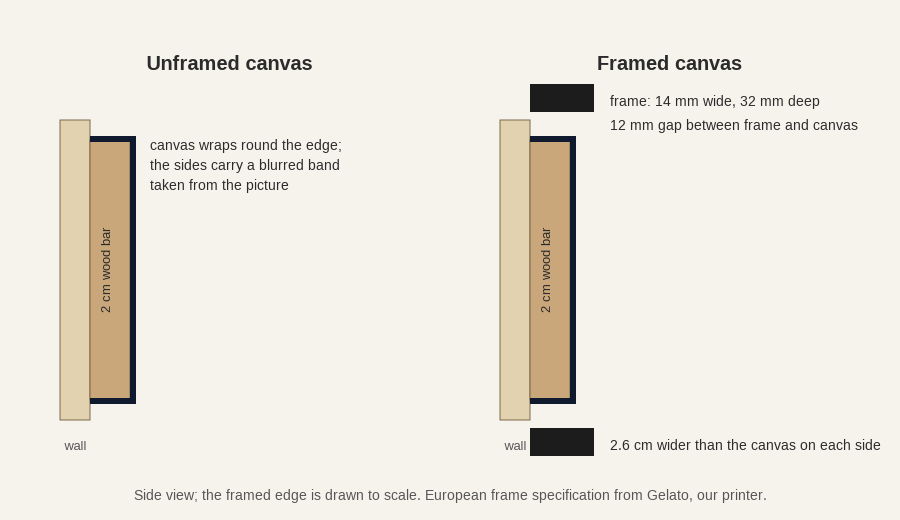
What the two finishes are made of
Our unframed canvas is stretched over a 2cm wooden bar, so it stands 2cm proud of the wall. There are two framed versions. A framed canvas sits in a slim frame. A float frame leaves a gap all round the canvas. The shadow in that gap is what makes a float frame look deliberate, and it is why the frame suits a dark deep-space picture: the image appears to sit in front of the wall rather than on it.
What a frame adds to the price
A frame costs the same in every colour: black, white, natural or brown. The float frame costs a little more.
| Size | Framed canvas | Float frame |
|---|---|---|
| 30 x 41cm | £79.00 | £89.00 |
| 41 x 51cm | £99.00 | £109.00 |
| 51 x 71cm | £119.00 | £149.00 |
The largest canvas, 60 x 80cm, comes unframed only, so for the widest wall the choice is already made. A framed canvas comes without fixings for the wall, so have a picture hook ready.
Finish questions belong to On the wall, where what DPI a photo needs covers the one thing no finish can rescue.
Written by Craig Fearn, Aphelion Prints. Last updated .