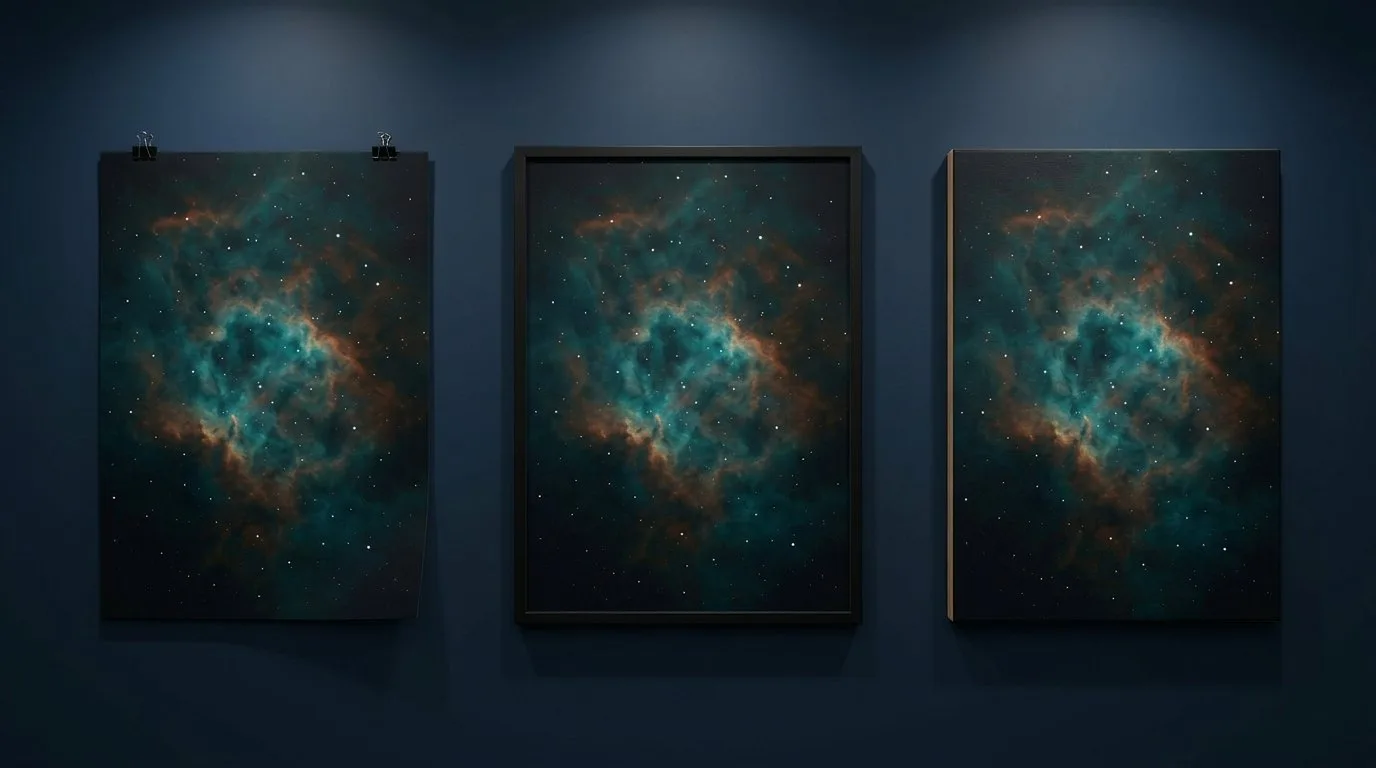
Same image, three very different objects. A poster, a framed print and a canvas of the exact same artwork will hang differently, last differently and cost differently: and the right pick depends less on the picture than on the wall, the budget and whether it's a gift.
Choose a poster if price matters and you might frame it yourself later; a framed print if you want it crisp, protected and ready to hang straight out of the box; and a canvas if you want a large, glare-free piece with real presence. The rest of this page is the reasoning behind those three.
Posters: the lightest, keenest choice
A poster is only the print itself (no frame, no glass) which makes it the cheapest way onto a wall and the easiest to post and store. The thing that separates a good art poster from a cheap one is the paper. Hahnemühle, a German fine-art paper mill founded in 1584, classes anything above 300 g/m² as high-weight and runs those stocks for large reproductions. Lighter sheets are thinner and less rigid; our posters print on 250 gsm uncoated paper.
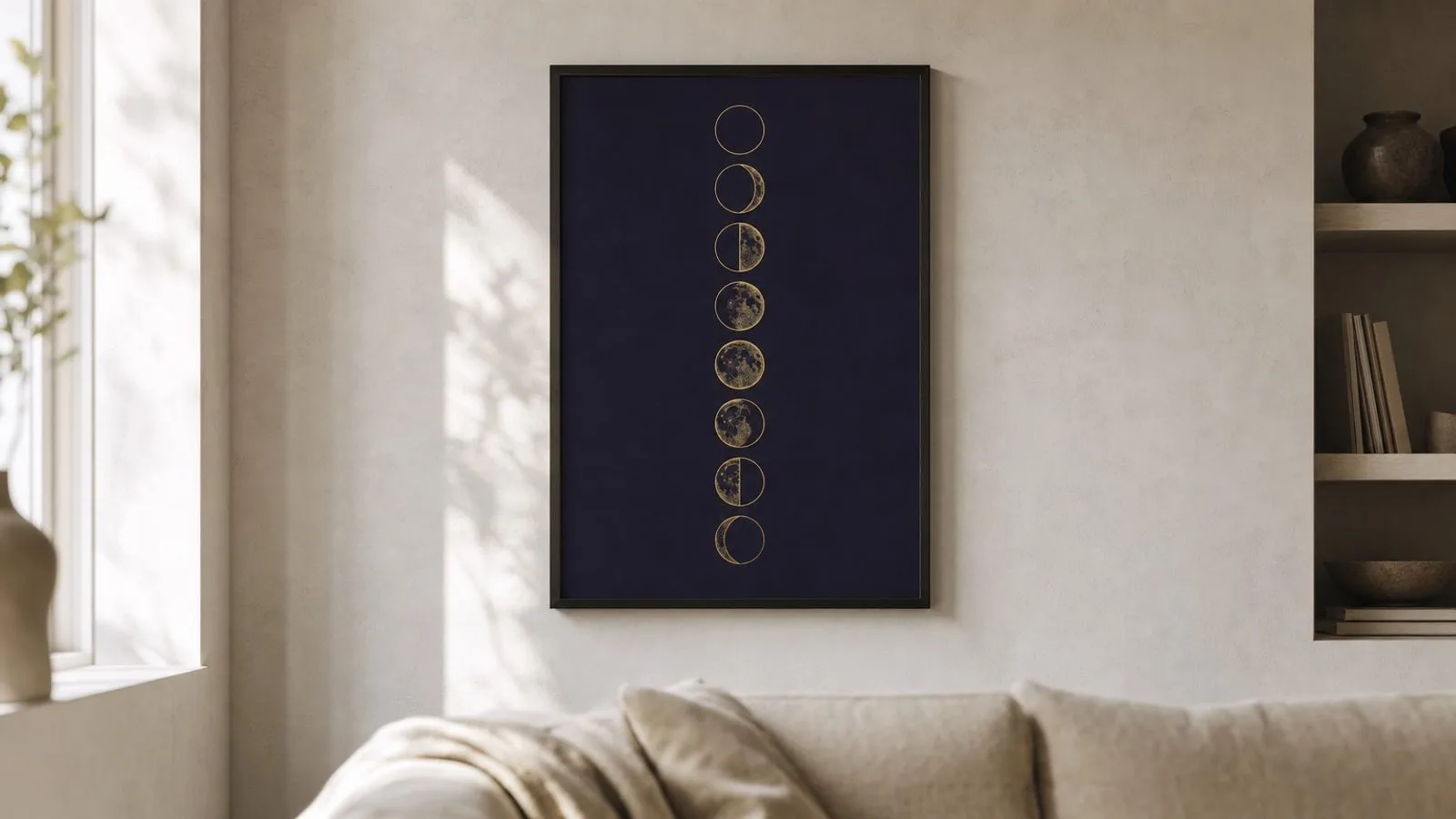
Posters are the natural starting point, and they keep their options open: you can frame one any time, swap it cheaply, or move it room to room. The trade-off is that, unframed, the paper is exposed: so a poster wants a little more care than a piece behind glass.
Framed prints: crisp, protected, ready to hang
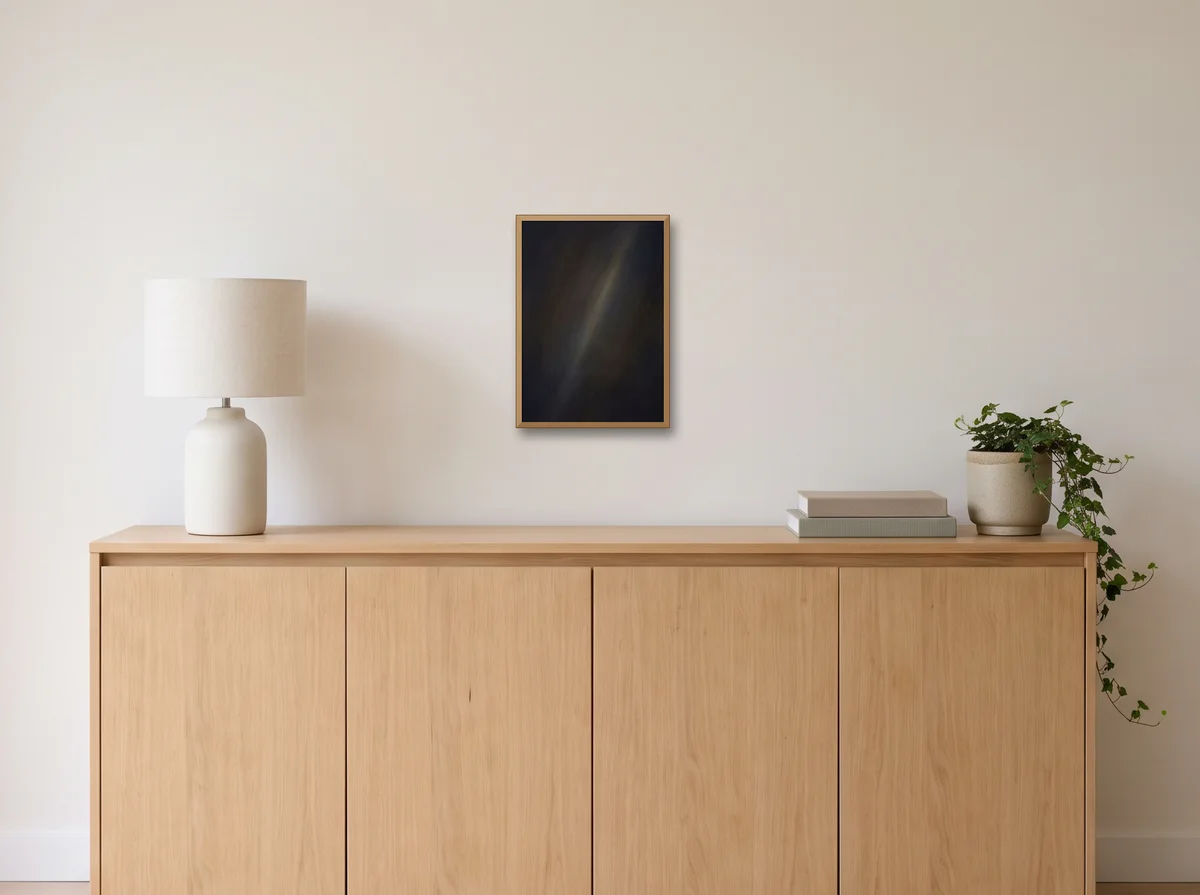
A framed print is the same paper, set behind glazing in a moulding and ready to hang the moment it arrives. That's its real appeal as a gift, there's nothing left to do. The glazing also protects the print: the US National Archives warns that exposure to all light, visible and ultraviolet, can cause fading and darkening, and tells you to pick glazing with ultraviolet filtering for anything hung in sunlight or under fluorescent light, with a window mat or spacers so the glazing never touches the surface.
The catch is glare. Any glazing reflects some light, so a framed print can mirror a bright window; ours is plexiglass, not glass, which is lighter, will not shatter in the post and is what the frames ship with as standard. Frames also add weight. For a deep, dark astronomy image, a frame in black or natural wood looks superb: hang it where it won't fight a window.
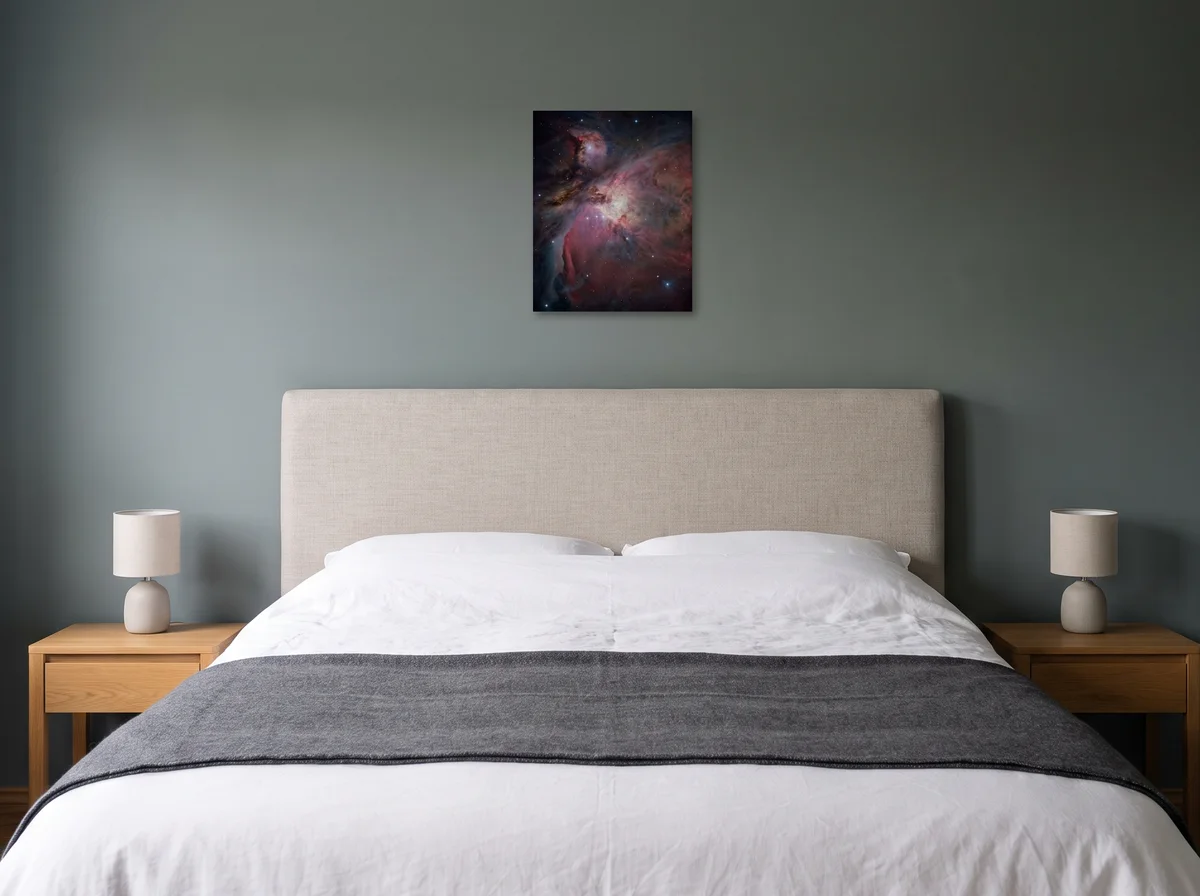
Canvas: depth, presence and no glare
Canvas is the odd one out, and often the right one for big atmospheric images. It's a heavyweight cotton-polyester weave, printed and stretched over a wooden frame, shown without any glass. Because the surface is matte and textured, it scatters light instead of bouncing it back, so there's no glare and it reads well from any angle, including opposite a window. That texture is also why canvas flatters a picture you see from across a room more than one you study up close.
For astronomy art this matters more than usual. The near-black grounds of a nebula or a black hole look richest without the cold sheen of glass on top, and the weave gives those darks a velvety depth. Canvas is the format we'd reach for on a large, moody piece: and it's why we offer the whole catalogue on canvas, as well as your own photo.
How long will a print last?
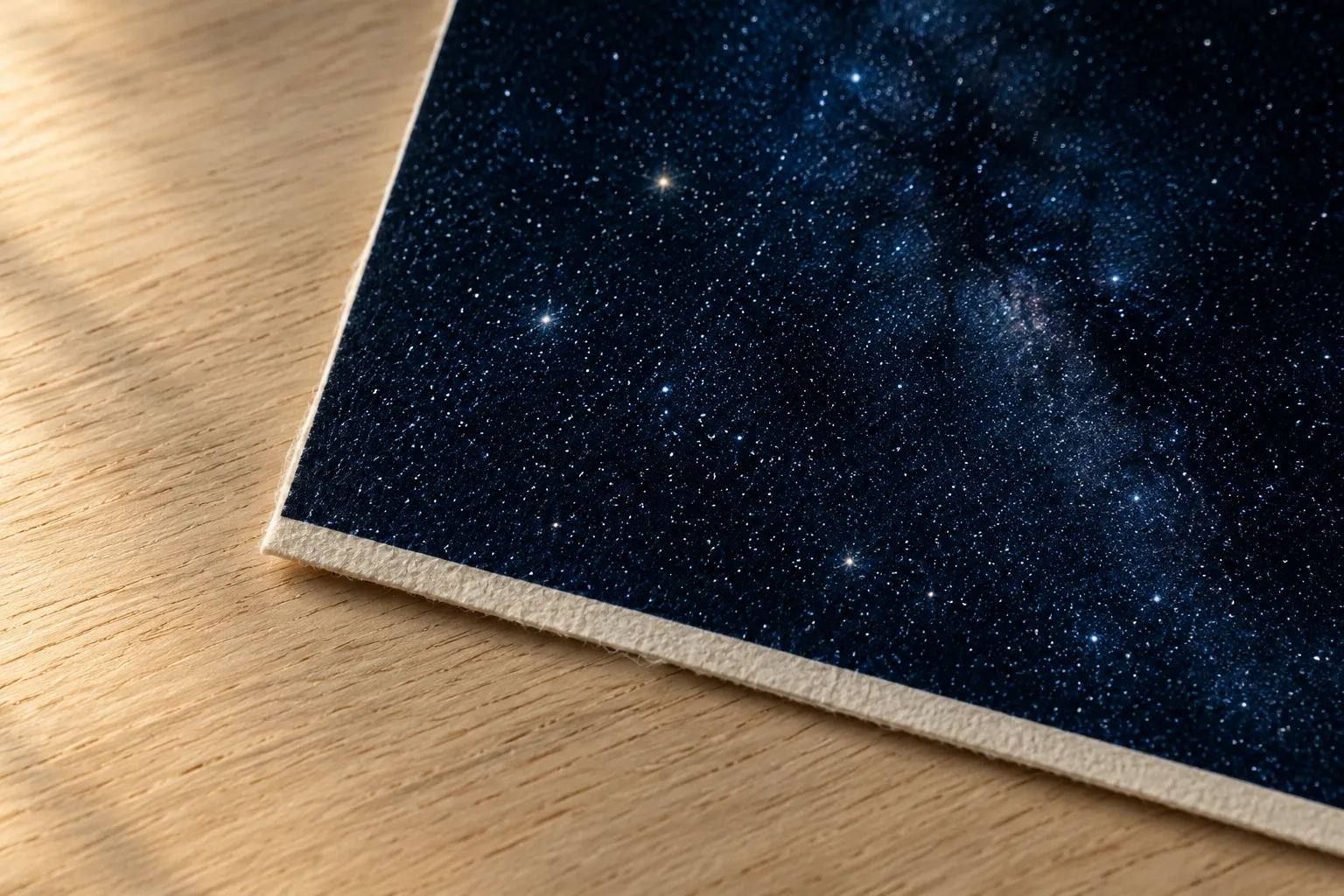
Longer than most people assume, if it's printed with the right ink. The dividing line is pigment versus dye. Pigment inks carry their colour in solid particles that resist ultraviolet light, while dye inks sit in solution and fade faster. For a sense of what pigment buys you, the US National Park Service's heritage documentation guidelines will only accept a digital print "printed using carbon or pigment inks", and require the printer, paper and ink combination to be "rated by an independent rating organization to have a permanency of at least 150 years".
We print every format (poster, framed and canvas) with pigment inks. We have not had our own paper, ink and printer combination permanence-rated by an independent organisation, so we will not put a number of years on it. Keep any print out of direct, all-day sunlight, whatever the format.
What about the materials and the planet?
Worth a line, because it's easy to check. Look for FSC certification on the wood and paper. The Forest Stewardship Council's own mission is to promote "environmentally appropriate, socially beneficial, and economically viable management of the world's forests", and its forest-management certificate confirms that a forest is managed in a way that preserves biological diversity and benefits local people and workers. The FSC label on a frame or canvas means the timber behind it was responsibly sourced. Made-to-order printing helps too: nothing is produced until it's ordered, so there's no warehouse of unsold stock heading for landfill.
What size, and where to hang it?
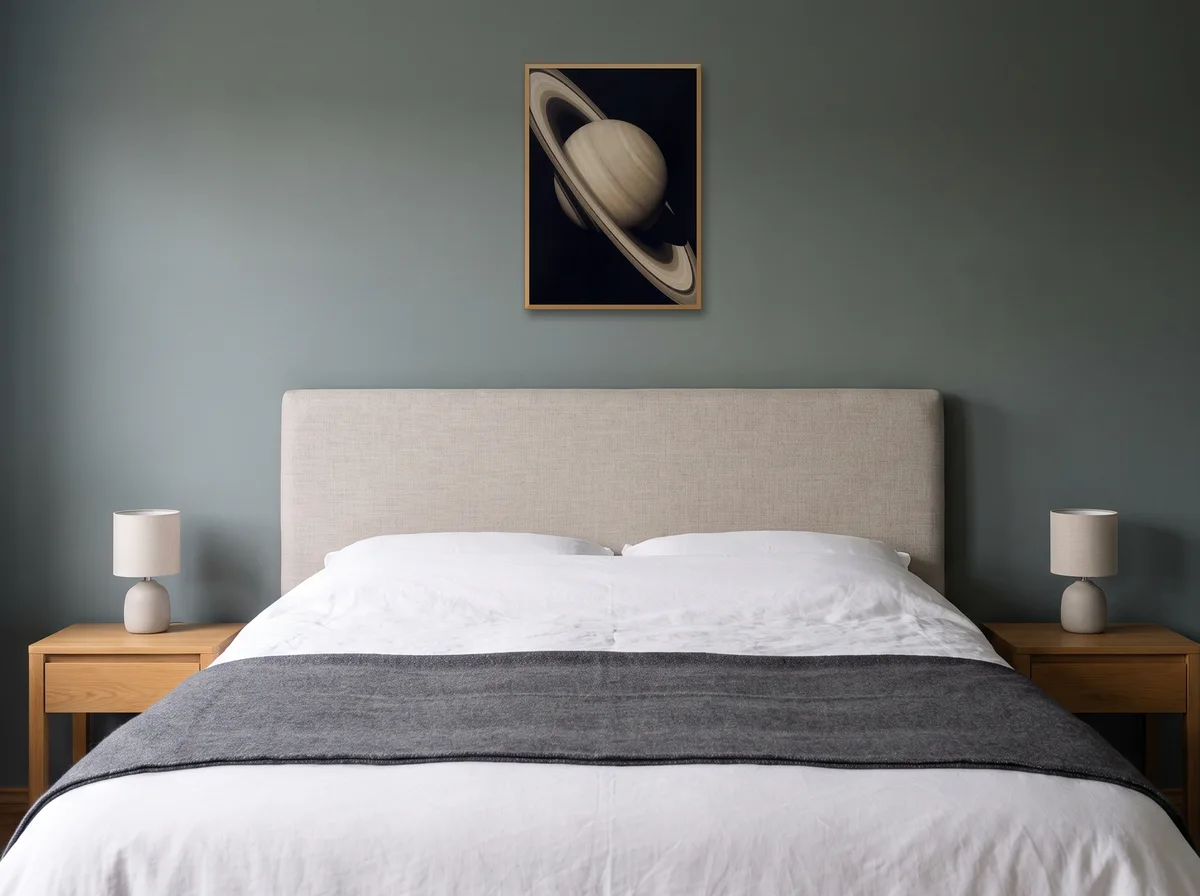
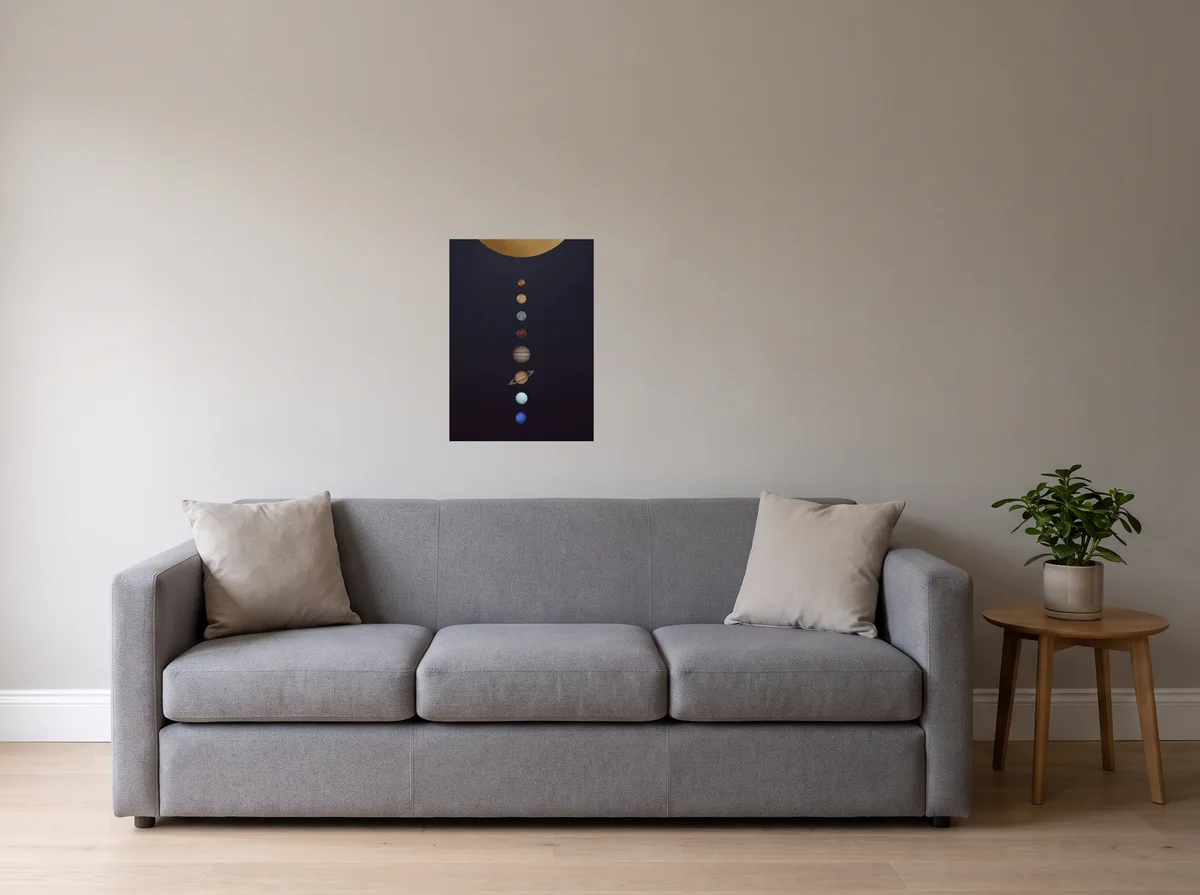
Our own rule of thumb, not a published museum standard: hang a piece so its centre sits about 145cm (57 inches) from the floor, roughly average standing eye level, and let it span about two-thirds of the wall or the furniture beneath it. Over a sofa or bed, leave a hand's width of clearance and go wide. A single larger print nearly always beats a cluster of small ones for impact.
Match the format to the distance, too. A framed print rewards a closer look, so it suits a hallway or a reading nook; a canvas is built for the long view across a living room. If you're torn, a framed print at a middling size is the easiest to live with on a wall you haven't fully planned.
Which one, for astronomy art
For a gift: a framed print, ready to hang, no decisions left for the recipient. For a large statement wall: a canvas, glare-free, deep and atmospheric. For value or for keeping your options open: a poster on heavy stock you can frame later. Whichever you choose, insist on pigment inks and FSC materials, then pick the image.
You'll find every plate in all three formats across the astronomy prints collection, with canvas and framed options on each.
This comparison opens On the wall, the stage about size and finish. What DPI a photo needs handles the resolution side of the same decision, and the right size for a wall handles the scale.