We'd like to use Google Analytics and Microsoft Clarity cookies to see how people use Aphelion Prints, so we can improve it.
They stay off unless you allow them. Privacy
All 110 Messier objects, with the months they are best on a UK evening and how high each one gets. Tick them off as you go and print a sheet for the next clear night.
Seen
0 of 110
On this list
110
Seen on this list
0
Tick an object when you have seen it. Your ticks stay on this device, in this browser only. Nothing is sent to us and there is nothing to sign up for.
Ticking needs JavaScript switched on. The list and the months work without it.
The sheet prints black on white with a box to tick for each object on the list above, and any you have ticked already marked.
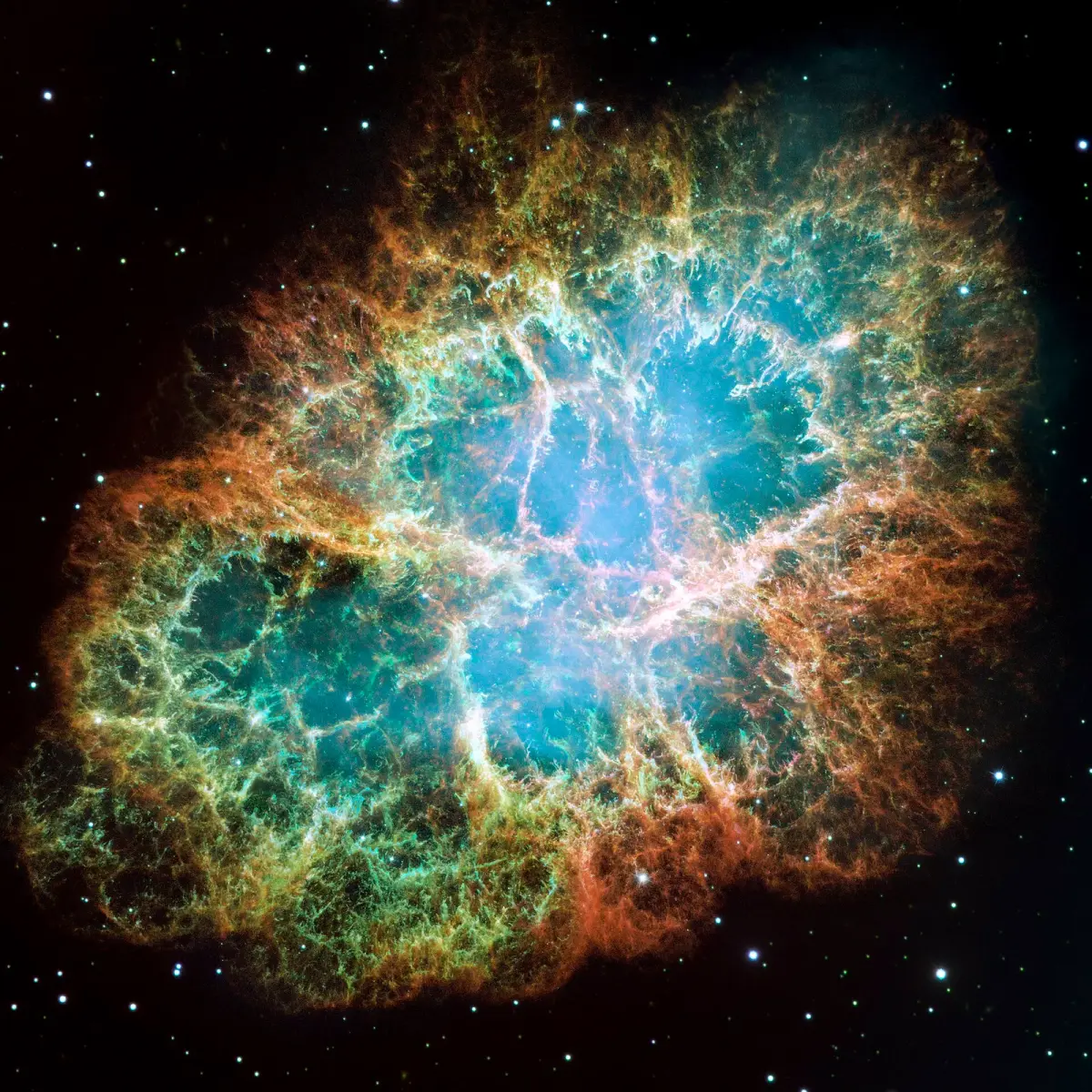
M1, the Crab Nebula, the remains of a supernova recorded by Japanese and Chinese astronomers in 1054, in a Hubble mosaic. Credit: NASA, ESA, J. Hester and A. Loll.
The 110 Messier objects
Best months are when the object crosses the meridian, the north-south line where it stands highest, between 9pm and 11pm UK time (GMT or BST). Highest is the most it ever climbs above the horizon from the middle of the UK (53.5°N). Below 10° it is lost in haze and rooftops from most gardens.
Nothing matches. Try another type, or untick "well up this month".
Seen
M
Object
Constellation
Mag
Best months
Highest
Crab NebulaSupernova remnant · NGC 1952
Taurus
8.4
Jan
59°
Globular cluster · NGC 7089
Aquarius
6.3
Sep to Oct
36°
Globular cluster · NGC 5272
Canes Venatici
6.4
May to Jun
65°
Globular cluster · NGC 6121
Scorpius
5.4
Jul
10°
Globular cluster · NGC 5904
Serpens
6.0
Jun to Jul
38°
Butterfly ClusterOpen cluster · NGC 6405
Scorpius
4.2
Jul to Aug
4°Barely clears the horizon
Ptolemy's ClusterOpen cluster · NGC 6475
Scorpius
3.3
Jul to Aug
2°Barely clears the horizon
Lagoon NebulaNebula · NGC 6523
Sagittarius
5.8
Jul to Aug
12°
Globular cluster · NGC 6333
Ophiuchus
8.4
Jul to Aug
18°
Globular cluster · NGC 6254
Ophiuchus
5.0
Jul
32°
Wild Duck ClusterOpen cluster · NGC 6705
Scutum
5.8
Aug
30°
Globular cluster · NGC 6218
Ophiuchus
6.1
Jul
35°
Great Globular Cluster in HerculesGlobular cluster · NGC 6205
Hercules
5.8
Jul
73°
Globular cluster · NGC 6402
Ophiuchus
5.7
Jul to Aug
33°
Globular cluster · NGC 7078
Pegasus
6.3
Sep to Oct
49°
Eagle NebulaNebula · NGC 6611
Serpens
6.0
Aug
23°
Omega or Swan NebulaNebula · NGC 6618
Sagittarius
7.0
Aug
20°
Open cluster · NGC 6613
Sagittarius
6.9
Aug
19°
Globular cluster · NGC 6273
Ophiuchus
5.6
Jul to Aug
10°
Trifid NebulaNebula · NGC 6514
Sagittarius
8.5
Jul to Aug
14°
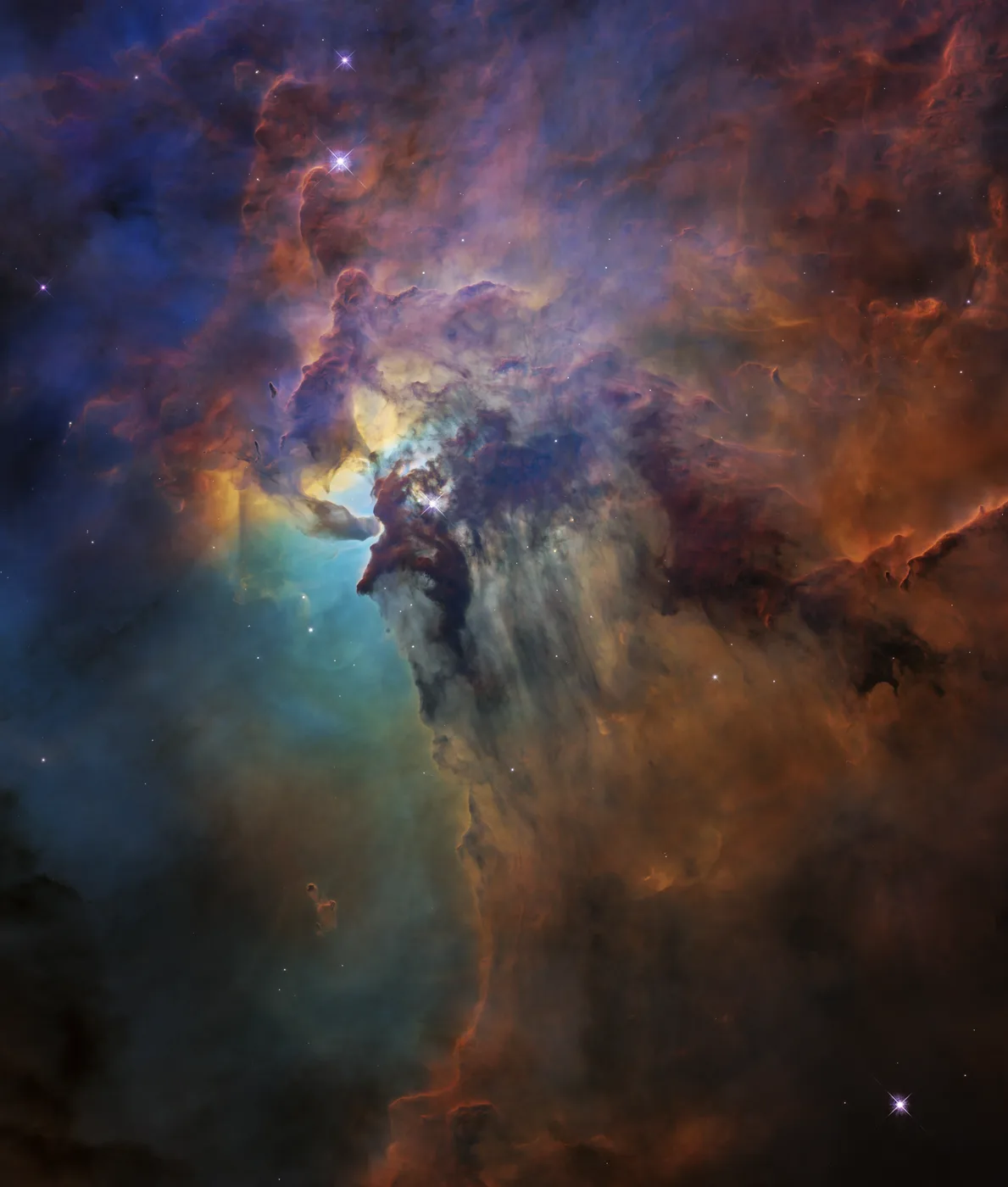
M8, the Lagoon Nebula, Hubble’s 28th-anniversary picture. Credit: NASA, ESA and STScI.
Seen
M
Object
Constellation
Mag
Best months
Highest
Open cluster · NGC 6531
Sagittarius
5.9
Jul to Aug
14°
Globular cluster · NGC 6656
Sagittarius
5.1
Aug
13°
Open cluster · NGC 6494
Sagittarius
5.5
Jul to Aug
18°
Small Sagittarius Star CloudStar cloud · IC 4715A bright patch of the Milky Way rather than a single cluster.
Sagittarius
4.5
Aug
18°
Open cluster · IC 4725
Sagittarius
4.6
Aug
17°
Open cluster · NGC 6694
Scutum
8.9
Aug
27°
Dumbbell NebulaPlanetary nebula · NGC 6853
Vulpecula
7.4
Aug to Sep
59°
Globular cluster · NGC 6626
Sagittarius
6.9
Aug
12°
Open cluster · NGC 6913
Cygnus
6.6
Sep
75°
Globular cluster · NGC 7099
Capricornus
7.1
Sep to Oct
13°
Andromeda GalaxyGalaxy · NGC 224
Andromeda
3.4
Oct to Nov
78°
Galaxy · NGC 221
Andromeda
8.1
Oct to Nov
78°
Triangulum GalaxyGalaxy · NGC 598
Triangulum
5.8
Nov
67°
Open cluster · NGC 1039
Perseus
5.2
Nov to Dec
79°
Open cluster · NGC 2168
Gemini
5.3
Jan to Feb
61°
Open cluster · NGC 1960
Auriga
6.0
Jan
71°
Open cluster · NGC 2099
Auriga
5.6
Jan
69°
Open cluster · NGC 1912
Auriga
6.4
Jan
72°
Open cluster · NGC 7092
Cygnus
4.6
Sep to Oct
85°
Double starTwo ordinary stars that happen to sit close together in the sky (catalogued as Winnecke 4), not a cluster or nebula. Messier logged it while looking for a nebula reported in that spot.
Ursa Major
8.0
May
86°
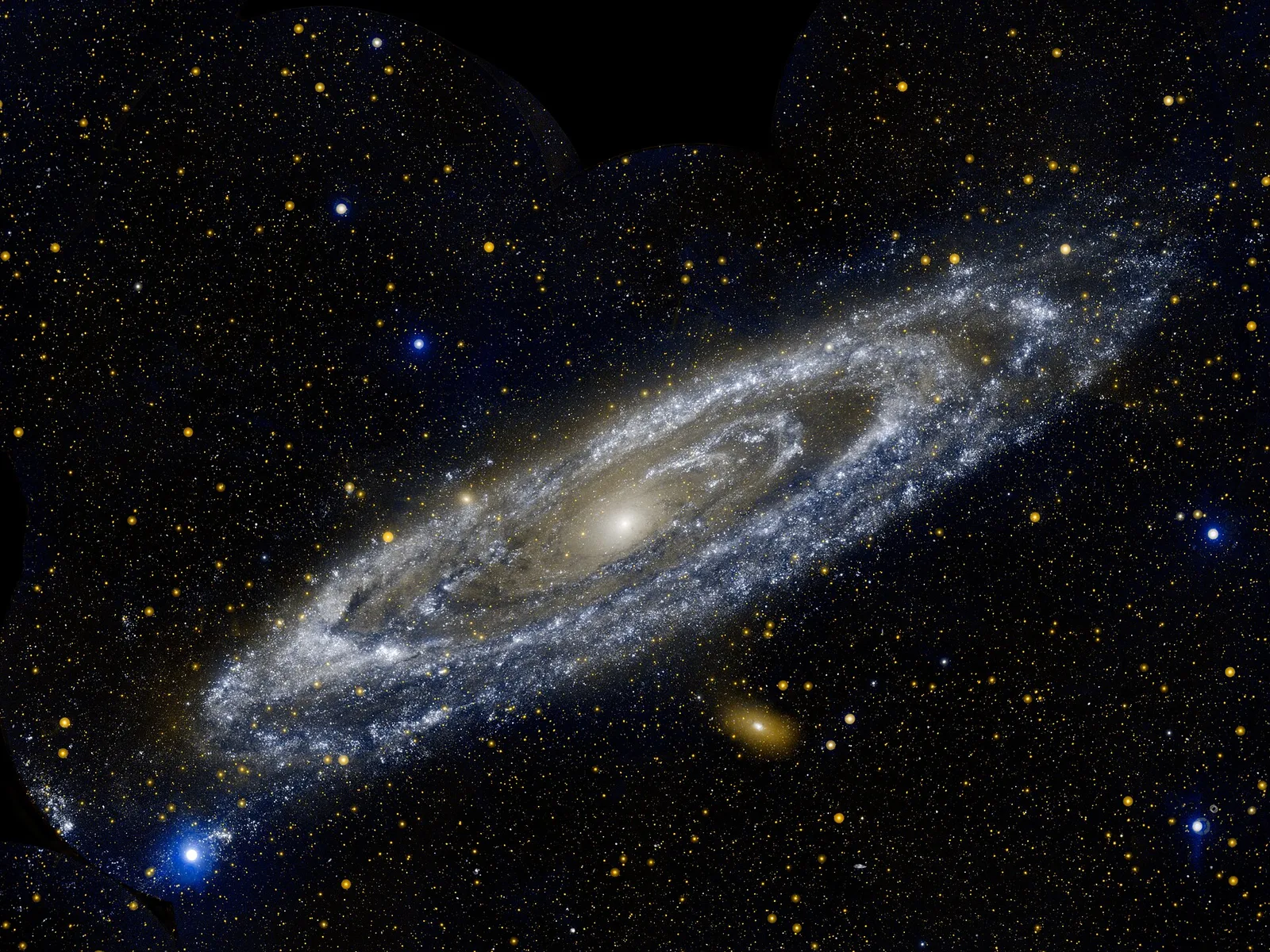
M31, the Andromeda Galaxy, in ultraviolet from NASA’s Galaxy Evolution Explorer. Credit: NASA/JPL-Caltech.
Seen
M
Object
Constellation
Mag
Best months
Highest
Open cluster · NGC 2287
Canis Major
4.5
Jan to Feb
16°
Orion NebulaNebula with a cluster · NGC 1976
Orion
4.0
Jan
31°
De Mairan's NebulaNebula · NGC 1982
Orion
9.0
Jan
31°
Beehive Cluster (Praesepe)Open cluster · NGC 2632
Cancer
3.1
Feb to Mar
56°
Pleiades (Seven Sisters)Open cluster · Melotte 22
Taurus
1.2
Dec
61°
Open cluster · NGC 2437
Puppis
6.1
Feb
22°
Open cluster · NGC 2422
Puppis
4.4
Feb
22°
Open cluster · NGC 2548
Hydra
5.8
Feb to Mar
31°
Galaxy · NGC 4472
Virgo
8.3
May
44°
Open cluster · NGC 2323
Monoceros
5.9
Jan to Feb
28°
Whirlpool GalaxyGalaxy · NGC 5194
Canes Venatici
8.4
May to Jun
84°
Open cluster · NGC 7654
Cassiopeia
6.9
Oct
82°
Globular cluster · NGC 5024
Coma Berenices
7.8
May to Jun
55°
Globular cluster · NGC 6715
Sagittarius
7.7
Aug
6°Barely clears the horizon
Globular cluster · NGC 6809
Sagittarius
6.5
Aug to Sep
6°Barely clears the horizon
Globular cluster · NGC 6779
Lyra
8.4
Aug to Sep
67°
Ring NebulaPlanetary nebula · NGC 6720
Lyra
8.8
Aug
70°
Galaxy · NGC 4579
Virgo
10.3
May
48°
Galaxy · NGC 4621
Virgo
9.6
May
48°
Galaxy · NGC 4649
Virgo
8.8
May
48°
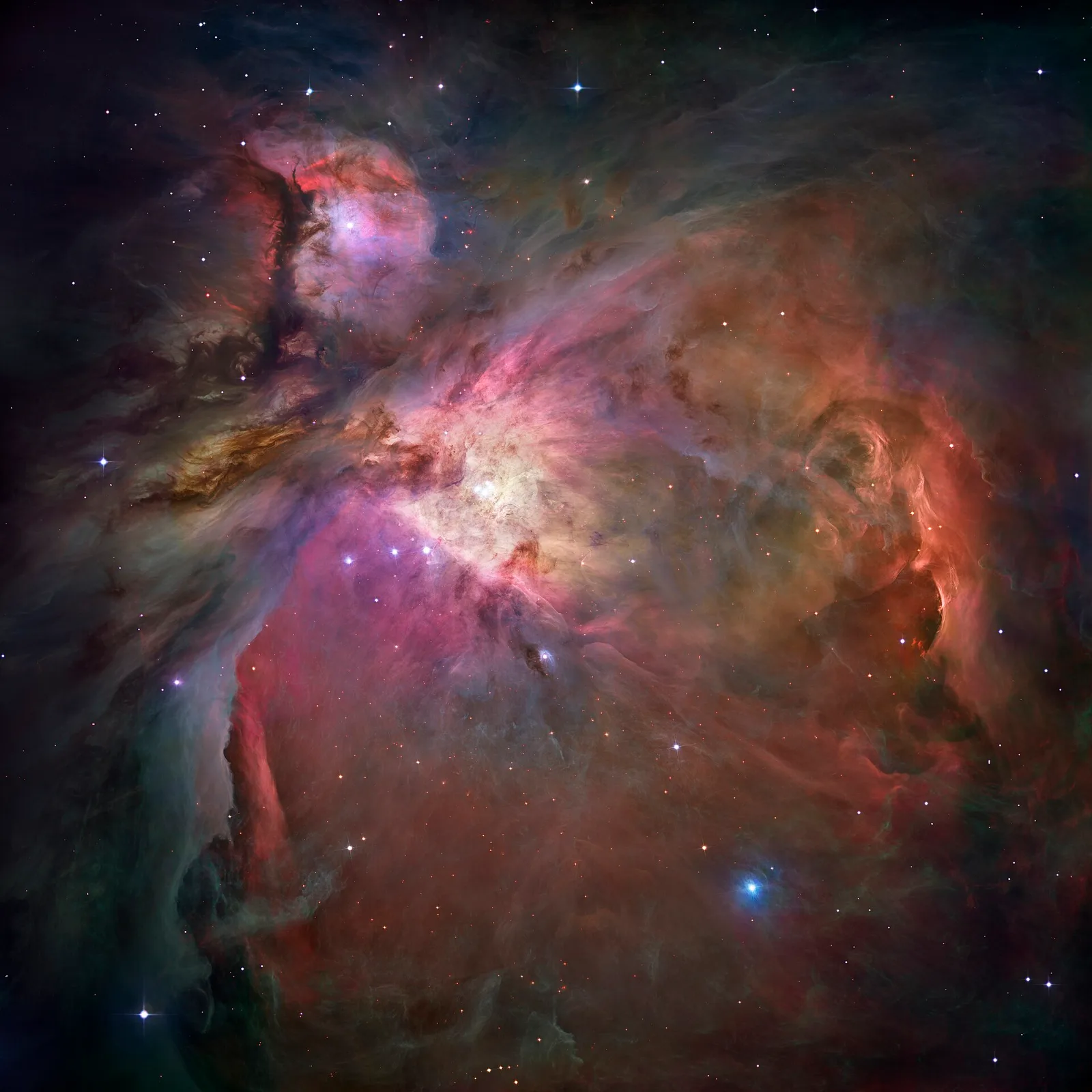
M42, the Orion Nebula, in Hubble’s 2006 mosaic. Credit: NASA, ESA, M. Robberto.
Seen
M
Object
Constellation
Mag
Best months
Highest
Galaxy · NGC 4303
Virgo
10.3
May
41°
Globular cluster · NGC 6266
Ophiuchus
6.5
Jul to Aug
6°Barely clears the horizon
Sunflower GalaxyGalaxy · NGC 5055
Canes Venatici
8.6
May to Jun
78°
Black Eye GalaxyGalaxy · NGC 4826
Coma Berenices
8.5
May
58°
Galaxy · NGC 3623
Leo
9.3
Apr to May
49°
Galaxy · NGC 3627
Leo
8.9
Apr to May
49°
Open cluster · NGC 2682
Cancer
6.9
Feb to Mar
48°
Globular cluster · NGC 4590
Hydra
8.0
May
10°
Globular cluster · NGC 6637
Sagittarius
7.6
Aug
4°Barely clears the horizon
Globular cluster · NGC 6681
Sagittarius
7.9
Aug
4°Barely clears the horizon
Globular cluster · NGC 6838
Sagitta
8.2
Aug to Sep
55°
Globular cluster · NGC 6981
Aquarius
9.0
Sep
24°
Asterism · NGC 6994A little group of four stars that only look close together, not a true cluster.
Aquarius
8.9
Sep to Oct
24°
Galaxy · NGC 628
Pisces
9.3
Nov
52°
Globular cluster · NGC 6864
Sagittarius
8.3
Aug to Sep
15°
Little Dumbbell NebulaPlanetary nebula · NGC 650
Perseus
10.1
Nov
88°
Galaxy · NGC 1068
Cetus
9.3
Nov to Dec
37°
Reflection nebula · NGC 2068
Orion
8.0
Jan
37°
Globular cluster · NGC 1904
Lepus
8.2
Jan
12°
Globular cluster · NGC 6093
Scorpius
7.3
Jul
13°
Seen
M
Object
Constellation
Mag
Best months
Highest
Bode's GalaxyGalaxy · NGC 3031
Ursa Major
6.9
Mar to Apr
75°
Cigar GalaxyGalaxy · NGC 3034
Ursa Major
8.3
Mar to Apr
74°
Southern Pinwheel GalaxyGalaxy · NGC 5236
Hydra
7.2
May to Jun
6°Barely clears the horizon
Galaxy · NGC 4374
Virgo
9.8
May
49°
Galaxy · NGC 4382
Coma Berenices
9.1
May
55°
Galaxy · NGC 4406
Virgo
8.9
May
49°
Galaxy · NGC 4486
Virgo
9.0
May
49°
Galaxy · NGC 4501
Coma Berenices
10.3
May
51°
Galaxy · NGC 4552
Virgo
10.1
May
49°
Galaxy · NGC 4569
Virgo
9.5
May
50°
Galaxy · NGC 4548
Coma Berenices
11.0
May
51°
Globular cluster · NGC 6341
Hercules
6.5
Jul to Aug
80°
Open cluster · NGC 2447
Puppis
6.2
Feb
13°
Galaxy · NGC 4736
Canes Venatici
8.2
May
77°
Galaxy · NGC 3351
Leo
9.8
Mar to Apr
48°
Galaxy · NGC 3368
Leo
9.2
Mar to Apr
48°
Owl NebulaPlanetary nebula · NGC 3587
Ursa Major
9.9
Apr to May
89°
Galaxy · NGC 4192
Coma Berenices
10.8
May
51°
Galaxy · NGC 4254
Coma Berenices
9.8
May
51°
Galaxy · NGC 4321
Coma Berenices
9.5
May
52°
Seen
M
Object
Constellation
Mag
Best months
Highest
Pinwheel GalaxyGalaxy · NGC 5457
Ursa Major
7.9
May to Jun
89°
Galaxy · NGC 5866Messier's own notes are unclear. OpenNGC treats M102 as a repeat of M101; most observing lists use the galaxy NGC 5866 in Draco, and so do we.
Draco
9.9
Jun to Jul
88°
Open cluster · NGC 581
Cassiopeia
7.4
Nov
83°
Sombrero GalaxyGalaxy · NGC 4594
Virgo
8.6
May
25°
Galaxy · NGC 3379
Leo
9.3
Mar to Apr
49°
Galaxy · NGC 4258
Canes Venatici
9.3
May
84°
Globular cluster · NGC 6171
Ophiuchus
7.9
Jul
23°
Galaxy · NGC 3556
Ursa Major
10.1
Apr to May
88°
Galaxy · NGC 3992
Ursa Major
9.9
Apr to May
90°
Galaxy · NGC 205
Andromeda
8.2
Oct to Nov
78°
Before you go out
Mag is magnitude, the brightness: the smaller the number, the brighter it is. From a dark country site you can see down to about magnitude 6 without help. Most Messier objects need binoculars or a small telescope, and the galaxies want a dark, moonless night.
From May to August the sky in the middle of the UK is not properly dark at 10pm: the Sun is less than 12° below the horizon, so the fainter objects wait until later in the night.
"Well up this month" means at least 20° above the horizon at 10pm UK time on the 15th of November. From 8 of the objects (M6, M7, M54, M55, M62, M69, M70, M83) you never get more than 10° from the middle of the UK. From the south coast they sit about 3° higher, and from northern Scotland about 4° lower.
The Messier marathon
Around the new Moon in late March or early April, the Sun sits in a part of the sky with no Messier objects. That leaves a few nights a year when, from far enough south, all 110 can be found between dusk and dawn. The next of those new Moons is on Wednesday 7 April 2027.
From the UK a full set is out of reach. The 8 far-southern objects above stay too low, and the ones caught low in the dusk or dawn twilight are hard even from the south coast. Most UK observers who try it aim for as many as they can, and the tally here keeps count.
Pick a type of object, or tick "well up this month" to see only the ones that stand at least 20° above the horizon at 10pm this month. Tick each object as you find it. The count at the top keeps your tally, and your ticks stay in this browser on this device. Nothing is sent to us.
Press Print this list for an A4 sheet of whatever is showing, black on white, with a box to tick and space for the date and a note. Clubs often hand these out at observing evenings.
How to read each row
M is the number Charles Messier gave it in his list of fuzzy objects that were not comets, published between 1774 and 1781. Mag is its magnitude, a measure of brightness where smaller numbers are brighter. A spread-out galaxy of magnitude 9 looks much fainter than a star of the same magnitude, because its light is smeared over a wider patch.
Best months are the months when it crosses the meridian, the north-south line where it stands highest, between 9pm and 11pm UK time. The Orion Nebula, M42, comes out as January, the Andromeda Galaxy, M31, as October and November, and the Great Globular Cluster in Hercules, M13, as July. Highest is the most it ever climbs from the middle of the UK. Eight objects in Scorpius, Sagittarius, Ophiuchus and Hydra never get above 10° from there, and M7 reaches only about 2°.
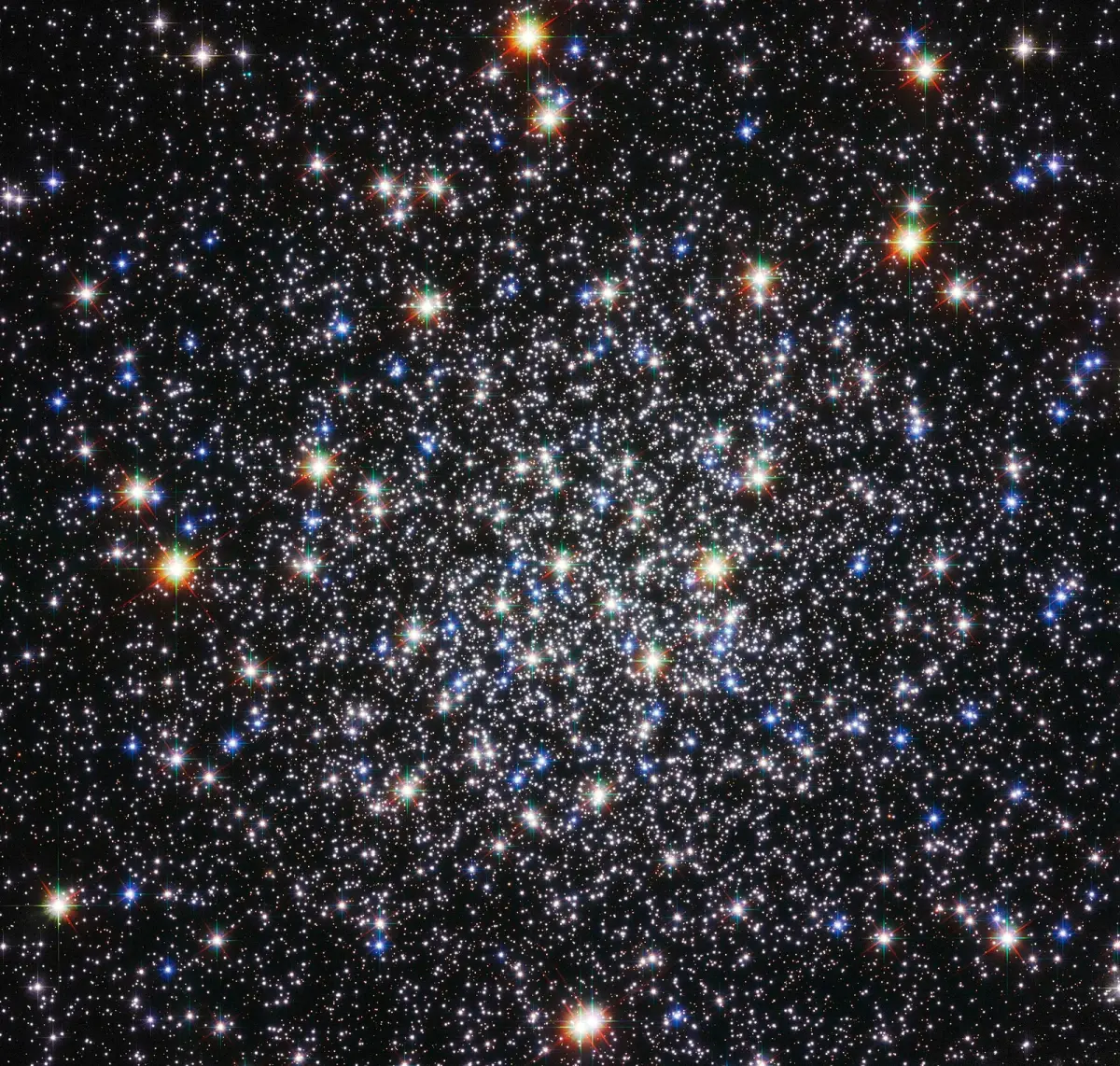
Messier 12, a globular cluster, from the Hubble Space Telescope. Credit: ESA/Hubble & NASA.
How it is worked out
The positions, types and magnitudes come from OpenNGC, an open catalogue of deep-sky objects kept by Mattia Verga and shared under a CC BY-SA 4.0 licence. Where OpenNGC has no magnitude we use William Harris's catalogue of globular clusters and, for M35, NASA's Hubble Messier Catalog.
The months and heights are our own sums. For every day of the year we take 10pm on a UK clock, work out which part of the sky is due south at that moment from 53.5°N, and see which objects are within an hour of it. Astronomy Engine, an open astronomy library, does the star time and the slow wobble of Earth's axis since 2000. Our results match NASA's own notes: M31 best in November, M42 in January, M7 at 10pm in July.
Two objects that are not what they seem
M40 is two ordinary stars that happen to sit close together in the sky. Messier logged it while looking for a nebula someone else had reported there. M102 is a puzzle: his notes do not match any one object well. OpenNGC treats it as a repeat of M101, while most observing lists use the galaxy NGC 5866 in Draco. We list NGC 5866 and say so on its row.
From the eyepiece to the wall
Many of the brightest Messier objects are galaxies and nebulae. Our galaxy prints and nebula prints are made to order for a wall at home or the club room. For the story of what you are looking at, what a nebula is and the life cycle of a star explain planetary nebulae and the Crab Nebula's supernova, and the Orion guide shows where to find M42.
Written by Craig Fearn, Aphelion Prints. Last updated .
Messier catalogue checklist questions
How many Messier objects are there?
There are 110. Messier published 103 in his lifetime, and later astronomers added seven more from his notes and those of his colleague Pierre Méchain. Two of them, M40 and M102, are odd ones: a pair of stars and a disputed galaxy.
Can you see all the Messier objects from the UK?
Not easily. From the middle of the UK all 110 do rise, but eight never climb more than 10°, and M7 reaches only about 2°. You need a clear, flat view to the south in summer to catch them. They sit about 3° higher from the south coast and lower again in Scotland.
When is the Messier marathon?
Around the new Moon in late March or early April, when the Sun is in a part of the sky with no Messier objects. From far enough south all 110 can be seen in one night. From the UK the far-southern ones are too low, so a full set is out of reach.
What does "best months" mean here?
The months when the object crosses the north-south line, where it is highest, between 9pm and 11pm UK time. It is often still visible a month or two either side, earlier or later in the night.
Where are my ticks saved?
In your own browser, on the device you ticked them on. Nothing is sent to us. Clearing your browser data, or using a private window, will lose them, so print a sheet now and then as a backup.