Free UK delivery

Your basket (0)

Free tool · nothing to join

Telescope magnification calculator

Type in your telescope and eyepiece to see the magnification, how much sky fits in the view, and the most and least power that telescope can really use.

The aperture and focal length are usually printed on the tube or the box, often as "130/650" or "200/1200". The eyepiece's focal length is on its barrel. Most standard eyepieces (Plössls) have a 52° apparent field; wide-angle ones are 66° to 82°.

26x with a 25 mm eyepiece

130 mm aperture, 650 mm focal length, f/5

Magnification
26x
Focal ratio
f/5
True field
2.00° (120′)
Moon widths
4
Exit pupil
5 mm
Resolves down to
0.89″

Exit pupil: Low power: bright, wide views. Good for star clusters, the Andromeda Galaxy and sweeping the Milky Way.

Useful range for this telescope: about 19x to 260x. The top figure is a rule of thumb, twice the aperture in millimetres. On many UK nights the air is not steady enough to go that high.

Resolving power: two equal stars 0.89 seconds of arc apart are the closest pair this telescope can show as two (Dawes' limit). A second of arc is 1/3,600 of a degree.

What common eyepieces give in this telescope

Same telescope, and the same 52° apparent field for each, so the field column is a guide.

EyepiecePowerTrue fieldMoonsExit pupil
32 mm20x2.56° (154′)5.16.4 mm
25 mm26x2.00° (120′)45 mm
20 mm33x1.60° (96′)3.24 mm
15 mm43x1.20° (72′)2.43 mm
10 mm65x0.80° (48′)1.62 mm
6 mm108x0.48° (29′)11.2 mm
4 mm163x0.32° (19′)0.60.8 mm
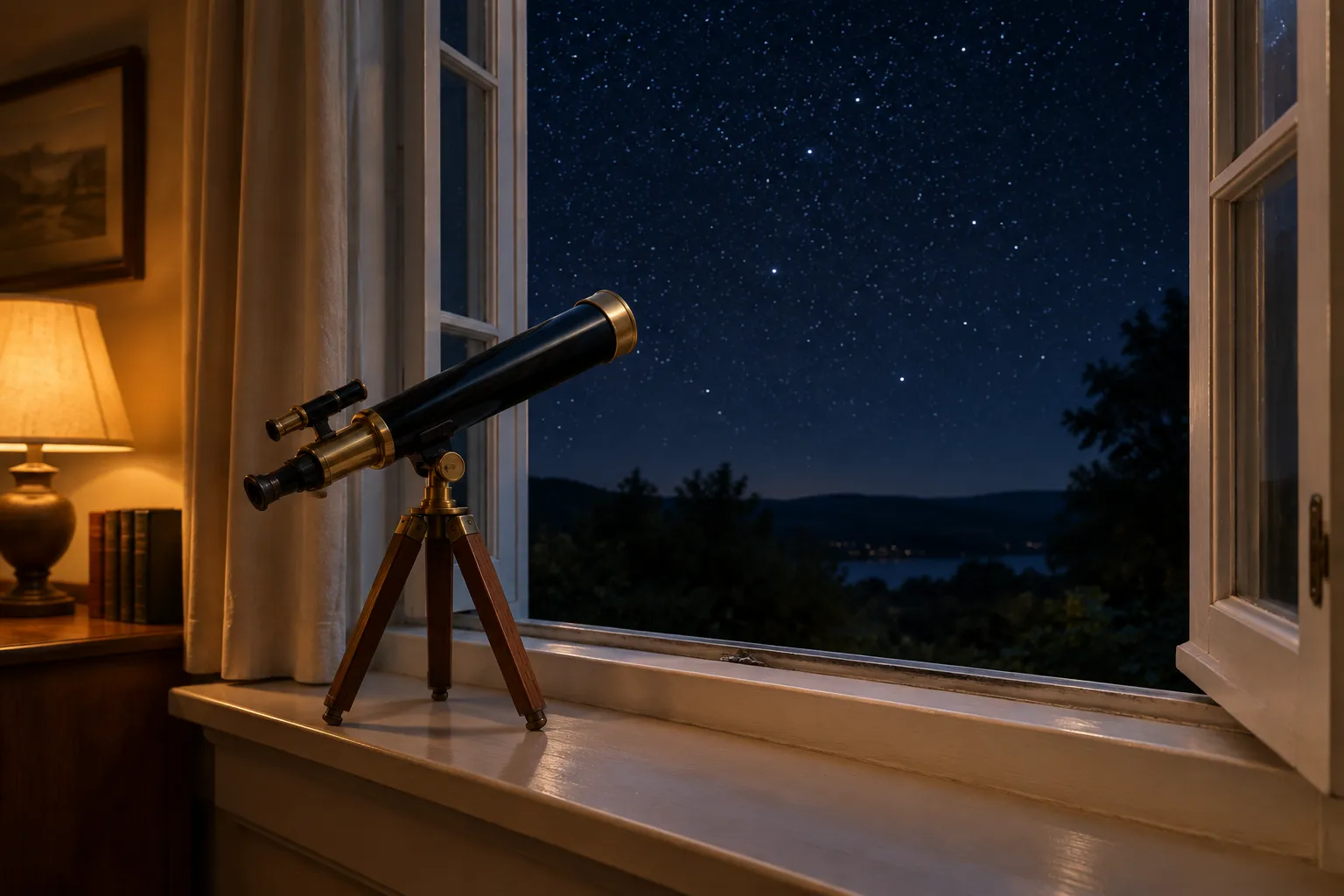
A small brass and black refracting telescope on a wooden tripod on a windowsill, pointing out of an open window at a starry night sky.

How to use it

Type in the two numbers printed on your telescope: the aperture, which is the width of the main lens or mirror, and the focal length. A box marked "130/650" means 130 mm across and 650 mm long in focal length. Then add the focal length of the eyepiece you are holding, which is written on its barrel, and pick a Barlow if you are using one. A Barlow is a small lens that goes in before the eyepiece and multiplies the power, usually by two or three.

The page works it out as you type, and the address in your browser changes to match, so you can send the answer to someone in your club.

How to read the answer

Magnification is how many times bigger things look than with your eyes alone. More is not always better. Past about twice the aperture in millimetres, the picture gets bigger but no sharper, and on many British nights the air is too unsteady to go even that high.

True field is how much sky you see at once. We also give it in Moon widths, since the full Moon is about half a degree across: a field of 2 Moon widths shows the whole Moon with room around it.

Exit pupil is the width of the beam of light coming out of the eyepiece. Around 4 to 7 mm gives bright, wide views of star clusters and galaxies. Around 1 to 2 mm suits the Moon and planets. Much wider than 7 mm and some light misses your eye; much smaller than half a millimetre and the view goes dim and blurry.

Resolving power is the closest two equal stars can be and still show as two. It comes from Dawes' limit, a rule worked out by the Victorian astronomer William Dawes from his own observing.
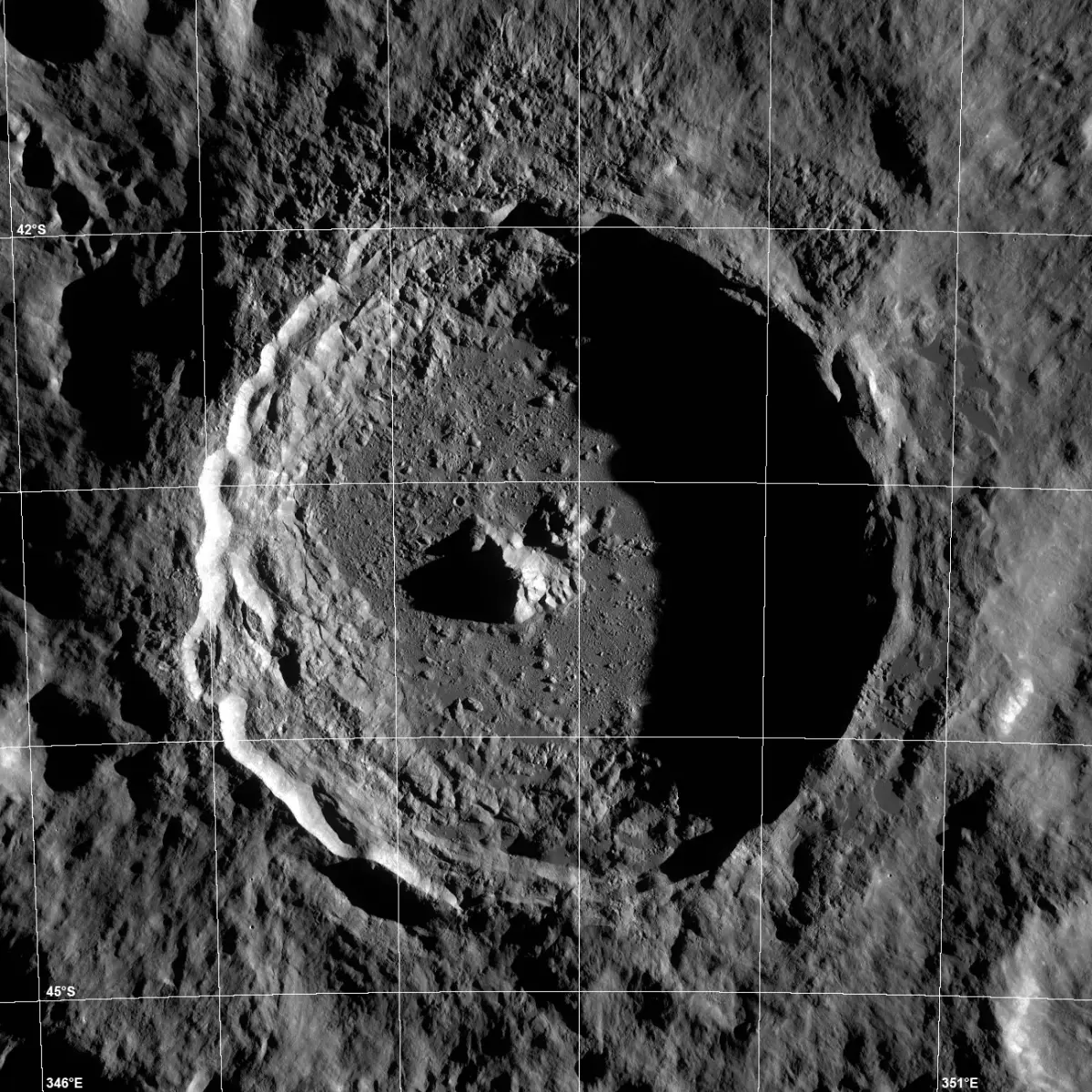
Tycho crater from above: a sharp round rim, terraced walls and a central peak, with a faint latitude and longitude grid.
Tycho crater in a Lunar Reconnaissance Orbiter mosaic 130 km wide, north up. Credit: NASA/GSFC/Arizona State University.

How it is worked out

All of this is standard telescope arithmetic. Magnification is the telescope's focal length divided by the eyepiece's. The true field is the eyepiece's apparent field divided by the magnification, which is the usual estimate; real eyepieces come out a few percent either side. The exit pupil is the aperture divided by the magnification. Dawes' limit is 116 divided by the aperture in millimetres, in seconds of arc.

We checked the sums against a published telescope. The Sky-Watcher Skyliner 200P is listed at 203 mm and 1200 mm, f/5.91, with 406x as its highest practical power. The calculator gives the same f/5.91 and 406x, and 60x and 96x with the 20 mm and 12.5 mm eyepieces that come with it.

What to point it at

The Moon is the easiest first target, and the Moon phase finder shows what shape it is tonight. The terminator, the line between light and dark, is where craters look sharpest. Even at low power, Jupiter shows its four big moons as points of light, and our guide to Jupiter's moons explains how they change places from night to night.

Written by Craig Fearn, Aphelion Prints. Last updated .

Common questions

How do I work out the magnification of my telescope?
Divide the telescope's focal length by the eyepiece's focal length. A 650 mm telescope with a 25 mm eyepiece gives 26x. A 2x Barlow doubles that to 52x.
What is the highest magnification my telescope can use?
A rule of thumb is twice the aperture in millimetres, so about 260x for a 130 mm telescope. In practice the unsteady air over the UK often sets a lower limit than the telescope does.
What is a good exit pupil?
Around 4 to 7 mm for faint, spread-out things like galaxies, 2 to 4 mm for general viewing, and 1 to 2 mm for the Moon and planets. Below about half a millimetre the view gets dim and blurry.
Which eyepiece shows the whole Moon?
Any eyepiece that gives a true field of more than half a degree. The table on this page shows the field for seven common eyepieces in your telescope, in degrees and in Moon widths.