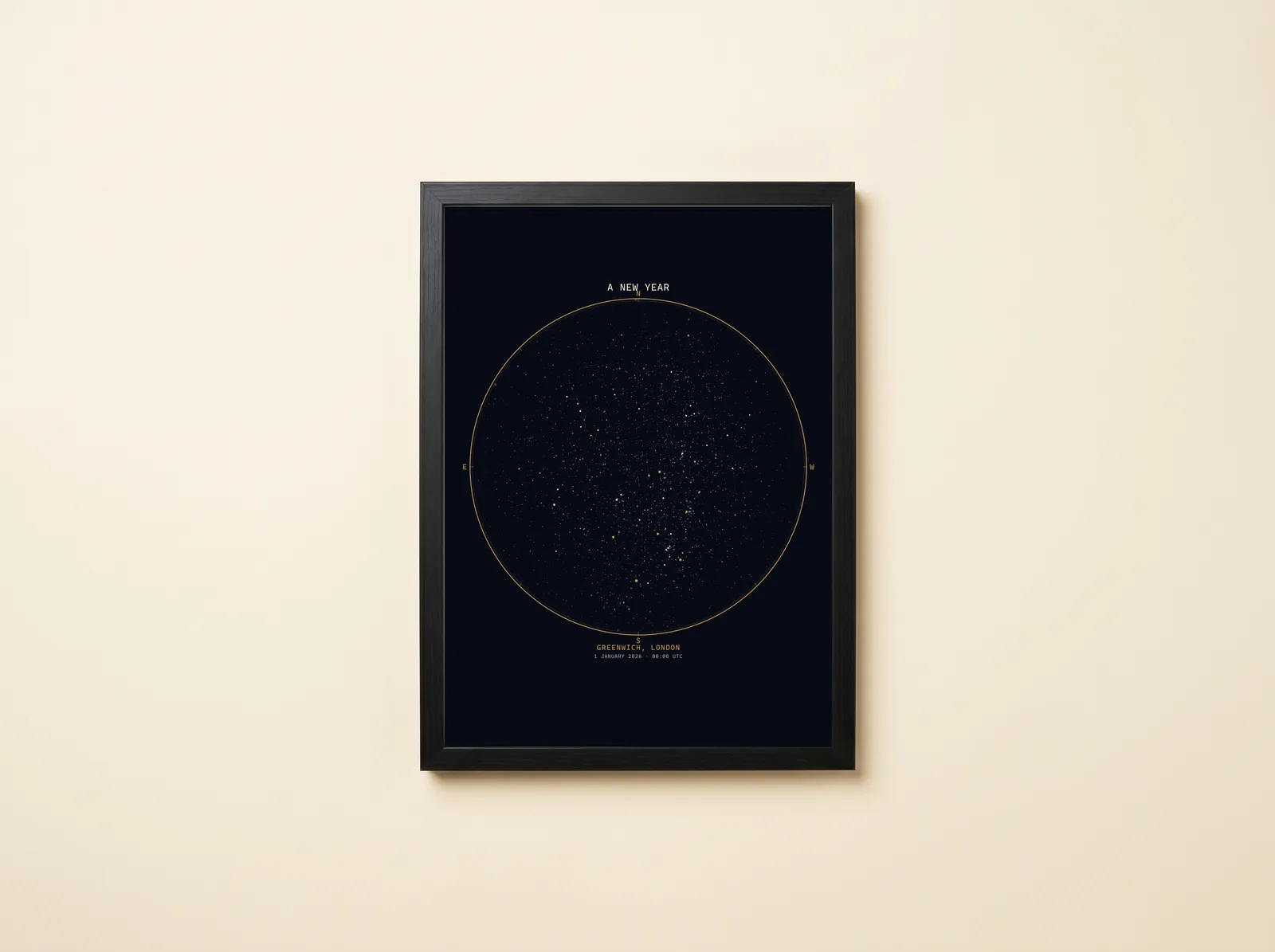
The map is calculated, not decorative. Give it a place, date and local time and the catalogue stars above the mathematical horizon are calculated for that latitude, longitude and instant, then drawn as a chart. Two maps for the same date but different cities differ, because the sky overhead differs. That's the appeal: it isn't a picture of space in general, it is a record of one night, which is why they are usually bought for a birth, a wedding, an anniversary or the night two people met.
Most are printed as a dark circular sky field with a caption line underneath carrying the place, date and coordinates. Ours is built from your own date and location at personalised star map, previewed before you buy. If you want the constellations themselves, not one particular night, the constellation prints are the standing charts, and what is a constellation explains the 88 official ones.
What is actually on the chart
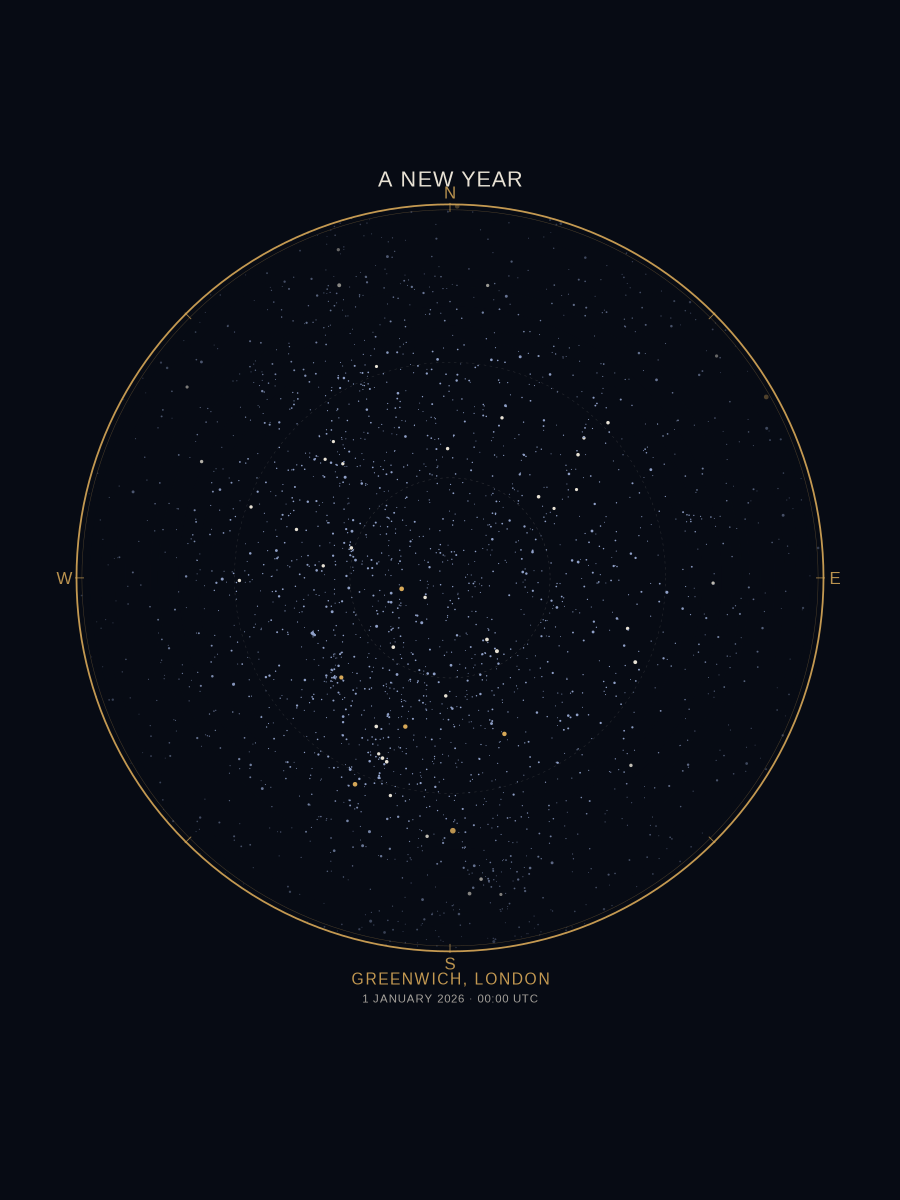
Ours plots 5,044 stars, every star down to magnitude 6, which is about the naked-eye limit under a properly dark sky, taken from the d3-celestial star catalogue. The sky is drawn as a stereographic projection: the point directly overhead at the centre and the horizon as the rim. Because a sky chart is read as if held above your head, east is on the left when north is at the top, the opposite of a road map. Only stars above the horizon at that moment are drawn, so maps of the same night for Penzance and Inverness differ most around the edge, where each place has stars the other cannot see.
What the print shows, and what it leaves out
You can chart any date from 1900 to 2100, past or future, and the time you enter is read as local to the place. A title of up to 40 characters can sit above the circle, with the place and date printed beneath it. Only stars are plotted. The Moon and planets are not drawn, and nor are the weather, the landscape or the bending of starlight near the horizon by the atmosphere. Brighter stars are drawn as larger dots, and the few brighter than magnitude 1 are picked out in gold.
One print can also carry two moments, say the night two people met and their wedding day, with one chart above the other and a caption for each. That layout comes as a poster, a framed poster or a digital file. A single-moment poster runs from £22.99 at A4 to £54.99 at 70 x 100 cm, a canvas starts at £85.00 and the digital download is £14.99. We do not print star maps on mugs or bottles, because the caption text would come out smaller than 7 point at that size.
For the long version, a worked Greenwich example and how to pick your moment opens Your own sky. The same stage also covers turning a photograph into cosmic art, which is the other way to put something of your own on the wall.
Written by Craig Fearn, Aphelion Prints. Last updated .