What astronomy art is
Astronomy art is any wall art that takes the night sky and the wider cosmos as its subject: the planets, the Moon, distant nebulae, the machines we send out to meet them. It spans a handful of distinct genres, and they look nothing alike. A photoreal galaxy and a flat, graphic travel poster are both astronomy art, yet they ask for very different walls. The five that matter most are deep-space scenes, the Solar System, lunar work, retro travel posters and spacecraft drawings.
The main genres
Each genre carries its own mood. Learn the five and you can read any astronomy print at a glance, and, more usefully, know whether two of them belong together.
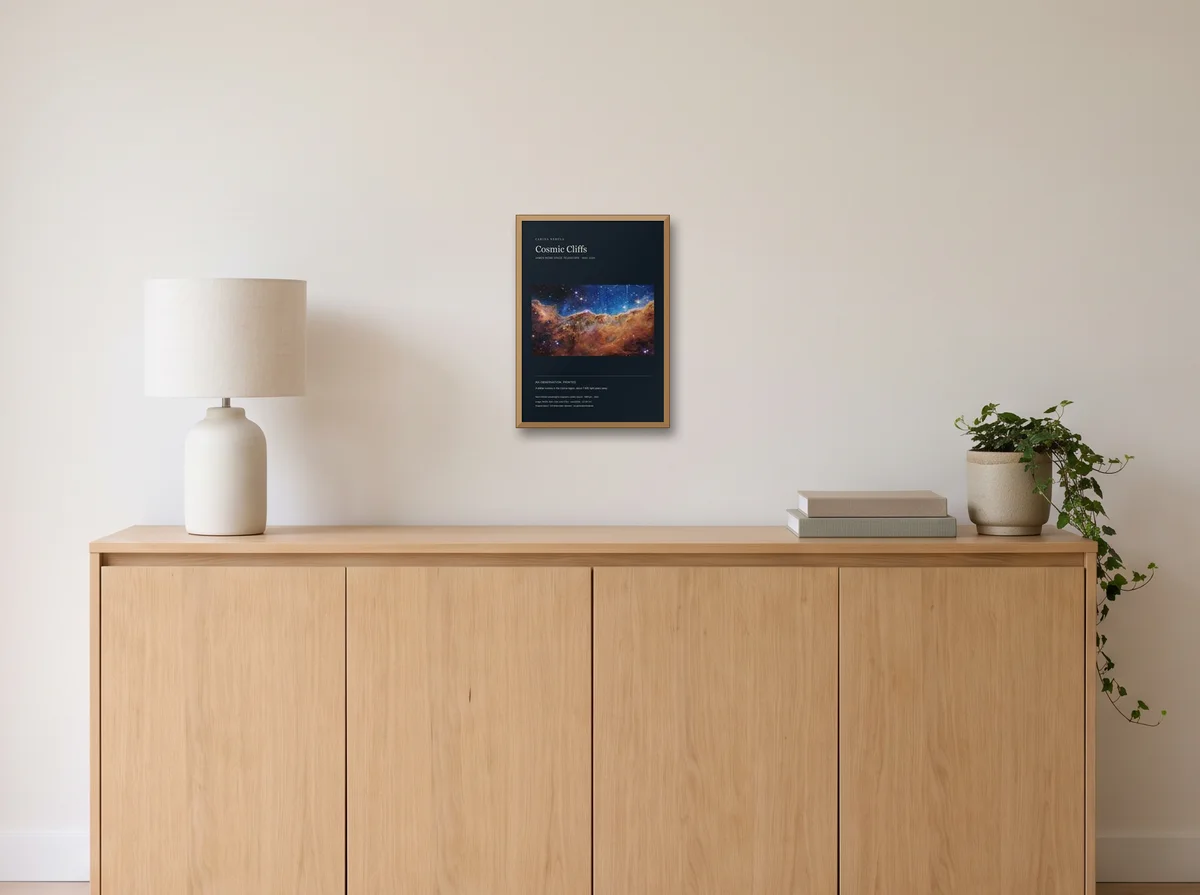
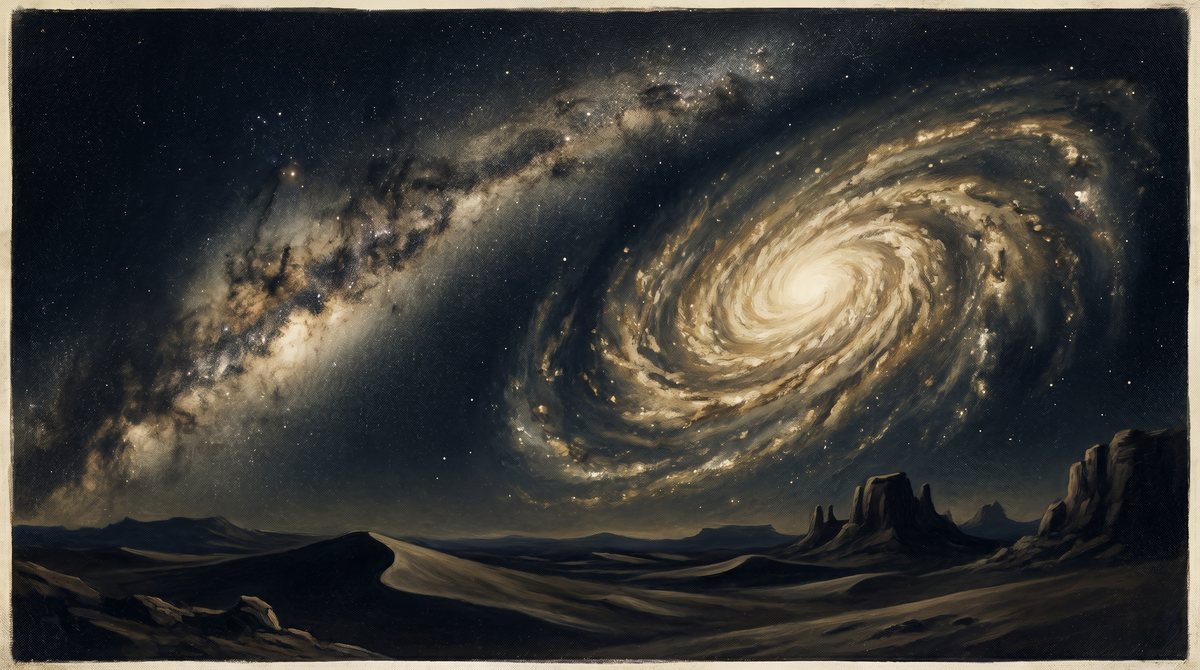
- Deep-space scenes: nebulae and galaxies, rich, atmospheric and slow to read. These are the prints that turn a room quiet. See the galaxy collection.
- The Solar System: the planets in their order, charts of the neighbourhood, single worlds close up. Familiar and grounding. See solar system prints.
- Lunar: phases, soft watercolour moons, the cratered surface in detail. The most forgiving genre to start with. See moon wall art.
- Retro travel posters: graphic, optimistic, in the golden-age style that imagines tourism among the planets. Bold, warm and easy to live with. See space posters.
- Spacecraft drawings: treatments range from an AI blueprint look, such as Voyager, to original reference-based linework, such as the Apollo Lunar Module schematic. Check the process and source notes; a blueprint appearance does not establish measured engineering geometry. Both can suit a study beside a travel poster.
Choosing prints that work together
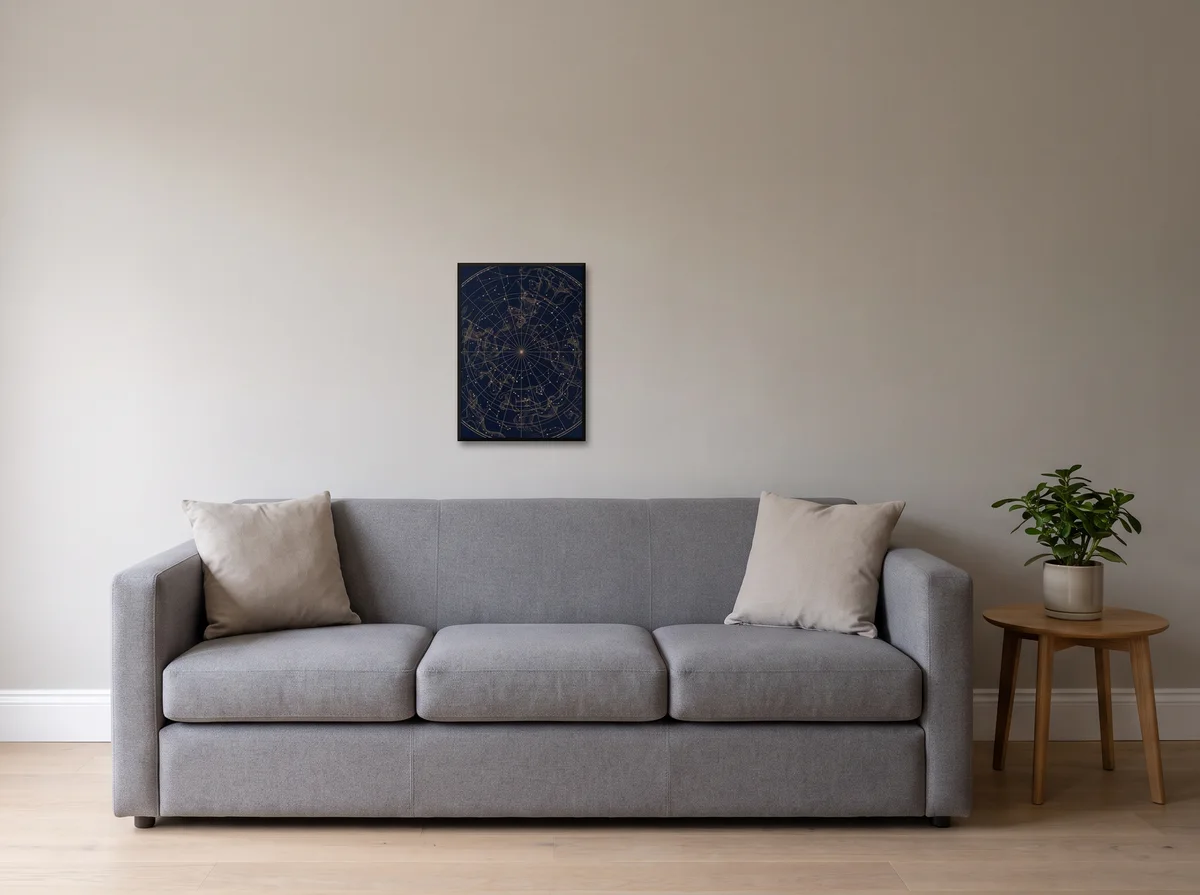
A wall holds together when its prints share a through-line. Pick one: a palette (cool blues throughout, or warm golds) or a treatment, so everything is either minimal or painterly, or a plain theme, where the whole wall stays lunar. Any one of those is enough to make a mixed set look deliberate.
Then think in terms of one focal piece and its supporting cast. A single bold print (a wide nebula, a large planet) earns the most space and the eye goes to it first. Two or three quieter prints around it carry the rest. Three loud pieces competing for attention almost always works less well than one bold print and two that defer to it.
A Moon and stars pair
For a small wall, put Lunar Phases beside Northern Constellations. Both use fine gold-coloured detail on dark ink. The simple vertical lunar sequence gives the circular constellation illustration room to lead. Keep both sheets portrait, choose the same size and align their top edges. These are decorative artistic interpretations; the lunar piece is not a calendar and the constellation piece is not a dated observing chart.
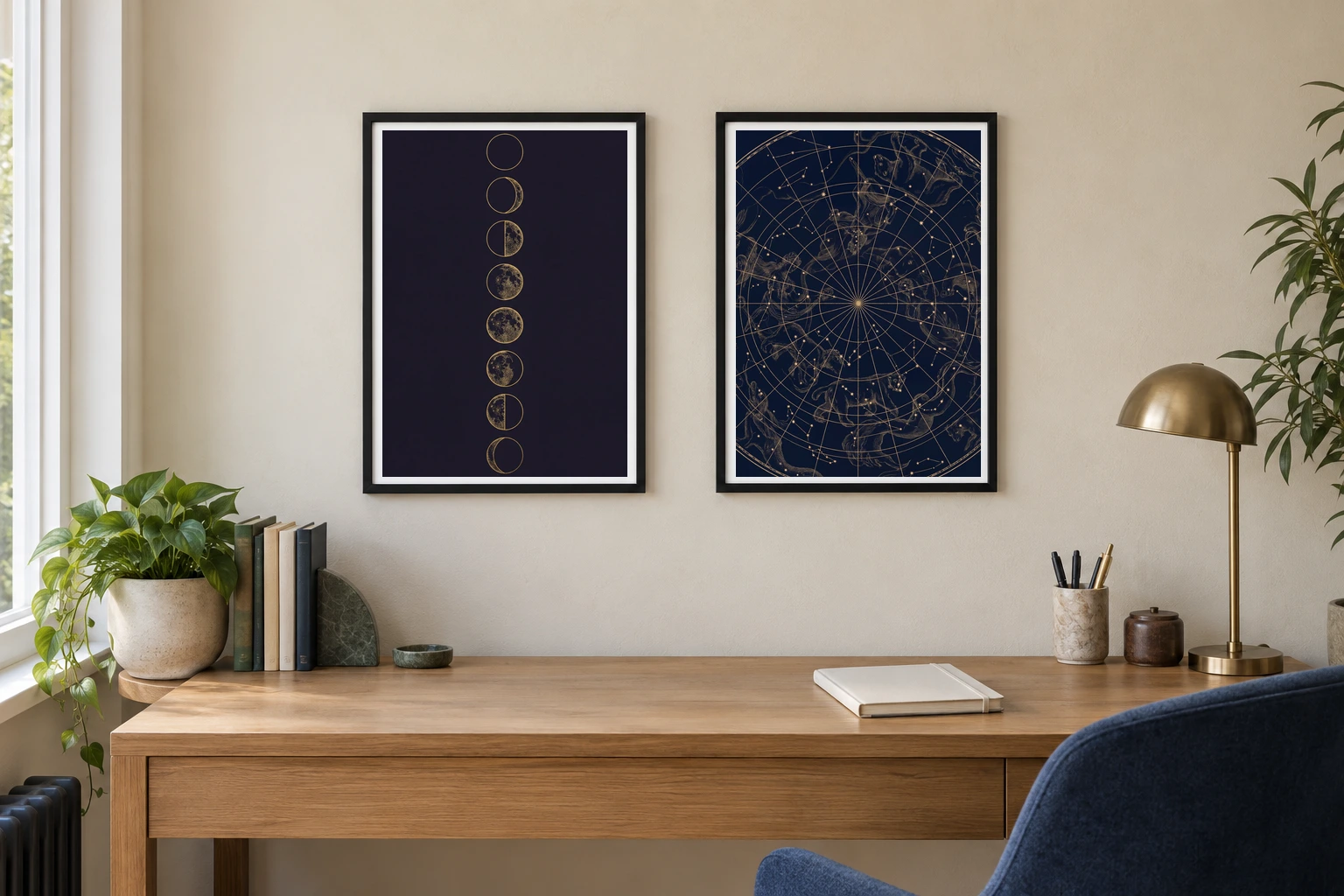
For the arrangement shown in the paper diagram, choose Lunar Phases as an A4 poster and Northern Constellations as an A4 poster. For a larger pair, choose Lunar Phases as an A3 poster and Northern Constellations as an A3 poster. The links open the matching poster selection; check the selected size and current price on each page before adding it to your basket.
Extend it to three prints
Add the existing Zodiac Constellations illustration on the right, leaving Northern Constellations in the centre. The mythological figures repeat its circular composition and gold-coloured linework. Choose the matching A4 poster or A3 poster. This is a suggested combination of separately sold prints; choose and add each piece individually.
Measure between the paper edges
Try a 60 mm gap between paper edges. Each A4 sheet is 210 × 297 mm, so the pair spans 480 mm and the trio spans 750 mm. Each A3 sheet is 297 × 420 mm; with the same 60 mm gaps, the pair spans 654 mm and the trio spans 1,011 mm. These widths exclude frames and mounts. If you frame the posters, measure the actual outer frames and allow extra space; the paper size isn't the framed size.
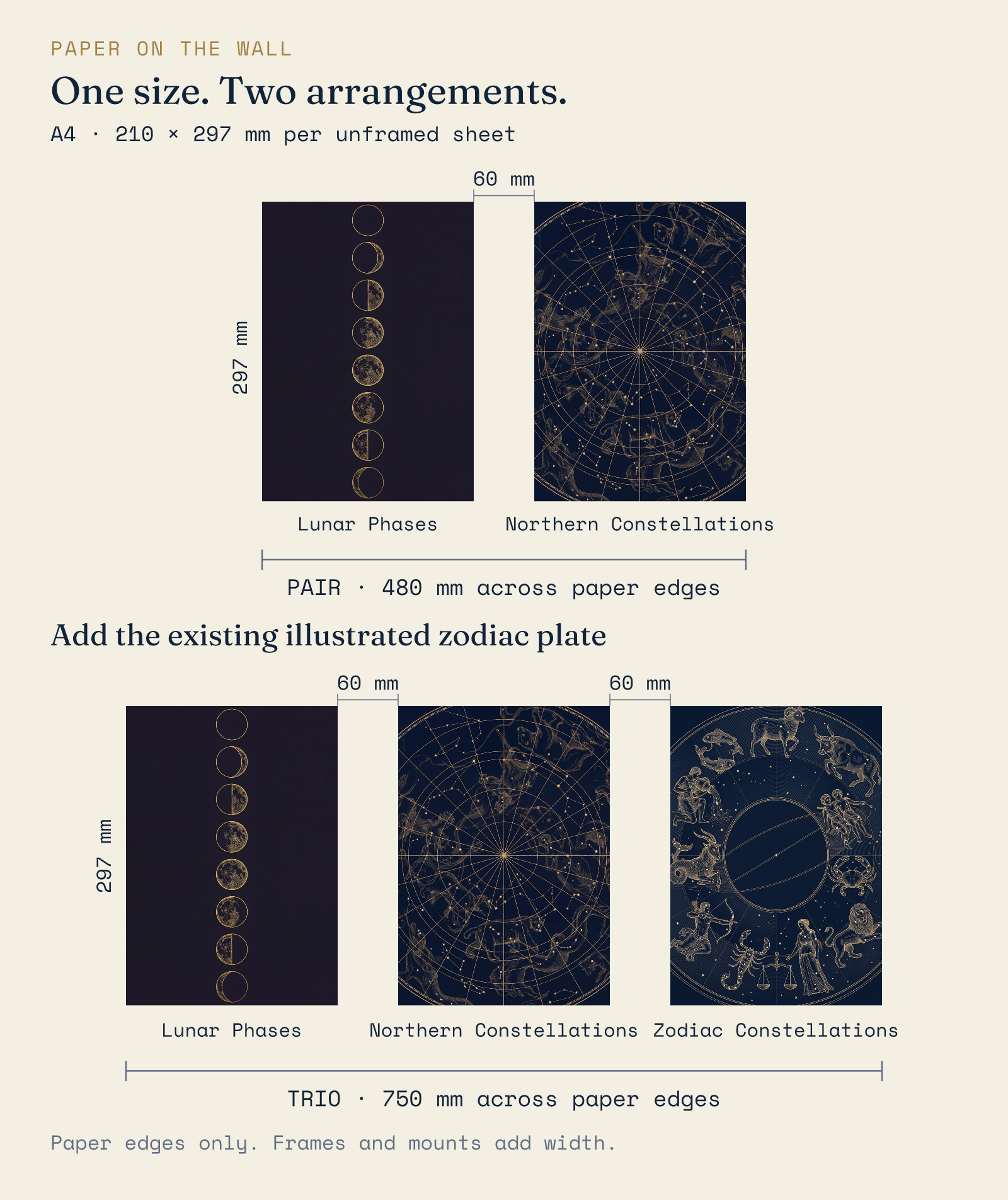
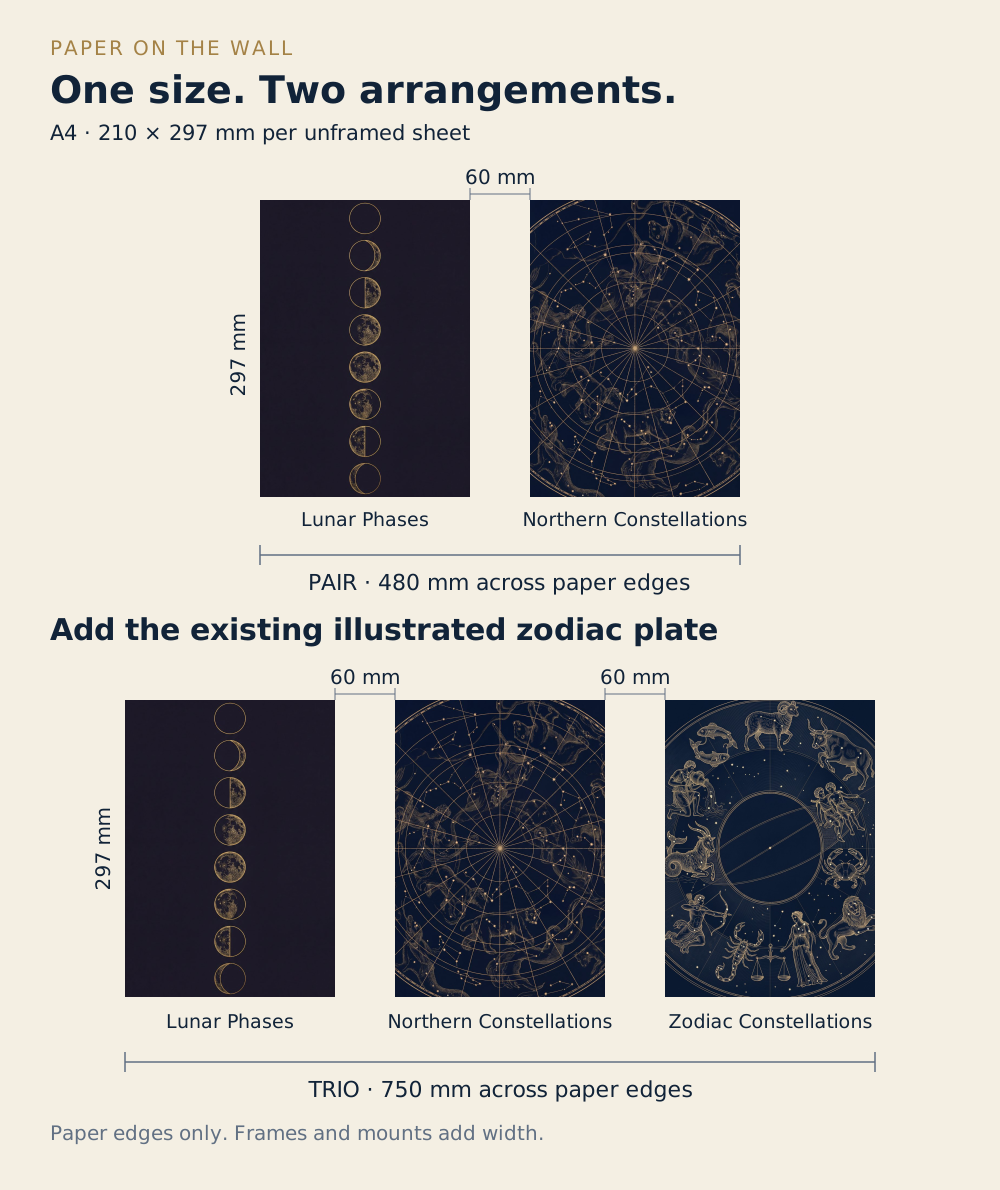
Open the full-size labelled pair and trio diagram to inspect the dimensions. The diagram shows the A4 paper trim; the room view above illustrates a framing idea.
Choose matching posters
The blocks below show current starting poster prices from the catalogue. Choose the same A4 or A3 size on each product page; frames are not included with those posters.
Framing and size for dark astronomy art
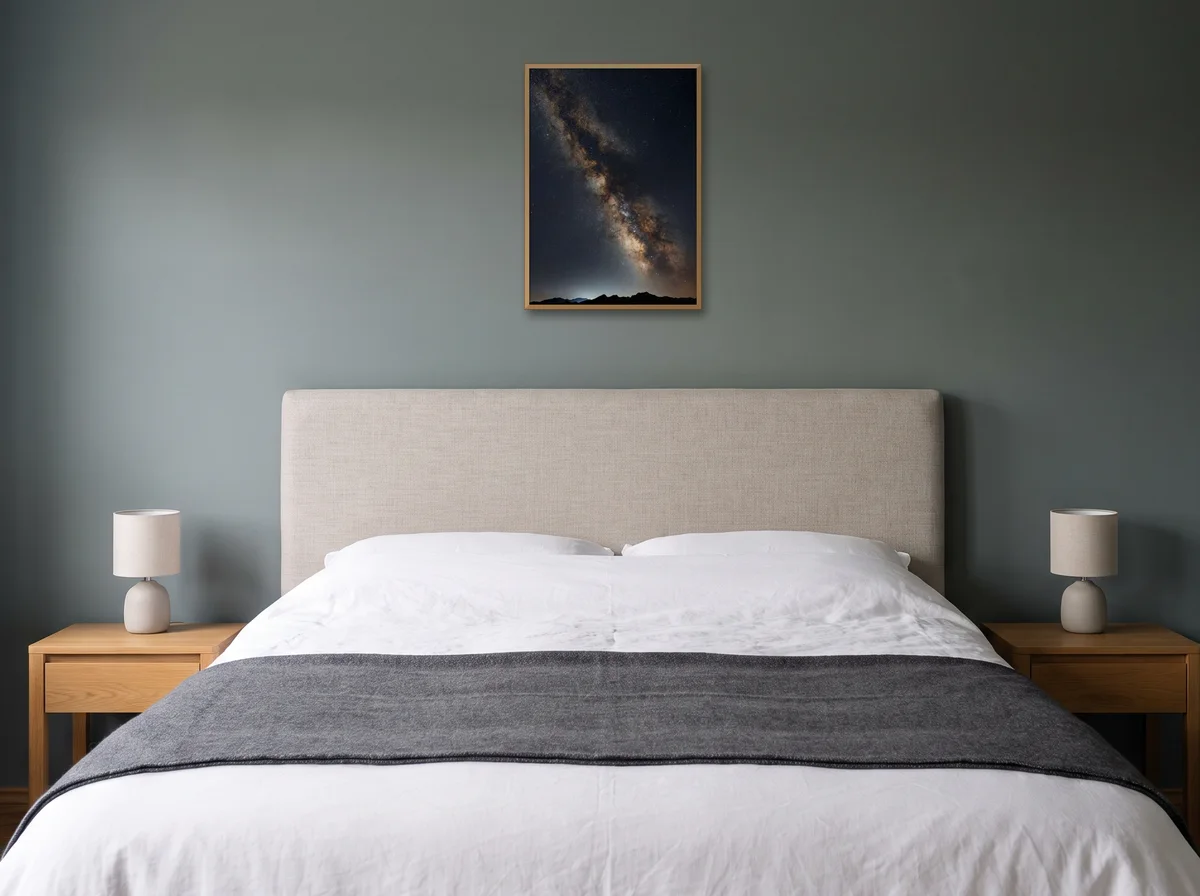
Most astronomy art is dark, and dark prints have their own rules. A black frame disappears into the image and lets the colour do the work; natural wood warms it and softens the edge against a pale wall. Either suits the genre, busy or ornate frames fight it. Leave a little breathing room in the mount so the dark field has somewhere to sit.
On size, go larger than feels safe for a single focal print. Deep-space scenes in particular lose their depth when shrunk, and a generous format is what makes a room feel considered rather than decorated. For a gallery wall, keep the pieces closer to a uniform size and let the spacing, not the scale, give it rhythm.
Making it personal
Astronomy art needn't be off-the-shelf. With Cosmic Canvas you can turn your own night-sky photograph into art (a meteor shower you stood out for, the Moon over somewhere that matters) rendered in one of the Cosmic Canvas styles. If your image is already finished, you can print it as it is. A print of a sky you watched yourself reads differently from one you bought.
If you are making astronomy art yourself
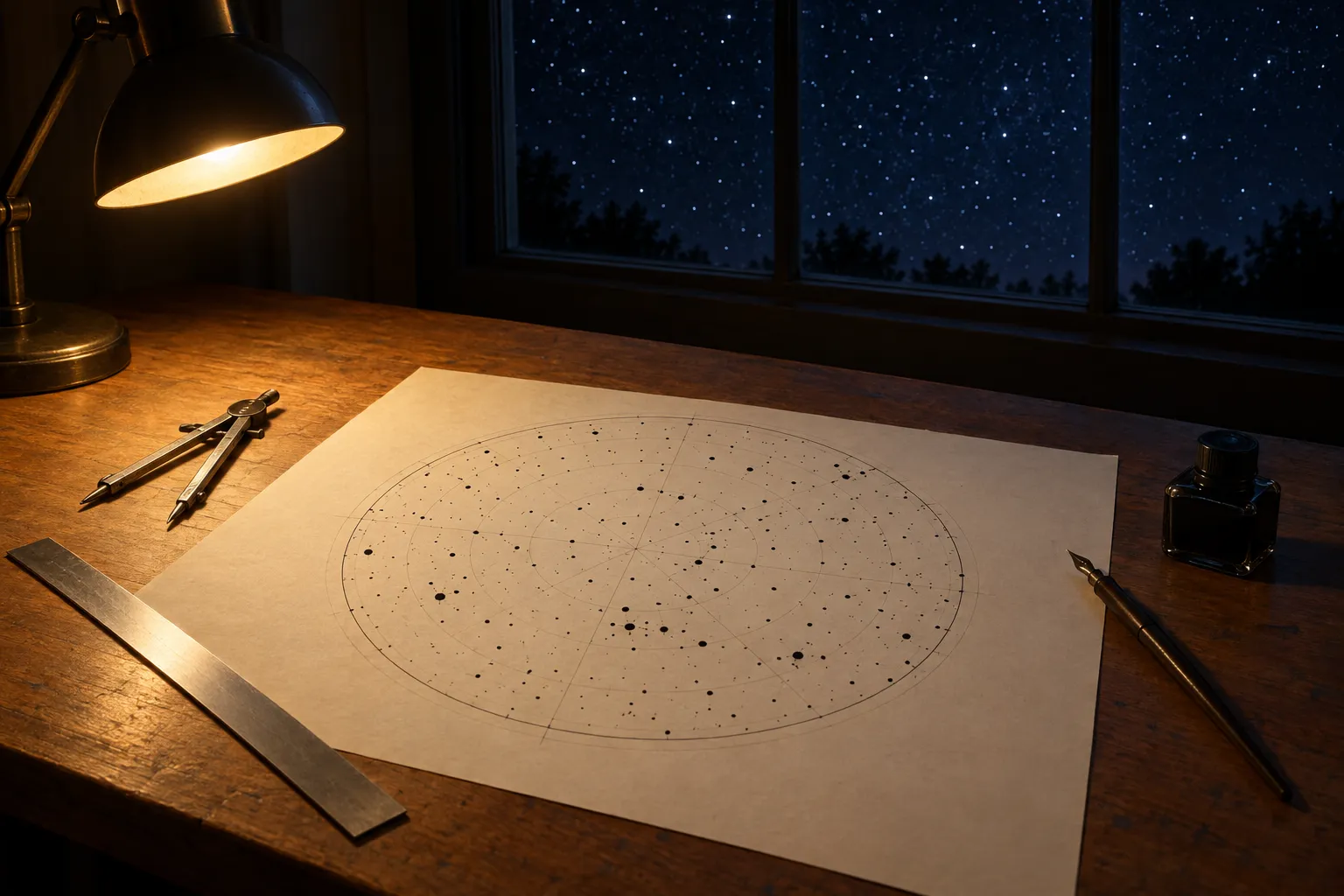
For an educational diagram or a dated sky map, the underlying science needs to be right. Decorative artwork can interpret its subject freely, while a reference chart needs clear conventions and accurate inputs. Three useful checks follow.
- The phase order is fixed, and there are eight of them. NASA lists eight, in one fixed order, over a cycle of about 29.5 days. The phases guide sets them out, and the moon phase checklist shows how to check a sequence.
- Nebula colour is partly a choice. NASA notes that the colours in a Hubble image follow the filters used to collect the data, and are partly a creative choice. So you are picking a palette, and you may as well pick deliberately. The sources are set out here.
- Constellations have boundaries. NASA counts 88 officially recognised constellations, and they are not free-hand joins between whichever stars suit the composition. How they were fixed is worth ten minutes before you place a single star.
These checks help with reference diagrams. An artistic interpretation can take a different approach, provided its purpose is clear.
Buying with confidence
Every piece is made to order, so nothing sits in a warehouse: your print is produced when you order it and delivered anywhere in the UK, delivery included. Start with one focal print you love and build the wall outward from there. Browse the full catalogue when you're ready to choose.
This guide closes On the wall. The two answers behind most of its advice are the right size for a wall and canvas, framed print or poster.