16 June 2026
The 8 Phases of the Moon, Explained
The Moon moves through eight phases in roughly 29.5 days: new, waxing crescent, first quarter, waxing gibbous, full, waning gibbous, last quarter and waning crescent. Here's what each one is.
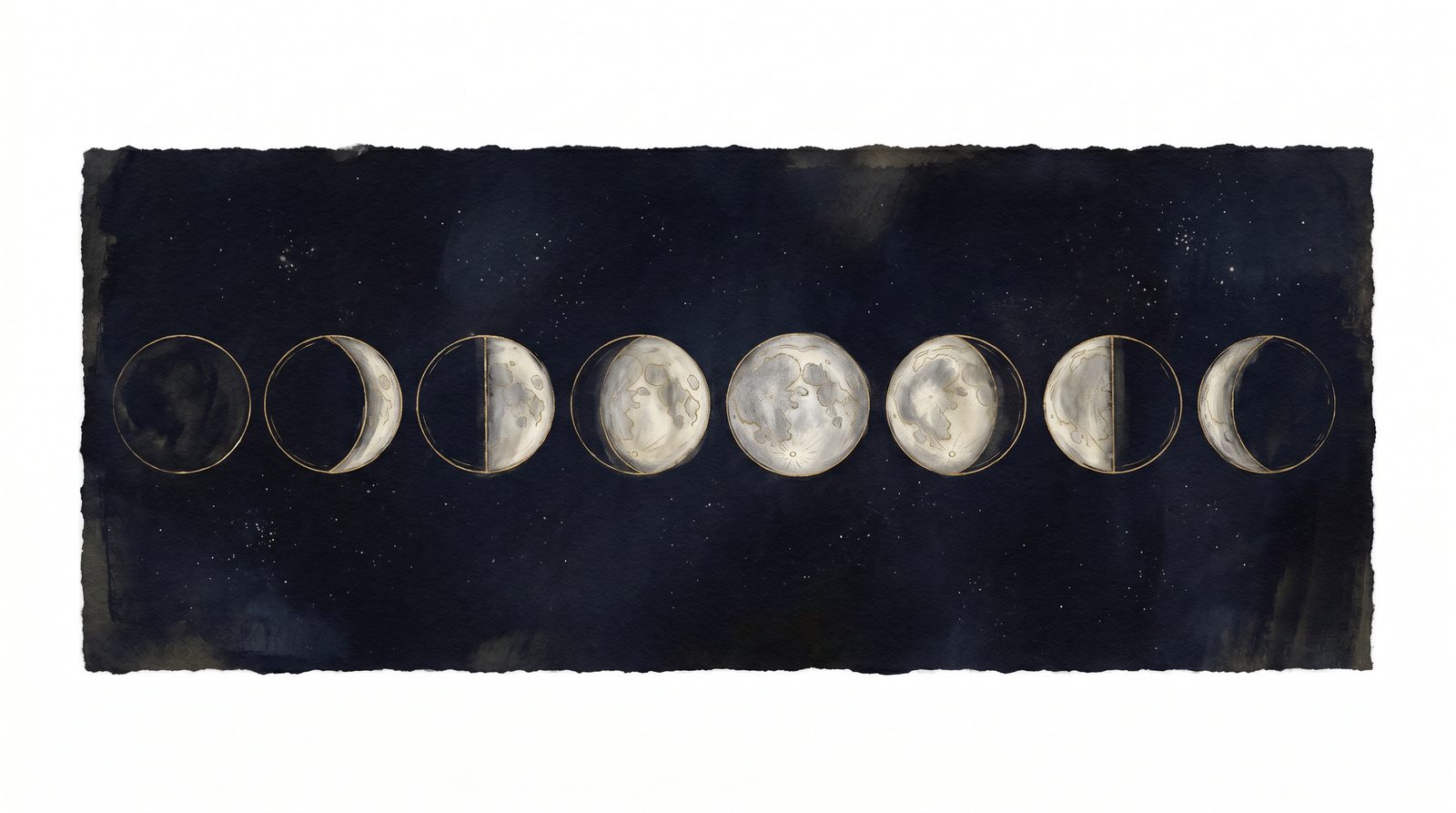
The Moon moves through eight phases in a cycle of roughly 29.5 days: new moon, waxing crescent, first quarter, waxing gibbous, full moon, waning gibbous, last quarter and waning crescent. Each is simply our changing view of one half of the Moon, lit by the Sun, as it travels around the Earth. Nothing about the Moon itself changes — only the angle from which we watch it.
The eight phases, in order
The cycle begins in darkness and returns to it. Light grows along one edge, swells to a full disc, then thins away along the other — a slow, dependable arc you can follow across a month of clear nights.
New moon
The Moon sits between the Earth and the Sun, so its lit half faces away from us. The near side is in shadow and the Moon is, for a night or two, effectively invisible — lost in the Sun's glare. This is where the cycle resets.
Waxing crescent
A thin sliver of light appears on the right-hand edge — from the northern hemisphere — and begins to grow. Waxing means the lit portion is increasing. You'll catch a waxing crescent low in the west just after sunset.
First quarter
Half the visible disc is now lit. It's called a quarter not because a quarter is showing, but because the Moon has completed a quarter of its orbit. It rises around midday and sets around midnight, riding high in the evening sky.
Waxing gibbous
More than half is lit now, the disc swelling toward full. Gibbous simply means humped or bulging — the term for any phase between a quarter and a full moon. The shadowed edge shrinks a little each night.
Full moon
The Earth lies between the Sun and Moon, and the whole near side is lit. A full moon rises as the Sun sets and stays up all night — the brightest, roundest moment of the month, and the one that has drawn human attention for as long as we've looked up.
Waning gibbous
Past full, the lit area begins to shrink. Waning means the illuminated portion is decreasing. The Moon now rises later each evening, well after dark, and the shadow creeps back across the disc from the opposite edge.
Last quarter
Half lit again, but the other half this time — the mirror of the first quarter. Also called the third quarter, it marks three-quarters of the orbit complete. It rises around midnight and is best seen in the small hours and at dawn.
Waning crescent
A thinning sliver lingers in the pre-dawn east, dimming night by night until the shadow takes the last of it. Then the Moon returns to new, and the whole quiet sequence begins again.
Why the Moon has phases
The Moon doesn't make its own light — it reflects sunlight. One half of it is always lit and the other always dark, just as one half of the Earth always faces the Sun. As the Moon orbits us, we see varying amounts of its lit half. The phases are nothing more than our changing view of the line between lunar day and night.
It helps to picture the geometry. At new moon the Moon is roughly between us and the Sun, so the dark side faces Earth. At full moon it's on the far side of us from the Sun, so the lit side faces Earth. In between, we catch the lit half at an angle — a crescent, a quarter, a gibbous swell. Eclipses are rare because the Moon's orbit is tilted, so it usually passes a little above or below the Sun-Earth line.
Waxing, waning and the in-between names
Two words carry the whole cycle. Waxing means growing — the lit portion is increasing toward full. Waning means shrinking — the light is retreating toward new. From the northern hemisphere, a waxing Moon brightens on the right; a waning Moon thins from the right, leaving light on the left.
The other terms describe shape. A crescent is less than half lit — a curved sliver. A quarter shows exactly half the disc, marking a quarter or three-quarters of the orbit. A gibbous moon is more than half but not yet full. Pair these with waxing or waning and you can name any phase at a glance.
How long is the lunar cycle?
One full cycle — new moon to new moon — takes about 29.5 days. This is the synodic month, and it's what we mean by a lunar month. It's why most calendars settle on months of roughly that length, and why twelve lunar months fall a little short of a solar year.
There's a subtler figure worth knowing. The sidereal month — the time the Moon takes to return to the same position against the background stars — is about 27.3 days, shorter than the synodic month. The difference exists because the Earth is also moving around the Sun, so the Moon must travel a touch further each cycle to line up with the Sun again. The phases follow the synodic 29.5 days; the stars follow the sidereal 27.3.
The phases as wall art
Laid out as a row, the eight phases make a quietly perfect print — a calendar of the night, drawn in light. There's a calm in the sequence: it asks nothing of you, repeats without fail, and turns a wall into a small window on something far older than the room. Few images do so much with so little.
Our Lunar Phases plate renders the full cycle in fine gold line — new to full and back to new — for those who like the night kept close. You'll find it, and more besides, in the moon & lunar collection.
Frequently asked
What are the 8 phases of the moon in order?+
New moon, waxing crescent, first quarter, waxing gibbous, full moon, waning gibbous, last quarter, waning crescent.
How long is one full moon cycle?+
About 29.5 days from one new moon to the next — a lunar month.
What does waxing and waning mean?+
Waxing means the lit portion is growing toward full; waning means it is shrinking back toward new.