18 June 2026
What Is a Constellation? The 88 Patterns, Explained
A constellation is a recognised pattern of stars — and, in the modern sense, a defined patch of sky around it. There are 88 official ones, set by the International Astronomical Union, and together they map the entire sky. Here's what that means, and how to read them.
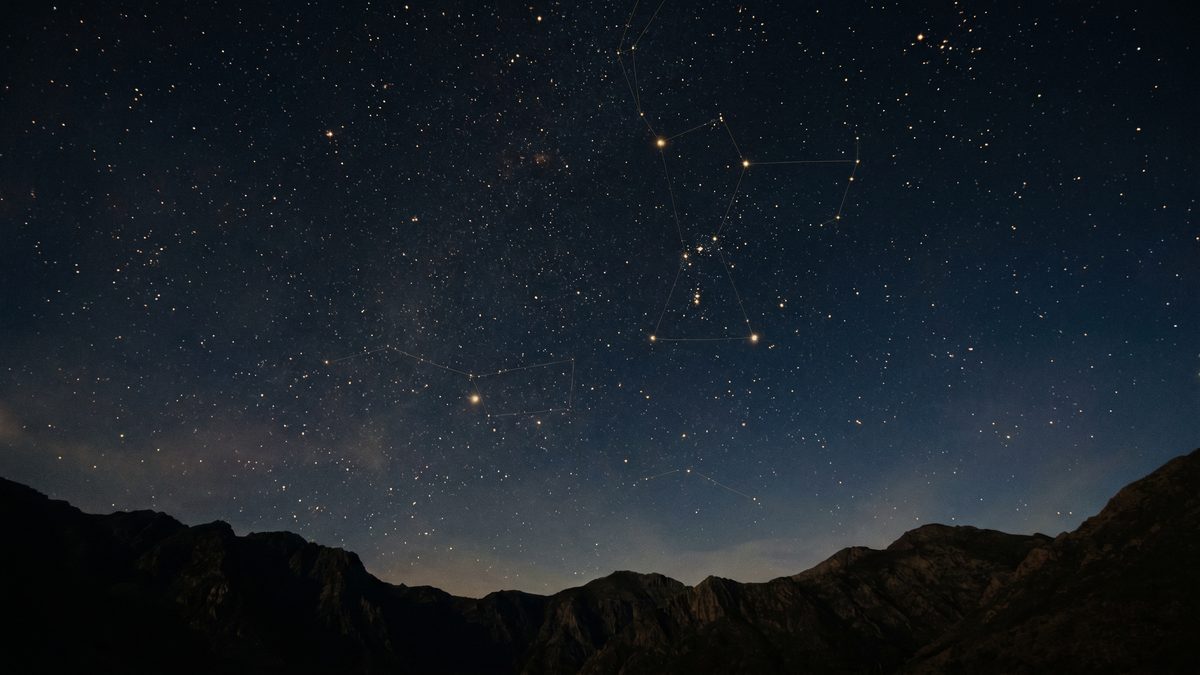
A constellation is a pattern of stars we've learned to recognise — and, to an astronomer, the region of sky that surrounds it. The Royal Observatory Greenwich puts the everyday version simply: constellations are groups of stars that together form recognisable patterns. The International Astronomical Union, which sets the official ones, defines each more strictly as an area of the sky inside a fixed boundary. Both are true; one is the shape, the other is the territory.
That second meaning surprises people. A constellation isn't only the dot-to-dot of bright stars — it's a parcel of sky, and every faint star, galaxy and planet that happens to drift through it is "in" that constellation while it's there. Here's how the 88 came to be, and how to actually find a few.
How many constellations are there?
Eighty-eight. The number is fixed because a single body decides it: the International Astronomical Union. The IAU adopted the list of 88 names at its first General Assembly in Rome in 1922, then approved precise boundaries — drawn along lines of right ascension and declination — at its 1928 meeting, published in 1930. NASA uses the same count. Between them, those 88 regions tile the whole celestial sphere with no gaps and no overlaps, so every point in the sky belongs to exactly one constellation.
It's worth knowing those boundaries are a fairly recent convention, not something eternal. For most of history a constellation was just a remembered shape, and different cultures drew different ones. The tidy modern map — every degree of sky accounted for — is barely a century old.
Constellation or asterism — what's the difference?
Here's the distinction that trips most people up. An asterism is a star pattern that isn't one of the 88. The most famous example in the northern sky is the Plough — or the Big Dipper, if you grew up with that name. It looks like a constellation, but it isn't one: it's the seven brightest stars of Ursa Major, the Great Bear, which is the actual constellation they sit inside.
So an asterism is a pattern; a constellation is an official region that may contain one or more asterisms. Orion's Belt is an asterism within Orion. The Summer Triangle is an asterism spanning three different constellations at once. Once the difference clicks, the sky gets easier to talk about.
Are the stars in a constellation actually close together?
Almost never. This is the part that quietly rewires how you see the sky. The stars of a constellation look like a group, but they're a trick of perspective — bright points at wildly different distances, lined up by chance from where we happen to stand. As NASA puts it, constellations aren't real objects; they're patterns seen from our observation point, and their stars can be separated by enormous distances with no real connection to each other.
Take Orion. The stars that draw its familiar figure sit at distances ranging from a few hundred to well over a thousand light-years. They feel like neighbours; they're nothing of the sort. Fly to another star and the whole pattern would dissolve into something unrecognisable. A constellation, in other words, is a thing we make — a line we draw between unrelated lights.
Which constellations can you see from the UK?
Plenty, and a few are up every clear night. From British latitudes, some constellations are circumpolar — they never set, wheeling around the North Star instead. Two are worth learning first:
- Ursa Major — home of the Plough, the easiest pattern to spot, visible all year and a signpost to almost everything else.
- Cassiopeia — a bright zig-zag like a "W" (or an "M", depending on the season), sitting opposite the Plough across the pole.
- Orion — not circumpolar, but the showpiece of winter evenings; find the three stars of the Belt in a short straight row and the rest follows.
Once you can find those, the others fall into place around them. The Plough's two end stars point at Polaris; Orion's Belt points down to Sirius, the brightest star in the sky. The constellations are, among other things, a map you read with your eyes.
Constellations, zodiac signs and galaxies — clearing up the muddle
Three quick distinctions save a lot of confusion. First, a constellation is astronomy; a star sign is astrology. The zodiac constellations are real patches of sky, but the horoscope signs tied to birthdays aren't astronomy — they parted ways with the actual sky long ago.
Second, a constellation is not a galaxy. A constellation is a pattern or region of sky; a galaxy is a vast, gravitationally bound system of billions of stars, like our own Milky Way. A single constellation's patch of sky contains countless galaxies far beyond its stars. And third, a constellation isn't a fixed, permanent thing — over very long timescales the stars drift (an effect called proper motion), and the shapes we know slowly deform. The night sky is patient, but it isn't still.
From the patterns to your wall
There's a reason people have hung the constellations on their walls for centuries: they're a map, a story and a decoration at once. Our constellation prints and star charts draw the northern sky in the manner of an old celestial atlas — fine engraved lines over deep midnight blue. And if you'd like the sky for one particular night and place rather than the catalogue of patterns, a personalised star map charts the real constellations exactly as they stood over a date that matters.
Either way, you're hanging the same thing astronomers map and sailors once steered by — the 88 patterns we've drawn across the dark. Browse the wider astronomy prints collection for where they sit among nebulae, planets and galaxies.
Frequently asked
What is a constellation?+
A constellation is a recognised pattern of stars in the night sky and, in the strict modern sense, a defined area of the sky around that pattern. There are 88 official constellations, and together their boundaries cover the entire sky without gaps.
How many constellations are there?+
Eighty-eight. The International Astronomical Union adopted the list of 88 names in 1922 and approved their official boundaries in 1928, published in 1930. They divide the whole sky between them.
What is the difference between a constellation and an asterism?+
A constellation is one of the 88 official sky regions; an asterism is an informal star pattern that is not on that list. The Plough (or Big Dipper) is an asterism — the seven brightest stars of the constellation Ursa Major.
Are the stars in a constellation close together?+
Usually not. They only look grouped from Earth. NASA describes constellations as patterns seen from our viewpoint, whose stars can lie at hugely different distances with no real connection to one another. It's a line-of-sight effect.
Which constellations can I see from the UK?+
Ursa Major (containing the Plough) and Cassiopeia (a W or M shape) are visible all year from the UK because they are circumpolar. Orion, with its three-star belt, dominates the winter sky.