18 June 2026
Personalised Star Maps: What They Show & How to Choose the Moment
A personalised star map shows the real night sky over one place, on one date and time — the actual stars that stood above a birth, a wedding or a first meeting. Here's what one shows, why the date, time and place all change it, and how to choose the moment.
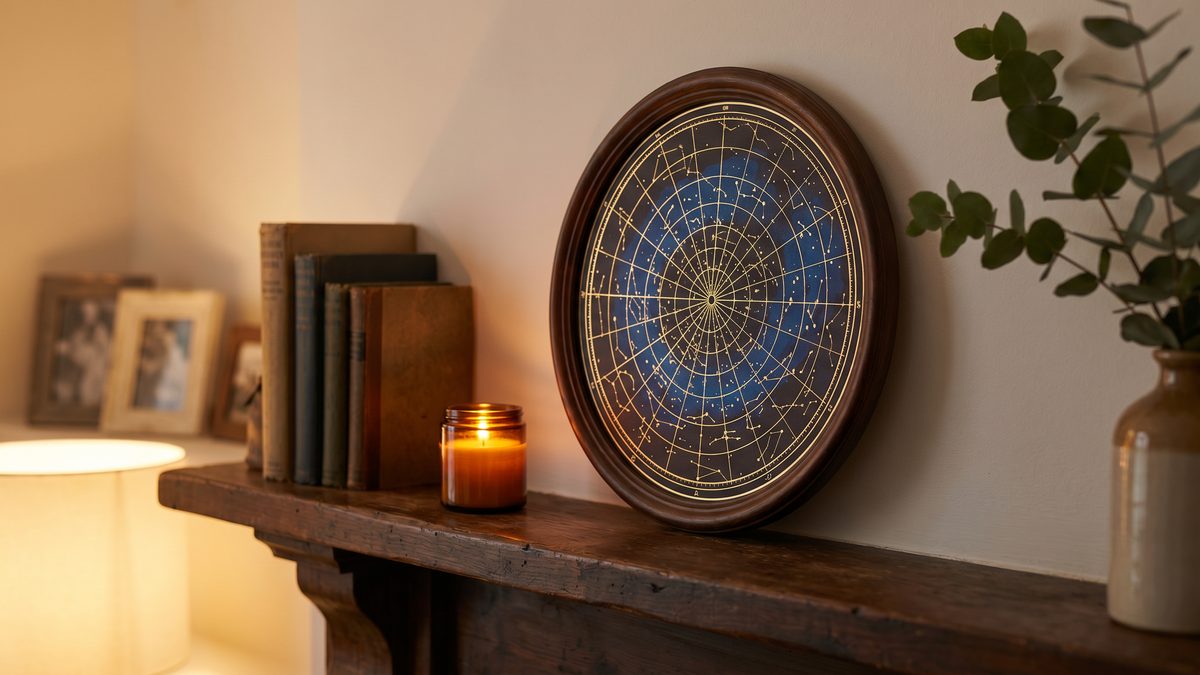
A personalised star map is a chart of the night sky as it really looked over one spot on Earth, at one moment in time. Not a pattern someone designed — the genuine arrangement of stars above that horizon, on that date, at that hour. Give it a place and a moment and it fixes the sky in place, the way a photograph fixes a face.
That's what makes it such a quietly good gift. Anyone can buy a print; a personalised star map records something that happened only once. Below is what one actually shows, why the date, time and place each change it, and how to pick the moment that's worth keeping.
What does a personalised star map show?
It shows the sky above your horizon at a chosen moment. Picture standing in an open field and looking straight up: the circle on the map is everything you could see from there, rim to rim, with the point overhead at the centre and the horizon running round the edge. The stars are placed where they truly sat — bright ones larger, faint ones smaller — so the shapes of the constellations come through.
A traditional planisphere, the rotating star wheel astronomers have used for generations, does the same job by hand: you dial in a date and time and it reveals the constellations above you. A personalised star map is that idea, frozen to a single meaningful moment and printed for the wall. The Royal Observatory Greenwich describes a planisphere as a tool that reveals the constellations visible at a given latitude on any night of the year — which is exactly the calculation behind a good star map.
Why do the date and time change the stars?
Because the sky is always turning. The stars themselves stay put, more or less, for a human lifetime — what moves is us. As the Royal Observatory Greenwich explains, the constellations only appear to move through the night and across the year because Earth is spinning on its axis and travelling around the Sun. Two motions, two effects.
The first is the spin. Earth turns once a day, so the whole sky wheels overhead through the night — roughly 15 degrees every hour. A map made at 9pm and one made at 1am on the same date show the same stars in different places, some risen, some set. The second is the orbit. As Earth loops the Sun across a year, the night side faces a slowly changing slice of space, so June's evening sky and December's are different skies entirely. Change the date, change the stars on show; change the time, turn the whole wheel.
Here's the reassuring part, though. You don't need the time to the minute. An hour either way nudges things gently and never changes the feel of the map, so a remembered "sometime that evening" is plenty. When nobody recalls the hour, we default to a pleasant evening sky.
Why does the location matter so much?
Because where you stand decides which half of the sky you can see at all. Someone in Edinburgh and someone in Cape Town, looking up on the very same night, see almost opposite skies. The clearest proof is the North Star. Polaris sits almost directly above the North Pole, which is why every other northern star appears to wheel around it — and why, as the Royal Observatory Greenwich explains in its guide to Ursa Minor and Polaris, it has guided travellers north for centuries. Stand far enough south and Polaris drops below your horizon completely. It simply isn't in your sky.
So the place isn't a label on the print — it genuinely sets the contents. A map for a birth in Manchester and one for a birth in Buenos Aires are different maps, because those two patches of Earth were facing different stars. That's the whole reason a star map feels personal: pick another city and you'd get another sky.
Is a star map the same as a star sign?
No — and it's worth being clear, because the two get muddled. A star sign is astrology: a zodiac name pinned to a birthday, a symbol with no bearing on what was overhead. A star map is astronomy: the measured positions of real stars and constellations above a real place on a real date. One is a horoscope; the other is a record of the sky.
A small myth worth retiring while we're here: the North Star is not the brightest star in the sky. Polaris is only the brightest in its own little constellation, and fairly modest overall — Sirius outshines it easily. Polaris matters for its position, not its brilliance. If you'd like to learn the real constellations behind a chart, our guide to constellation prints and star charts is a good next stop.
How many stars will a star map show?
More than you'd guess, and fewer than the internet often claims. Under a genuinely dark sky a sharp pair of eyes might take in somewhere around 2,000 to 2,500 stars at once — a widely cited estimate rather than a fixed figure, since it swings with conditions, eyesight and how much of the night is up. The reasoning is tidy enough: by the usual estimate, somewhere around 9,000 stars are bright enough to see without a telescope across the entire sphere, you can only ever face one hemisphere of it, and only the night half is above the horizon. Halve, halve again, and you land near a couple of thousand.
A printed star map usually plots the brighter, named stars — the ones that draw the constellations — rather than every faint speck, so the shapes stay legible at arm's length on a wall. NASA's skywatching pages are a lovely way to see how much the visible sky shifts from month to month, which is the same effect a dated map captures and holds still.
Which moments make the best star maps?
The ones you'd want to stand under again. A few that work especially well:
- A birth. The sky over the hospital, the night a person arrived.
- A wedding or the day you met. One sky, two people, kept on the wall.
- A first home. The stars over the new address, the first night in.
- A goodbye. Quietly, a star map can hold the sky over a last day, too.
The gift works because it's specific. It isn't "space" in the abstract — it's that night, over that place, and only the person it's for could own it. Pair it with a title or a name and it stops being décor and starts being a record.
What should you write on a star map?
Less than you'd think. The map does the heavy lifting; the words just anchor it. Two lines beneath the chart carry almost every star map you'll see: the place and the date. "London, United Kingdom" and "14 February 2019" is enough to fix the whole thing in a particular night.
Above the chart you can add a short title if you'd like one — a name, a line, a single word. Keep it brief and let it breathe; a star map looks best with plenty of dark around the circle, so resist the urge to crowd it. "Under these stars", a couple's names, or simply "The night you arrived" all sit well. If you're stuck, leave the title off entirely — place and date alone are quietly perfect, and arguably more elegant.
Poster, framed print or canvas?
All three suit a star map; it comes down to the room and the feeling. A poster is the lightest, keenest option and frames beautifully later if you change your mind. A framed print arrives ready to hang in black or oak — the safe choice for a gift, since there's nothing left to do but find a nail. And a canvas leans into the depth of the night sky: its matte weave swallows glare and holds those near-black grounds without the cold sheen of glass.
For a present, our honest steer is a framed print at a middling size — substantial enough to read across a room, finished enough to give as-is. For your own wall, a canvas of the same sky is hard to walk past. Whichever you choose, the chart underneath is identical: the same real stars, the same real night.
From the real sky to your wall
A star map is only as good as the maths behind it. Ours computes the genuine positions of around five thousand stars for the exact date, time and coordinates you choose, then draws only those above the horizon at that instant — so the chart is true to the moment, not a pretty approximation. You can preview your own star map free before deciding on anything, and print it as a poster, a framed print or a canvas.
If the sky itself is the thing you love, the wider astronomy prints collection runs from nebulae to eclipses, and the constellation charts sit somewhere between the two. But for a single night that mattered — a date, a place, a sky that won't come again — a personalised star map is hard to beat.
Frequently asked
What is a personalised star map?+
A chart of the real night sky as it appeared over one place, at one date and time — usually printed as a circular star chart with the location and date beneath it. The stars shown are the ones genuinely above that horizon at that moment, not a decorative pattern.
Do I need the exact time?+
A rough time is enough. The sky turns slowly — about 15 degrees an hour — so an hour either way shifts things a little but never changes the character of the map. If you do not know the time, evening (around 9pm) is a safe, attractive default.
Why does the location matter?+
Different places on Earth look out at different parts of the sky. Someone in London and someone in Sydney see almost opposite skies on the same night — the southern hemisphere can't even see Polaris, the North Star. So the place sets which stars are above the horizon at all.
Is a personalised star map the same as a star sign?+
No. A star sign is astrology — a zodiac label tied to a birthday. A star map is astronomy: the actual positions of real stars and constellations over a place on a date. One is a symbol; the other is a record of the sky.
What date should I choose?+
The date of the moment you want to keep — a birth, a wedding, the night you met, a first home. The map then shows the sky exactly as it stood over that event, which is what gives it meaning.