16 June 2026
A Beginner's Guide to Astronomy Art
Astronomy art runs from photoreal nebulae to graphic retro posters. Knowing the main genres makes it far easier to choose prints that work together on a wall.
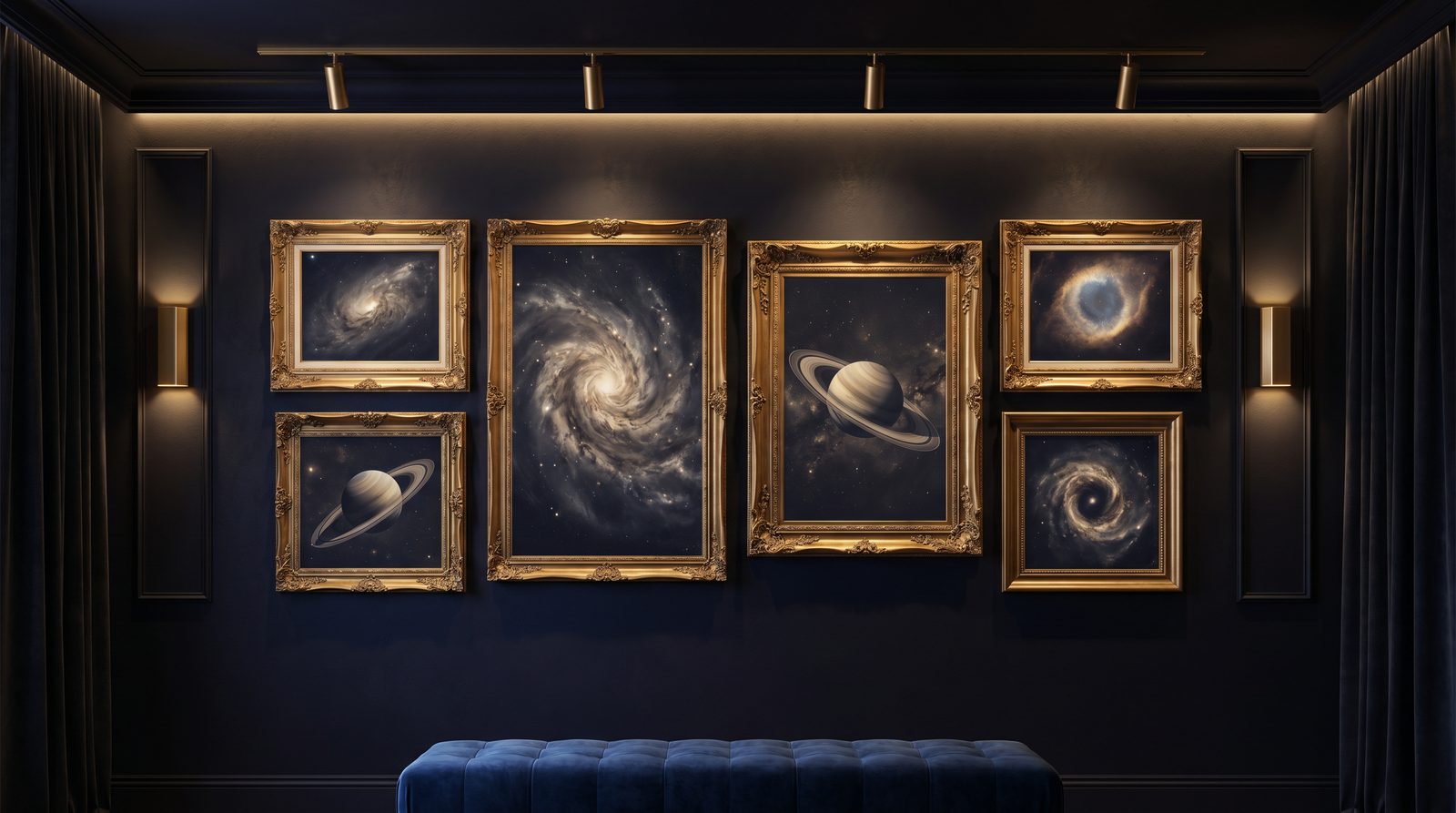
What astronomy art actually is
Astronomy art is any wall art that takes the night sky and the wider cosmos as its subject — the planets, the Moon, distant nebulae, the machines we send out to meet them. It spans a handful of distinct genres, and they look nothing alike. A photoreal galaxy and a flat, graphic travel poster are both astronomy art, yet they ask for very different walls. The five that matter most are deep-space scenes, the Solar System, lunar work, retro travel posters and technical blueprints.
The main genres
Each genre carries its own mood. Learn the five and you can read any astronomy print at a glance — and, more usefully, know whether two of them belong together.
- Deep-space scenes — nebulae and galaxies, rich, atmospheric and slow to read. These are the prints that turn a room quiet. See the galaxy collection.
- The Solar System — the planets in their order, charts of the neighbourhood, single worlds rendered close. Familiar and grounding. See solar system prints.
- Lunar — phases, soft watercolour moons, the cratered surface in detail. The most forgiving genre to start with. See moon wall art.
- Retro travel posters — graphic, optimistic, drawn in the golden-age style that imagines tourism among the planets. Bold, warm and easy to live with. See space travel posters.
- Blueprints — clean technical line drawings of real spacecraft, all schematic and restraint. They suit a study or a workspace, and sit happily beside the posters.
Choosing prints that work together
A wall holds together when its prints share a through-line. Pick one: a palette — cool blues throughout, or warm golds — or a treatment, so everything is either minimal or painterly, or a plain theme, where the whole wall stays lunar. Any one of those is enough to make a mixed set read as deliberate rather than accidental.
Then think in terms of one focal piece and its supporting cast. A single bold print — a wide nebula, a large planet — earns the most space and the eye goes to it first. Two or three quieter prints around it carry the rest. Three loud pieces competing for attention almost always works less well than one bold print and two that defer to it.
Framing and size for dark astronomy art
Most astronomy art is dark, and dark prints have their own rules. A black frame disappears into the image and lets the colour do the work; oak warms it and softens the edge against a pale wall. Either suits the genre — busy or ornate frames fight it. Leave a little breathing room in the mount so the dark field has somewhere to sit.
On size, go larger than feels safe for a single focal print. Deep-space scenes in particular lose their depth when shrunk, and a generous format is what makes a room feel considered rather than decorated. For a gallery wall, keep the pieces closer to a uniform size and let the spacing, not the scale, give it rhythm.
Making it personal
Astronomy art needn't be off-the-shelf. With Cosmic Canvas you can turn your own night-sky photograph into art — a meteor shower you stood out for, the Moon over somewhere that matters — rendered in the same painterly treatments as the catalogue. If your image is already finished, you can print it as it is. A print of a sky you watched yourself reads differently from one you simply bought.
Buying with confidence
Every piece is made to order and printed on gallery-grade archival stock, so nothing sits in a warehouse fading — your print is produced when you order it and shipped worldwide, from £24. Start with one focal print you genuinely love and build the wall outward from there. Browse the full catalogue when you're ready to choose.